


The Great
Demonstration


Download the Fillmore Wings Course Guide for Lesson 6 The Great Demonstration:
(8.5x11) for printing one page/sheet on letter sized paper
Introduction to The Great Demonstration
Lesson six, Demonstration, frames a systematic theology of Charles Fillmore's teachings. His language is traditional. The terms he uses are theological. They are readily comprehensible to those educated in Christian theology. And Charles Fillmore wrote them with perfect comfort. He used the same language ten years later in publishing his Statement of Faith. In April 1921, he wrote:
"It has often been claimed that we do not believe in Christ, the atonement, and several other of the sacred doctrines of Christianity. A careful perusal of the foregoing will convince any one that we do believe all that is taught by the church, and also that our faith is bulwarked by an understanding of the underlying spiritual laws upon which the church bases its doctrines."
The theological assertions Charles Fillmore frames in this lesson are explained in depth in the next six lessons of the Correspondence Course, which we have numbered lessons 7-12 and named "Fillmore Wings Theology." So the connection of Fillmore Wings to the Fillmore Statement of Faith is unmistakable. He continued his April 1921 article saying,
"Those who want a detailed exposition of what we teach should write to us for the literature that more fully explains the doctrine epitomized in a certain paragraph, always giving the number. Regular readers of our periodicals and our literature, as printed in books and tracts, will at once recognize that they have gleaned, it may be in fragmentary and scattered study, a concept of the various points set forth in this Statement of Faith."
I do not have the document that was sent to those who asked for it, but my bet is that much of it was taken from this sixth lesson, Demonstration.
Lesson for The Great Demonstration
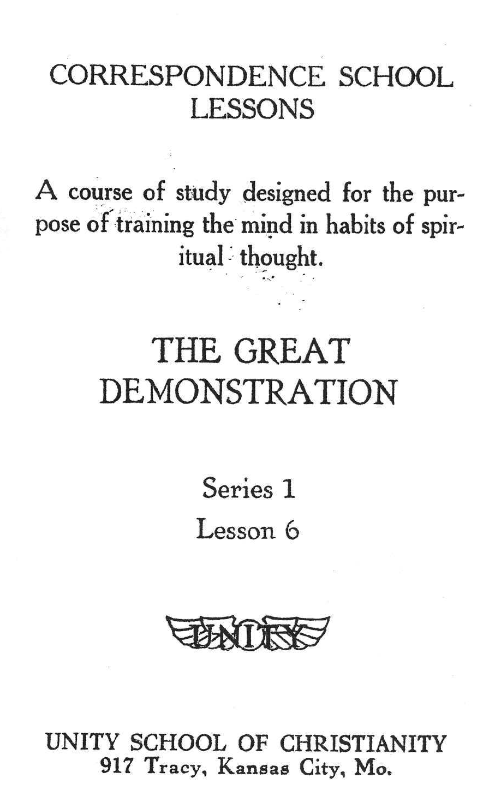
(Source: Unity Correspondence School Course Series 1 Lesson 6)
The Great Demonstration Defined
What is meant by "demonstration" in Truth study? What is "the great demonstration"?
1. We often hear and read the word demonstration in Truth study. It is defined as: an exhibition; proof; especially, proof beyond the possibility of doubt or denial. In this lesson we may designate a "demonstration" as an exhibition or example of the working of a spiritual law; a proof–beyond the possibility of doubt or denial–of the operation of a principle of good. In order to have this proof there must be a change in a person's consciousness from error thoughts to thoughts of Truth. This is brought about by thinking true ideas (spiritual principles)1 in the conscious phase of mind until they take root in the subconscious phase, or feeling nature. In this phase of mind, the ideas will, like seeds, grow and produce "after their kind" through the "spoken word" (silent or audible). In mind, these seed-ideas will bring forth alertness, keenness, positiveness; in body, they will manifest as health, strength, vitality, beauty; in affairs they will produce success, prosperity, harmony, order, and peace.
2. The "great demonstration," that which crowns all others and includes all others, is the individual's consciousness of life–omnipresent, radiant, pure, perfect life, without beginning or ending. It is the demonstration of eternal life2 for spirit, soul, and body in harmonious unity here and now.
3. The "great demonstration" is the continuous proving of spiritual laws, a harmonious solving of all the problems of life. The "great demonstration" is the understanding of perpetual growth, renewal, and reproduction of the life idea. It is knowing that life is inexhaustible and indestructible, and a showing forth (demonstrating) of this life eternally by the individual consciousness. It is demonstrating the Christ mastery over one's thoughts, feelings, words, actions, and reactions. The "great demonstration" is mastery in one's entire being. His very life stands forth (demonstrates) as a living proof that he is a conscious soul. He is spiritually awakened and illumined in mind, peaceful in heart, radiant in body, harmonious in his human relationships.3 He is victorious in living and conscious of the omnipresent substance of God as his constant and abundant source of supply.
4. Since the teachings of Jesus are practical for daily living, the "great demonstration" must mean the practical application of His instruction in our daily living right here and now, showing forth (demonstrating) the principles of Truth successfully. In this way we truly bear witness4 to our knowledge and use of Truth.
- thinking true ideas (spiritual principles). “The real principle is always Spirit, and by Spirit we also mean the higher range of mind. According to Webster’s Dictionary, Spirit and mind are almost synonymous. When we understand that Spirit and mind are closely related, we get a better understanding of what Spirit is and what we are as spiritual beings. We should deal with our mind as if it were a Spiritual Principle—which it is. We may thus erase from consciousness all misunderstanding of mind, and give place to a broader, higher understanding of the Real Self. If we are spiritual brings, it behooves us to study ourselves in relation to the Supreme One, who is our Source.” Charles Fillmore Temple Talks, Series Three, Chapter 4 Obedience.
- It is the demonstration of eternal life. “The great demonstration is attaining eternal life in the body.” Mysteries Of The Four Gospels, Lesson Eight, November 13, 1941. See “the life idea” in the following paragraph.
- mind, heart, body, relationships. [A four-square perfection of being]
- bear witness. [We bear witness to Truth by demonstration, not confession.]
Consciousness
What is consciousness? What is its importance in "demonstration"?
5. All the attributes of Spirit–life, substance, intelligence, love, and so on–are eternal, but nothing exists for one unless he becomes conscious of it.1 The importance of "consciousness" in all demonstrations, in the whole of salvation, should be clearly understood. "Consciousness" is all the states of mind that have been formed by thinking and feeling.
6. Life is consciousness; direct knowledge of a person, thing, or situation; knowing for oneself without the possibility of doubt; knowing all the time so that such knowing is a habit of thought.
7. Consciousness and demonstration are related as cause and effect. Consciousness is cause, demonstration is effect. Consciousness is therefore the forerunner of demonstration. When the intellect grasps Truth, that act symbolizes John the Baptist's going before and preparing the way. But a greater one than John must come,2 and that greater one is Jesus Christ, representing the realization and the demonstration of Truth. "He that hath the Son hath the life; he that hath not the Son of God hath not the life" (I John 5:12). Man in limited consciousness is not aware of eternal life, thus he is not able to demonstrate it.
What is the Absolute?
8. The actual operation of a law brings the functioning of that particular law to our notice. A person may be aware of the probability of divine powers within himself, but until he knows by experiment that he can use them he is not really conscious of possessing them. Realization (consciousness) of the effect of a single thought, or train of thought, upon the body gives man possession (knowledge) of the mental law of cause and effect. The conscious use or application of this law is the motive power in changing from the limited, personal consciousness to the universal Christ consciousness. The change is brought about by letting go of error beliefs concerning life and by taking into the mind the true understanding of life in the Absolute. The Absolute is God, the good omnipotent. The Absolute is that which is;3 the limitless, the unrelated, the unqualified Truth, pure Being, pure knowing; not in a state of becoming as is the relative.
- nothing exists for one unless he becomes conscious of it. [That which exists is an expression.] “Because man was created or brought into the visible universe in the image and likeness of God, he, spiritually, has like powers with God: he has the power of creating, of bringing into visible form that which before did not exist.” Emilie Cady, How I Used Truth, The Spoken Word.
- But a greater one than John must come. John the Baptist is everyday thinking. Jesus Christ is a consciousness capable of expressing eternal life capability.
- The Absolute is that which is. The Absolute is not an expression. It is eternal. It has being, not existence. Our participation in the life of Jesus Christ raises our consciousness to a place where Spirit can bring forth eternal life.
The Devil and Sin
What is sin? How is sin the cause of what is called death?
9. Jesus came to show us how1 to attain the consciousness of life in its fullness. By understanding and applying the principles which He taught and proved, each one may reach the same consciousness of life and thus make the "great demonstration." Jesus' teachings are not to prepare men for a heavenly home after they have separated from the body, but to give them the victory over death, "the last enemy," so that they may become conscious of heaven and enter into its joys here and now.
10. "There is no need of any state or condition called death. The word 'death' is a denial of God's idea of life.2 If we would accept life as God offers it to us, we are obliged to refuse the conditions that man has attached to it" (Talks on Truth 149).
11. Paul stated to the Romans "The wages of sin is death" (Rom. 6:23). So long as we continue to sin we may expect to receive the wages of sin. The race in general accepts the belief that death is inevitable because it refuses to acknowledge the cause of death as sin. The way to overcome the effect, death, is to remove the cause, sin.3
12. "Cast away from you all your transgressions,4 wherein ye have transgressed; and make you a new heart and a new spirit: for why will ye die . . . for I have no pleasure in the death of him that dieth, saith the Lord Jehovah: wherefore turn yourselves, and live" (Ezek. 18:31-32).
13. In Talks on Truth 155, we read:
"If we are not spiritually alive, if we have not the Christ Mind, we are not alive at all.5 ... In order to be alive, we must be sanctified, purified, and regenerated.6 We must be perfect, even as Jesus Christ was perfect. . . . If I am in any degree a sinner, I have in that degree a corruptible, dead body. . . . And what is the remedy? I must get rid of carnality; that is all. The quicker I do that, the quicker I shall become alive. I should not expect that through my further dying the good Lord will make me alive. I can find in the Scriptures no hint of a promise that warrants such a presumption. 'God is not the God of the dead, but of the living' (Matt. 22:32)."
14. Mankind in general looks upon "sin" as a transgression of the moral law only; that is, nonconformance to the law as set forth in the Ten Commandments. These laws have to do with the conduct of man. "Sin" originates in the human consciousness or soul, the realm of thinking and feeling. God is perfection; man, God's image-likeness, His offspring, is also perfect in the spiritual phase of his nature and always one with his indwelling Father. "Sin" is primarily man's belief that he is separate from God; that he is limited and unlike his divine Parent. "Sin" is ignoring the divine law of life; it is a failure to recognize one's own innate divinity7 and failure to apply (demonstrate) spiritual principles (divine ideas) in his own life and affairs. Such negative thinking and feeling result in an adverse state of consciousness that is called "the Devil" or "the Adversary." Whether sin is committed willfully or in ignorance, the effect of the transgression is the same.
What is the meaning of "the Devil" sometimes called Adversary and accuser?
15. In the American Standard version of the New Testament, "the Devil" is referred to as "the Adversary." This "Adversary" is an adverse state of consciousness which has developed in man. Because of man's dual consciousness (belief in two powers), there is warfare in the individual soul. Spiritually, man is the "descent" of the Holy Spirit, and humanly, his aspirations for good draw him upward toward his source, God. "No one hath ascended into heaven, but he that descended out of heaven, even the Son of man who is in heaven" (John 3:13).
16. The Hebrew word that is translated Adam means "red earth." The unenlightened Adam man is ascending from "red earth," from a lower or undeveloped consciousness. It is from this undeveloped consciousness that his low desires and impulses come. Not knowing that this conflict is within his own consciousness, man has felt as if he were in the hands of two powers, and has imagined one as a good being, God, and the other as an evil one, the Devil. He has made the Devil his alibi for selfishness and for the weakness of his will when he has been led astray by low desires. Paul's description exactly fits when he calls man's low desires "the mind of the flesh" (Rom. 8:7). The concept of a "personal God" must give way to the knowledge of a universal God individuated in every man.8 Belief in "the Devil" must go before the understanding that "the Devil" is only the personalization that man has given to his wrong thoughts, feelings, and beliefs. "The Devil" is the mental image that man has made of his own concept of evil.
How may one overcome adverse states of consciousness called "the Devil," "the Adversary," or accuser?
17. When Jesus took on Himself "the likeness of sinful flesh," (Rom. 8:3) He placed Himself where He had to meet and overcome all that man has to meet, including the adverse state of mind called "the Devil." He found that "the Adversary" tried to overthrow Him by quoting Scripture. We need to be on guard and to be so rooted and grounded in the knowledge of Truth that we shall at once detect any illegitimate use of Scripture that would aim to keep us bound in the limitations of the manifest or physical man.
18. Since God is the one Presence and the one Power in the universe, the seeming power of "the Adversary" must come from man,9 to whom God has given all authority, dominion, and freedom of will, for he is to represent God in the manifest world. By using this freedom and power for his own selfish interests instead of recognizing the unity of all creation, man has built within himself a state of consciousness adverse to the universal good. The strength of the adverse thought lies in the power attributed to it by the people who have accepted it. By such acceptance they have given to this adverse belief the substance and intelligence of their thought. Thus it seems to be a separate force, no longer under the control of man. It is an enemy, subtle, lying, deceiving; it is "a liar, and the father thereof" (John 8:44).
19. Part of man's great problem is to learn how to overcome "the Adversary."10 To overcome it, he needs to know its character, that he may not be deceived by it. He must also understand that "the Adversary" is not his true Self. Adverse states of consciousness keep their hold on man when he continues to believe they are part of his true Self. When adverse states of mind express selfishness in some of its forms–jealousy, greed, lust, anger, envy–then man feels that he is a great sinner without redemption. He forgets that he is the sinless offspring of the perfect Father. He identifies himself with adverse states of mind and thus loses the consciousness of his heritage of divinity.
20. "The Adversary" helps to accuse man of sin. In Rev. 12:10, this Adversary is called the "accuser." Every overcomer needs to be on guard that he may not be deceived by the accusing voice within him. God does not accuse His offspring of anything wrong; His eyes are too pure to behold iniquity. God constantly beholds man in the perfection of his spiritual nature. Man must learn to cast out all depression, all discouragement, all bondage to a belief in sinfulness as being a part of his nature. The image of Truth constantly repeated or reproduced in mind11 will eliminate all other concepts and the sinner will not exist because man's mind will have no image or reproduction of that thought, thus the act cannot exist either. "Be fruitful, and multiply" (Gen. 1:28) was the command, and this growth and multiplication of awareness of the divine image is the essential factor in life. A good overcoming statement is:
Greater is he that is in me than he that is in the world. (Based on I John 4:4.)
21. That is, greater is the Christ in each of us than "the Adversary" who is of the world.
- Jesus came to show us how. "It is a metaphysical law that there are three steps in every demonstration: the recognition of Truth as it is in Principle; holding an idea; and acknowledging fulfillment" (RW/demonstration).
- death is a denial of God's idea of life. This death or dissolution of the body is the "second death." The first death is where the consciousness has lost sight of spiritual wisdom and sunk into the belief that God is absent from man and the universe“ (MBD/dying).
- The way to overcome the effect, death, is to remove the cause, sin. Sin is man's failure to express the attributes of Being--life, love, intelligence, wisdom, and the other God qualities. (RW/sin)
- a transgression of the moral law only. Transgression is thinking thoughts that violate the principle of mental harmony inherent in Being (RW/transgression).
- we are not alive at all. If you allow yourself to go to sleep spiritually–that is, if you live in the senses and fail to recognize your spiritual selfhood and your relation to Being–you are already virtually dying or dead. (MBD/dying)
- sanctified, purified, and regenerated. Regeneration begins its work in the conscious mind and completes it in the subconsciousness. The first step is cleansing or denial in which all error thoughts are renounced. This includes forgiveness for sins committed and a general clearing of the whole consciousness. After the way has been prepared, the second step takes place. This is the outpouring of the Holy Spirit (RW/regeneration)
- one's own innate divinity. The only reference to "innate divinity" found outside the Correspondence School lessons is Myrtle Fillmore, How To Let God Help You, The Christ Spirit: "Christ is the real self of each individual. By seeing only the Christ in all people, we not only strengthen our own spiritual consciousness but help all whom we contact to realize and express their innate divinity."
- a universal God individuated in every man. This phrase is found only in the Correspondence School Course, but it is repeated in several of the lessons, particularly the first six lessons of the Advanced course. This is an alternative to the often-quoted "God is principle."
- "the Adversary" must come from man. The vain imagination that there could, in reality, be anything opposed to Divine Mind, or could be any separation of man from it, led to the forming of a state of mind that is described in the Bible as the "adversary" (RW/adversary)
- how to overcome "the Adversary." Henry Wood, a well-regarded New Thought author, offered this advice: “Though the law of non-resistance is looked upon as weak and impractical, it is divine and conquers. ‘But I say unto you that ye resist not evil.’ Absurd! says the worldly policy. Again, ‘Love your enemies.’ But there are no enemies, for love makes them friends. There is an objective world, but in deeper reality every man creates his own world. Whether here or hereafter, unlimited antagonism is hell. In proportion as one installs adversaries about him, he shrinks in soul and weakens in body.” (Henry Wood, The New Thought Simplified, chapter 7 “Agree With Thine Adversary Quickly”)
- The image of Truth constantly repeated or reproduced in mind. This is the answer to "How may one overcome adverse states of consciousness?"
Christ Righteousness
What is the Christ righteousness?
22. The Christ righteousness1 is our true or spiritual nature. By faith in our Christ righteousness, sin is overcome. This Christ righteousness is not based on personal merit, but is a heritage that is ours as sons of God. God's own nature of Absolute Good is our inherent perfection. We may manifest this perfection by claiming it and holding firmly to it in the face of all appearances set up by "the Adversary." If we claim our divine heritage, know ourselves as the sons of God, free from all sin, and refuse to be identified with adverse states of mind, we shall overcome all sin. Consequently, we shall also overcome death, for death can come only through sin. Our realization that sin has no power, except what we give it by believing in and making ourselves one with it, makes this overcoming more easy to accomplish. Christ is Truth, and righteousness is the functioning of Truth in the mind of man.
23. The first appearance of "the Adversary" is recorded in Genesis under the figure of a serpent,2 which was "more subtle than any beast of the field which Jehovah God had made" (Gen. 3:1). The "serpent" represents the quality in the human consciousness that ignorantly takes of the good of God and uses it for ignorant, selfish, unlawful, or sensuous purposes. The "serpent" told Eve a lie in the very beginning and she believed him instead of Jehovah-God. Jehovah-God had told Adam and Eve that the result of disobedience would be death, but the serpent said, "Ye shall not surely die" (Gen. 3:4). The life force working out the divine command to "be fruitful, and multiply" (Gen. 1:22) reproduces the body form, but when man is not fully enlightened he does it only in a separate organism instead of reforming and renewing the cells within his own body, as divine wisdom directs. Man is thus reproducing only limited concepts of himself, the physical man, instead of going further and reproducing In himself a consciousness of what God is, the immortal or spiritual man, the Christ.
24. The lie that the Adam man is immortal and does not die because of sin became incorporated into the race consciousness. Many men are still believing that although they sin they are by nature immortal and will not lose the physical body through their sin. When the Christ idea of life is quickened in man and he lays hold of it; when he enters into the Christ consciousness; when he directs the life force in obedience to divine law, thus conserving it indefinitely,3 then, and then only, does man prove his claim to eternal life.
- righteousness. A state of harmony established in consciousness through the right use of God-given attributes (RW/righteousness)
- serpent. Sense consciousness. It may also be called desire, and sensation, or the activity of life in an external expression, apart from the Source of life. When the life is lifted to the realization that it is Spirit, it becomes healing, as illustrated by Moses' lifting up the serpent in the wilderness (MBD/serpent).
- when he directs the life force in obedience to divine law, thus conserving it indefinitely. A subtle reference to sexual moderation. See Statement of Faith #29.
Reincarnation and Resurrection
What is reincarnation? What purpose does it have in the experience of man?
25. The "deceiver" deludes man with the thought that death does not come by sin but comes because it is the will of God, or the course of nature, or the inevitable. Let us not allow ourselves to be robbed of life by any of these delusions. God is life, and it is His will that all His children should have life abundantly. If they have not realized their privilege, or have not succeeded in demonstrating life, the loving Father has provided opportunity for them to try again in a new body vehicle. Through this new embodiment opportunity is given to express and manifest man's inherent perfection in accordance with divine wisdom. This is called "reincarnation."1
26. When man understands the plan and purpose of life,2 he begins to exercise his mastery over all limitations. He consciously forms his own body vehicle, a spiritual creation, an image of the divine ideal. In its true state the body is the embodiment of all the laws of the universe.
What is the resurrection? How is man individually resurrected?
27. Thus we see that the goal of man is not reincarnation, but resurrection:3 a rising again; the resumption of vigor–the raising of the whole man, spirit, soul, body, into the Christ consciousness of righteousness and life. There is first the divine center–the creative idea; then an unfolding or expression of the divine faculties of the soul that it may be a true "temple of the Holy Spirit"; then a vehicle for the manifestation of all the God qualities–the body of man.
- This is called "reincarnation." A new soul is not created with every physical birth. A physical birth simply means that a soul is taking on another body. Every man inhabiting this earth and the psychic realms immediately surrounding it has gone through this process of dying and being reincarnated many times (The Twelve Powers of Man 138).
- the plan and purpose of life. The real purpose of your life is to express the creation of God—to unfold the many departments of your mind which God has planned for you, and which will enable you to know and to do His will. When you know that there is nothing for you to worry about or to fear, you may then relax and feel happy. When you know that living, as God has planned it, here and now, is beautiful and that you can know just what God’s plans are for you, you will be really interested in living, won’t you? (Myrtle Fillmore, How To Let God Help You, chapter 1, The Purpose of Living.)
- resurrection. The restoring of mind and body to their original, undying state (RW/resurrection)
Salvation
How does salvation come to man?
28. It should be remembered that "salvation"–freedom from sin and its bondage, freedom from all the limitations of both mind and body–and the attainment of a consciousness of eternal life are not dependent upon man's own power or ability. "By grace have ye been saved" (Eph. 2:5). Salvation1 is the gift (grace) of God. That is, it is man's heritage on account of his divine origin. It is not anything that is man's because of his personal merit. In his human consciousness man has no power of himself, and usually it is the realization of this fact that leads him to seek spiritual comfort in a higher power. Man has so long thought of his limitations that he has failed to perceive that all freedom is his, that all good is a part of his being.
29. Jesus Christ brought knowledge of the gift of salvation within the reach of man.2 Through His teachings and His example in proving the principles of right thinking and feeling, He showed the way to eliminate the consciousness of sin and to establish the consciousness of divinity. The Old Testament words, "Ye are gods, and all of you sons of the Most High" (Psalms 82:6) were reiterated by Jesus, "Is it not written in your law ... Ye are gods?" (John 10:34).
30. The first chapter of Genesis states that man was created in the image and after the likeness of God. Metaphysically, Christ is the image or divine principle, which is inherent in each one. Metaphysically, Jesus is the Saviour,3 or the constant outworking in man's mind of the Godlikeness; the claiming and unselfish use of the attributes of God; the continuous proving or showing forth of the laws of life.
What has man to do with the working out of his own salvation?
31. Jesus made the gift of salvation possible by showing the way. Man's responsibility is to take the gift and use it, to make practical application of it spiritually, mentally, emotionally, and physically. The gift is individual, and each man must use it in his thinking, feeling, speaking, and acting. That is, each man must work out his salvation or he will not be freed from belief in sin, sickness, poverty, and death. All his concepts of life, his manner of living, must undergo a revision in order that he may unfold his knowledge and powers. (See Annotations for Lesson Nine, Lessons in Truth, and Annotations for Lesson One, How I Used Truth on "salvation.")
32. The process by which the old state of consciousness (which produces general death to the physical from or vehicle of manifestation) is changed into the Christ consciousness,4 which gives life to the body, is called putting off "the old man" and putting on "the new man." In Truth "the new man" is and always has been present and intact in every man, and is the only reality for it is the divine nature or pattern of every man–"Christ in you" (Col. 1:27). We must have faith that this is true. "The old man" has been put on by man's wrong thinking, built into his consciousness by ignorance. In other words, "the old man" is the outgrowth of wrong thought habits. Since "the old man" has been put on by wrong thinking, he must be put off by right thinking.
33. Paul said to the Ephesians,
"That ye put away, as concerning your former manner of life, the old man . . . and that ye be renewed in the spirit of your mind, and put on the new man, that after God hath been created in righteousness and holiness of Truth" (Eph. 4:22-24).
34. To get spiritual understanding of Paul's meaning, one must take the statements into the silence. By meditation and prayer one prepares for the quickening of Spirit that will make Truth a saving power in one's consciousness and daily experience. Words like these used by the individual will help to quicken his understanding:
Old thoughts and old conditions are as waters that have passed away.
Behold, all things are made new in my life.
Pain, sickness, poverty, old age, and death cannot master me, for they are not real.
I am a new creature in Christ Jesus.
I am alive, alert, awake, joyous and enthusiastic about life.
35. To put off "the old man" one must have faith in God. Despite all appearances to the contrary, man is alive unto God in Christ Jesus. Man begins to demonstrate this when he is willing to cooperate, to make the effort. The first step is to believe in his inherent divinity and to put away all thought of himself as a sinner. The next step, taken by faith, is to begin daily to unfold the spiritual powers (divine ideas) latent within him. Each day he becomes more and more alive to Spirit, basing his thinking on the divine ideas of the Christ Mind and living the Christ life in all that he does.
36. The divine law5 is constantly in operation, working out the adjustment of all things in perfect order and harmony. Everything in life works toward the observance of this law. So long as man believes himself a sinner, falling short of the perfection inherent within him, he is disobedient and causes friction, inharmony, with resultant loss of power and dominion. Man's endeavor to be a law to himself has formed conditions which bring him sorrow, suffering, and dissolution. The resolving of these conditions by divine law into their primal elements is not vengeance or punishment by God, but rather releasing of life and substance from the error. By so doing the integrity of the whole is preserved. There are in reality no destructive forces. What man sometimes calls a destructive force, that seems to bring him punishment, is actually divine love purifying and protecting and preparing him for a more perfect expression. The old error conditions must be dissolved before the new conditions based on God's plan of good can manifest.
What is "the law of the Spirit of life in Christ Jesus" (Rom. 8:2)?
37. The raising of man's consciousness to the Superconscious realm6, or the Christ Mind, frees him from "the law of sin and of death" (Rom. 8:2); that is, the effect, death, is dissolved by the removal of the cause, sin. A new law (the law of right thinking), "the law of the Spirit of life in Christ Jesus" (Rom. 8:2), is set into action. A new cause will be set into operation bringing forth eternal life instead of death, when the following conditions are met:
- (a) Man must understand the relationship that exists between God and man himself; between himself and his fellow man; and between himself and the universe.
- (b) All men must be guided by divine wisdom in thought, word, and deed.
- (c) Universal love must be expressed in each heart.
- (d) Each man must be conscious of all as much as he is of self.
How does the body benefit by salvation?
38. The body must share in the scheme of salvation, for it is "a temple of the living God" (II Cor. 6:16) and "the whole creation groaneth ... waiting for ... the redemption of our body"7 (Rom. 8:22). One may redeem one's body by understanding Truth and by holding words of Truth in mind until they become a part of the subconscious phase and are built into the flesh. The Word must be made flesh through the law of righteous thought. The flesh, nourished and sustained by thoughts and words of Truth, is immortal and incorruptible. It is not subject to decay or death, because it is formed of the pure substance of Spirit and is eternally renewed by God's life and power.
39. Love is the great organizing power of Being (God) and is an essential factor in demonstrating eternal life. Love, united with wisdom, harmonizes all the functions of the organism and saves mind and body from the destructive, disintegrating effects of jealousy, hate, and anger. Divine power gives dominion and establishes in man's mind a positive force which prevents the forming of negative states of mind that cause conditions of weakness. When one perceives that the body is an instrument of Spirit,8 such perception helps to redeem it from the belief that it is merely physical or of animal origin. Every one of the attributes (ideas) of Being has a place in the work of redemption. "Every idea has a specific function to perform" (Mysteries of Genesis 21). One should keep the life, intelligence, love, power, and substance of Spirit active in the body by giving attention to these qualities or ideas in meditation and prayer. The conscious thought should be carried through the organism every day, giving to every part of the body words of Truth that will quicken it and make it truly God's temple. Silently hold these quickening words:
The Spirit of Him that raised up Jesus quickens my body.
My body is the temple of the living God, because the Spirit of God dwells in me.
The law of the Spirit of life in Christ Jesus has made me free from the law of sin and death.
40. To speak some word that has direct reference to a particular part of the body is sometimes a help in awakening life in that part. For instance, if you wish to feel the quickening power of the Word in your feet, you will find it easier to center your attention on them if you concentrate on statements like these:
My feet are established on the rock of Christ Jesus.
My feet are filled with the quickening, vitalizing life of Spirit, and they love to express it.
41. Jesus said to the woman of Samaria, at the well,
"If thou knewest the gift of God, and who it is that saith to thee, Give me to drink; thou wouldest have asked of him, and he would have given thee living water. ... the water that I shall give him shall become in him a well of water springing up unto eternal life" (John 4:10, 14).
What is the river of life? How do we become conscious of it?
42. In Revelation, this water is described as a "river of water of life,9 bright as crystal" (Rev. 22:1). This great fountain or river of life is the activity of the life idea, the life principle, the I AM or Christ within man. Man becomes conscious of this life when he comes into touch with the quickening power of Spirit through sincere desire to know God and feel His presence. The life idea is the desire of God for self-expression; it is the active or positive energy of which divine substance is the negative (responsive) or passive counterpart. It flows through man, a life-giving stream of intelligent, vitalizing energy, renewing and restoring the body to the wholeness of Spirit. To know about this life energy is not enough; it must be felt. The consciousness must receive it and feel it filling and thrilling the body from the innermost to the outermost parts of the organism. There can be no death where this life stream flows. It flows freely and continuously when the Christ righteousness opens the way, and it keeps spirit, soul, and body eternally renewed. This is what it is to be saved "to the uttermost" (Heb. 7:25).
43. IN THE BEGINNING
The great God dreamed a dream through me,
Mghty as dream of God could be;
He made me a victorious man,
Shaped me unto a perfect plan,
Summoned me forth to radiant birth Upon the radiant earth.
He lavished gifts within my hand,
Gave me the power to command
The thundering forces that He hurled
Upon the seething world. . . .
Creation's dream was wondrous good
Had I but understood.
The great God dreamed a dream through me,
But I was blind and could not see.
My royal gifts were laid in rust,
For parentage, I claimed the dust.
Decay and sorrow, age and blight --
These gifts I deemed my right.
The great God spoke a word through me --
That word was Life. How can it be
That I, in God's own substance made,
Should face the universe, afraid?
Born of eternal life am I --
Why should I fail and die?
O God, so huge was Thine intent,
So greatly was Thy passion spent,
This counterfeit is not the plan
That Thou didst dream for man.
'Tis this: Man's dream must mate with Thine,
Man's word, man's life, must be divine;
Man must be conscious through and through
To make Thy dream come true!
-- Angela Morgan (Copyright by Dodd Mead & Co., Inc.)
- Salvation. The restitution of man to his spiritual birthright; regaining conscious possession of his God-given attributes. It comes as the result of redemption; the change from sin to righteousness ... The belief that Jesus in an outer way atoned for our sins is not salvation. Salvation is based solely on an inner overcoming, a change in consciousness. It is a cleansing of the mind, through Christ, from thoughts of evil (RW/salvation).
- Jesus Christ brought knowledge ... within the reach of man. The lesson is referring to knowing, not knowledge. Metaphysically, knowledge is not knowing. Knowing is a capacity transcending intellectual knowledge. ... The knowing that man receives from the direct fusion of the Mind of God with his mind is real spiritual knowing. (RW/knowing).
- Jesus is the Saviour. Jesus saves by showing the way to claim and use the Christ within.
- Christ consciousness. "Christ consciousness is the name of the evolutionary goal for the present human family on earth. The term itself is hard to define or explain. We urge Truth students to let their intuition give them a 'feel' for this term. Mr. Fillmore helpfully reminds us that in our present state of consciousness, the only begotten Son (Christ) is still in the seed stage in most of us. We are still working to germinate that seed. Most of us are still far from being able to express the Christ to any degree of fullness. But right now our direction is the most important thing. Greater wonders will come later!” Ed Rabel, Metaphysics 1, The Christ in You, Christ Consciousness"
- The divine law. Divine law is the orderly working out of the principles of Being, or the divine ideals, into expression and manifestation throughout creation. Man, by keeping the law of right thought, works in perfect harmony with divine law, and thus paves his way into spiritual consciousness. (RW/law)
- the Superconscious realm. A state of consciousness based on true ideas, on an understanding and realization of spiritual Truth. The connection between the superconscious mind and the conscious mind is established within—by meditation, by going into the silence, and by speaking the word.(RW/superconscious)
- the redemption of our body. The process by which the life and substance of man's lesser self are brought to conform to the standards of his spiritual self. The body is redeemed from destruction by attaining spiritual consciousness on earth. (RW/redemption)
- the body is an instrument of Spirit. Traditionally, the body has been seen as the temple of Spirit but here it is an instrument of Spirit. This phrase is found only in the Correspondence School lessons. It may be an acknowledgement of the power of positive emotions. Regardless, it is clearly an acknowledgement of the body's role equal to the soul.
- river of water of life. The source of the natural healing impulse that constantly reconstructs the organism. When a man in faith makes intimate connection between his mind and the Father's, he enters into the river of life. And he has the ability to take others with him into the waters that cleanse, purify, and vitalize. (RW/river)
Original Annotations for The Great Demonstration
Here are the Annotations for Lesson 6, The Great Demonstration. These questions and answers were used to “grade” papers and so they represent the “correct answers.” We’ve included them in this course guide to provide a second look at what the Fillmores wanted their students and ministers to know.
The Great Demonstration Defined
1. What is the "great demonstration"?
As man was created in the image and after the likeness of God, the "great demonstration" is to show how the connection is made between man and God, so that all that God is will show forth in man's spirit, soul, body. It is the victory over physical death and the redemption of the body to eternal life. Jesus Christ made this demonstration. He set the example of regeneration through crossing out the animal instincts that are in carnal-mindedness, the consciousness that is of the flesh, and replacing them with the wisdom of the Christ Mind. He redeemed the lower emotions of fear, anger, hate, greed, and the like in man's feeling nature through faith in God, Good, causing man's thoughts to respond to the nature of divine love. Victory over death of the physical form becomes possible only as man succeeds in working victoriously with the so-called animal instincts and lower emotions as they present themselves for redemption. It is the aggregate of these smaller victories that gives him an understanding of the divine power and nature inherent within him.
The "great demonstration" is that which shows life with all its beauty and abundance here and now to be God's glorious gift to man, His son.
This lesson teaches that the "great demonstration" is accomplished through an understanding of all supplementary spiritual laws or principles of Being (God), and the using of these laws in our daily living in accordance with universal good.
Consciousness
2. What is consciousness? What is its importance in demonstration?
The word "conscious" applies primarily to that which is felt as within one's self. When we speak of having a "consciousness" of some state it means that we feel as well as think on that subject. One may have a "consciousness of poverty" or a "consciousness of prosperity"; a "consciousness of ill health" or a "consciousness of health." (See How I Used Truth Lesson 1 Annotation 4, on "consciousness.")
When we speak of "man's consciousness" we mean the totality of his thinking and feeling–his mind, or his soul. Mind is, and wherever there is any kind of feeling there consciousness exists. Consciousness is made up of desires, sensations, emotions, thoughts, feelings, perceptions–any soul quality. It is a stream of thought or current of "inner" life; man thinks and man feels, and the result is consciousness, or the total states of mind in the soul.
It is not possible to bring forth any demonstration without "consciousness." Our lesson material states, "Consciousness and demonstration are related as cause and effect. Consciousness is cause, and demonstration is effect." The cause must have both thinking and feeling in order to produce, or as Annotation number One states, "to point out," "to show." Therefore, we may say that "consciousness" has a vital place in demonstration. One may long for healing, success, prosperity, harmony, but until he feels that these blessings are his by divine right he has no "consciousness" of them to act as the cause that can demonstrate or bring them forth in his life.
"If two of you shall agree on earth as touching anything that they shall ask, it shall be done for them of my Father who is in heaven" (Matt. 18:19).
The "two of you" may be construed as the mind and the heart–the thinking and the feeling abilities in man. The ideas of God must find complete and harmonious reception in man's whole consciousness. In the natural man the intellect (thinking faculty) decides what shall enter man's consciousness; so it is imperative that the intellect, the thinking power, accept Truth. It has the power to accept or to reject. But intellectual acceptance is not sufficient, as the intellect is only part of this process. The intellect prepares the way by affirming Truth until the heart or subconscious phase of mind (feeling faculty) accepts the word of Truth so that the greater One, the Christ, who is the "fire ... from heaven" (Rev. 13:13 A.V.) descends to lift the whole man into a harmonious unit. Really to know is to have blended these two processes of mind, thinking and feeling. It is this, plus the divine fire of the Christ zeal, that leads to demonstration of all the desired blessings of life–the ultimate of which is demonstration of eternal life.
3. What is the Absolute?
The Absolute is God, fundamental Principle, Spirit, from which everything emanates or proceeds.
The Absolute is that which is complete in itself, perfect, not dependent on anything else for support. It is ultimate, immutable; nothing can be added to it, nothing taken from it. The Absolute is infinite and eternal, the Alpha and Omega, the beginning and the end. It is Truth that cannot be altered or twisted to coincide with the limited opinions, beliefs, or desires of mankind.
The Devil and Sin
4. How is sin the cause of what is called death?
The cause of death is belief in separation from life. This belief is sin for it falls short of God's plan of life for man. "The wages of sin is death; but the free gift of God is eternal life in Christ Jesus our Lord" (Rom. 6:23). Jehovah God (the Lord God) formed man and when He breathed into him the breath of life He gave man unlimited freedom to exercise the spiritual powers and capacities of his own being as he chose. The only mandate was that man should not take into his developing consciousness a belief in both good and evil for in so doing he would separate his consciousness from the Life Principle. This belief in separation would result in death or nonrecognitlon of the omnipotence of God, the Good.
The will, plan or intention of God is that man should maintain a perpetual, conscious connection between himself and Jehovah God, allowing the life current to move through him in an uninterrupted flow. Too often unenlightened man allows the limited desires and impulses of his feeling nature to sway him and he willfully disobeys the law. In so doing, man becomes separated in his consciousness from the life idea and accepts the belief in mortality. Man fails to realize his divine origin; fails to cooperate with the Author of his being. He uses his mental powers to build up a limited personal or sense consciousness, which is the cause of all the inharmony in the world today.
Jesus came to awaken the dead consciousness in man and through regeneration to redeem the whole man, to quicken man's consciousness of the life principle and to restore him to consciousness of his divine origin.
5. What is sin?
Sin is man's falling short in demonstrating the image and likeness of God, the I AM, the spiritual law of life that is immanent in every human soul. "whatsoever is not of faith is sin" (Rom. 14:23). "All have sinned, and fall short of the glory of God" (Rom. 3:23). Sin is not the mere doing of wrong acts that do not conform to the moral law or the committing of offenses against others. Sin is a failure to recognize and apply spiritual principles despite the fact that we have an inner knowledge that may be drawn on at will. Sin is a failure to acknowledge the Christ, I AM, within ourselves and others. We sin daily in our lack of trust in the Father; in our failure to live as becomes children of God; in our dependence on people and on so-called material things for our sustenance and happiness. Many who truly desire to live a righteous life sin because of ignorance. But when we pray to be delivered from such ignorance and to be illumined by Spirit within, we come to realize what sin really means, and then we seek to know and demonstrate the true Christ righteousness.
6. What is the meaning of "the Devil"? What other names are given to him? Is there a personal devil?
Devil is a generic term for all beliefs opposed to God's perfect law of life, the law of universal good. What is termed "the Devil" is the accumulated evil-thought force of the world seeking expression in humanity and deceiving all men. The statement contained in John 3:43-44 means that men (mankind) are children of the devil in that they are born under the delusion, the one great paramount lie, that the physical body with its sensations and desires, together with material existence, is the great reality. Man must come to know instead that the personal self, the outer consciousness, is the vehicle through which the individuality, or Christ self, is given expression.
The word devil means the synthetic embodiment of all man's concepts, beliefs, and notions of a personal devil: the selfishness that takes hold of man's nature through the unrighteous use of his will. "Devil" is the total of man's perverse and degrading beliefs and practices in connection with the physical life force–all that is in opposition to God's will or perfect law of life. Other names are Satan, Belial, the Adversary, the Old Serpent, liar, and the Father of Lies, the Evil One. There is no personal devil, no personality known as "the Devil." God is the one Presence and one Power, the one Creator so He could not have created a being called "the Devil" as opposed to His own nature of Absolute Good.
7. Explain where the Adversary gets its power.
The "Adversary" derives its seeming power from man. Through a belief in a power opposed to God, man has in ignorance given power to the Evil One by incorporating thoughts of fear, hate, envy, injustice, and lack in his subconscious phase of mind or feeling nature. These have formed specters that appear to him to have power to harm and destroy. Working in an ignorant, selfish way instead of a universal way, man defeats the very freedom and mastery for which he strives.
"Let us make man in our image, after our likeness: and let them have dominion" (Gen. 1:26).
"Thou hast made him but little lower than God, and hast crownest him with glory and honor. Thou makest him to have dominion over the works of thy hands; Thou hast put all things under his feet ... Whatsoever passeth through the paths of the seas" (Psalms 8:5,6,8). "The paths of the seas" represent the thought currents in the ocean of mind. In reality, man has power and authority not only over manifested creation but also over the thoughts, beliefs, and images that pass through the paths of his mind. Every thought, belief, and word of man has mental power within it to produce according to its kind. Through mind action man also has the capacity to sustain all thoughts, beliefs, and concepts, whether they are good or whether they are contrary to God's standard of Absolute Good.
8. How may one overcome adverse states of consciousness called "the Devil," "the Adversary," or the Accuser?
The "Accuser" is that in man which gives him a sense or feeling of guilt or remorse for his shortcomings; that which convicts him of sin. He feels obligated to do that which is good, but not knowing the saving power of the Christ within, he feels his inability to gain mastery. This hopeless feeling causes him to give way to self-pity and condemnation, two of the worst states of mind that man can have.
Who is it that has power or authority to accuse man? God is the one and only Power in the universe. But God never accuses His dearly beloved son of sin and evil. Anything that is unlike God and seems to have power is fraudulent. We need to make a distinction here between the voice of God within us and what is termed "conscience." When our conscience accuses us of sin and evil it is not the voice of God but of the "Accuser." (See Annotations for Lessons Six and Seven, Lessons in Truth on "conscience.") The overcomer must be steadfast in the knowledge that in his true nature he is the sinless offspring of a perfect Father. In the name of Jesus Christ he must deny both the accuser and the accusation. He must affirm that he does not believe in a mixture of good and evil, but has faith in good only. Thus he casts out the "Accuser" and then proves his divinity in thought, feeling, word, and deed.
"This is the at-one-ment–'I am in the Father, and the Father in me'–and the apprehension of that at-one-ment dissolves forever that inner monitor called accusing conscience" (Keep a True Lent 53).
Christ Righteousness
9. What is the Christ righteousness?
The Christ righteousness is the sinless condition that is the primal and natural state of man; it is every man's divinity or true pattern. Christ righteousness is right feeling, right desires, right thought, right speech, right conduct. It is thinking, feeling, and living in accordance with the divine law of life, I AM or Christ in man.
The Christ righteousness is the expressing of divine ideas freely, harmoniously, wisely, and in their right relation. It is the will of God lovingly expressed in our mind, body, and affairs. Through holding to our Christ identity and refusing to recognize mental beliefs or outer appearances to the contrary, we bring forth the spiritual body, for death can be manifested only through sin, which is based on false imaging. Unless man lives the true life he will never really understand Truth. Real knowledge of Truth comes from experiencing Truth. This practice incarnates Truth into every cell of the body; incorporates it in every atom of one's being. Then the man himself becomes Truth in the flesh–"the Word ... made flesh" (John 1:14 A.V.).
10. What deceptive thoughts concerning life does the Adversary give to the race?
The Adversary, represented in Genesis by the serpent, presented the first deceptive thought when he told the woman the first lie–"Ye shall not surely die (Gen. 3:4). The woman believed the lie instead of believing Jehovah God, the law of life. Jehovah God had warned the man that "in the day that thou eatest thereof thou shalt surely die" (Gen. 2:17). The "eating" of the tree represents disobedience to the law of God; thinking thoughts that do not accord with the truth of man's being. By taking these false beliefs and wrong concepts into his unfolding consciousness man begins a process that is called the "fall of man," that is, he begins to form a consciousness, a pattern of thinking and feeling, that is adulterated. (See Annotations for Lesson Three, Lessons in Truth.) He thus "dies" or becomes unconscious of good only as being the reality. He has a consciousness that is filled with beliefs of both "good and evil" (Gen. 2:17).
The serpent of sense (i.e., wrong use of the five senses) tends to encourage disobedience to spiritual law by tempting man to sin through plausible arguments such as these: "You do not have to obey God. You do not have to think only good thoughts. It cannot hurt you to have sensual desires and appetites. It does not hurt you to be envious, to be jealous, to hate, to want revenge, to be greedy, to be self-righteous. You have done it before and you are still alive." The subconscious phase of mind, or the feeling nature (the feminine quality of mind represented by Eve), is not given to reasoning. It accepts whatever is given to it as Truth, acting principally from desire and impulse, and is thus easily beguiled or fooled. The reasoning state, the intellectual phase or thinking faculty (the masculine quality of mind represented by Adam) is disobedient and thus sins willfully. In such cases the mental law acts automatically and brings negative results.
Eternal life implies an eternal, unbroken consciousness of life in the spirit, soul, and body of man. This consciousness is attained only by man's uniting his intellect (thinking faculty) and his feeling nature with the Christ Mind or Superconscious. This can be done only under the guidance of Spirit. Such true guidance enables man to incorporate into his mind and body the life, substance, and intelligence of Spirit already a part of his divine nature. (See Annotations for Lesson Ten, Lessons in Truth.) He does this through the power of the creative Word of God carried consciously into his soul (mind) and body.
Reincarnation and Resurrection
11. What is reincarnation? What purpose does it have in the experience of man?
Reincarnation is the re-embodiment of man in a physical form; the rebirth of an individual in a new human body. Reincarnation is the mercy of God, made possible by the love of God, as man seeks to fulfill his divine destiny of demonstrating perfection. God's Plan is all-inclusive of good and part of this Plan is giving man unlimited opportunities to become conscious of who and what he is–a spiritual being–and to make "the great demonstration" of Truth here and now.
Reincarnation is essentially the formation and responsibility of the soul of man. It is a merciful provision for man that gives him other opportunities to express life in the physical body in order that he may learn the lessons of right thinking, right feeling, right speaking, right acting on this plane. In order to manifest in the physical realm, the soul must have a physical body, as a vehicle of expression, through which to prove its birthright. "He is not the God of the dead, but of the living" (Luke 20:33), states the Scriptures. Therefore, reincarnation is a merciful provision for the soul, giving it unlimited opportunities to demonstrate eternal life.
In the divine ongoing of the soul nothing is ever lost. The essence of wisdom garnered through all experiences and incorporated in the ego (self-consciousness) through both intuition and conscience is carried forward to guard and guide the soul through further experiences. While conscience prevents man from indulging in wrong ways of thinking and feeling, it is intuition which, when heeded and followed, leads man into a conscious realization of the love of God for man. This realization comes from knowing "I am now the beloved son of God." Such knowledge helps man to fulfill the purpose of life on this physical plane.
12. What is resurrection?
The root of the word resurrection is given in Webster's dictionary as: re, meaning again, and surgere, to rise. It means, therefore, a rising in consciousness from the limitations of the human to the limitlessness of Spirit. It is the lifting up of man out of false and limited states of mind into a higher state. Resurrection is the lifting up of man as a threefold being– spirit, soul, body–restoring him to his rightful place in God's Kingdom. It is lifting man to the consciousness of the omnipresence of God.
Resurrection is raising the consciousness of life from the human concept to the God idea; from the limited expression of life to the unlimited expression of eternal life. It is the soul coming up out of a belief in death to faith in life. "We all can see our body with the single eye of which Jesus spoke, and through this faith in the reality of the invisible body we can regenerate the flesh" (Talks on Truth 119).
Resurrection is, therefore, a constant, conscious understanding and realization of oneself as a son of God, created in the image and after the likeness of God, thus always one with God. Jesus expressed this oneness when He said, "I and the Father are one" (John 10:30).
Regeneration is the process by which ideas of abundant life are consciously incorporated into the soul and body of man. These divine ideas begin a cleansing work in man's consciousness, freeing him from all belief in death as being reality and establishing the truth of undying life in every cell of his body. As this work continues in him and reaches into every fiber of his being, all the unproductive spots are lifted up, reanimated, and revitalized. We need to remember that all the work of regeneration begins in our consciousness, is developed in our consciousness, and is completed in our consciousness.
On the other hand, resurrection begins when man takes hold of the idea of his body as being spiritual; as a body of divine ideas (light). The belief in death and the belief that death is God-ordained have caused man to come into a state of mind that is far below his true estate. Man must come to recognize his body as the life, substance, and intelligence of God in expression, and not subject to decay and death. Only then he can start the process of resurrection of the body.
Resurrection is the ultimate fulfillment of the work of regeneration in man's being. Since the law of manifestation for man is the law of thought, his body begins to show forth the new patterns when he raises (resurrects) the character of his thinking and feeling. The body is restored to "the heavenly estate, which is substance so pure that no disintegrating force can be found in it" (Talks on Truth 118). The body can then be seen in its original purity, a body of light, the temple of God.
Salvation
13. How does salvation come to men?
Salvation is deliverance from the consciousness of sin and death. It is freedom from belief in bondage to the limitations of the flesh consciousness. Salvation is an inheritance that is man's as a spiritual being, and it is not gained through any merits of the personal man. It is the gift of God through Jesus Christ.
"In none other is there salvation: for neither is there any other name under heaven, that is given among men, wherein we must be saved" (Acts 4:12).
Man must be saved through Jesus Christ, and "must" signifies the certainty of the outcome.
We may consider the names "Christ" and "Jesus" metaphysically as follows: The Christ principle is that which contains all the principles or powers of God as individuated in each human being. Christ is the "image" of God or the spiritual pattern in every man including the resources or means for bringing it into manifestation. A principle may be active or inactive as far as the individual is concerned; it may be used or not used; it may be alive or it may be buried.
Metaphysically, Jesus represents the understanding use of the pattern and the resources of the principle in transforming the mind, body, and affairs of the individual. Jesus represents that in every man which makes the God ideas righteously active in man's mind and in his body. Jesus is the Saviour, for man becomes conscious of salvation only through understanding and continually proving the laws of Spirit, thus making his claim to divinity sure and plain. Jesus is the "likeness," that which is continually working to bring forth the perfect man, the image-likeness of God made manifest in the flesh. (For added reference re-read Annotations for Lesson Seven, Lessons in Truth.)
14. What has man to do with the working out of his own salvation?
Man has a great deal to do with the work of salvation for he is a co-worker with his Father-Mother God. At first he may only be able to acknowledge the gift in awe and reverence, but he must come to the place of accepting it. God gives and man receives through faith. The reception of the gift is as vital as the giving of it. The acceptance of the gift means that man must make his mind receptive to the inflow of the spiritual ideas that make up the gift of salvation (the indwelling Christ). Through faith man must acknowledge the infinite grace and mercy of God and his own relationship as a son. Then he must use the divine ideas that come to him as his inheritance. In this way they are incorporated in his consciousness and spontaneously and naturally bring forth good in his body and environment.
Our environment is God. We are one with Him, and salvation is here and now. Our responsibility is to become conscious of it. As soon as we shake off the belief that we are only a product of the flesh and begin to claim our divinity as a son of God, we have our first perception of salvation. As our beliefs in separation, limitation, and difference are dissolved from consciousness, and replaced by faith in our unity, oneness, with God, humanity, the universe, our perception of life grows clearer. Salvation is of the Lord, but the attaining of the consciousness of it is dependent on man's receptivity to and use of the revelations of Spirit. Its perpetuity is dependent on man's constant application of the spiritual principles (divine ideas) that make up the Christ principle.
15. What is the first step in putting off the "old man" (Eph. 4:22)? What is the first step in putting on the "new man" (Eph. 4:24)?
The first step in putting off the "old man" is denial of the reality of all that the "old man" represents–thoughts and feelings of separation from God, of limitations in any form, of selfishness, greed, fear, sickness, poverty, old age, and death. It is saying "no" to all the errors that have appeared to bind man in limited conditions.
Through faith in God, as the Creator, man is awakened to the truth about himself as a child or son of God and his ability to show forth his divine nature in his daily life and affairs. He responds to the idea with a sincere desire, then he wills to carry it out in mind, body, and affairs. With firm denials he begins a great cleansing process within his mind and heart–the thinking and feeling phases of his being.
"If you have done any piece of work incorrectly, the very first step toward getting it right is to undo the wrong, and begin again from that point. ... We have believed that God was angry with us and that we were sinners who ought to be afraid of Him ... All this is false, entirely false! And the first step toward freeing ourselves from our troubles is to get rid of our erroneous beliefs about God and about ourselves" (Emilie Cady Lessons In Truth 4:11).
The first step in putting on the "new man" is affirmation, the "yes" attitude of mind. By affirmation, man accepts and identifies himself with his spiritual Self, the I AM, Christ, Image of God, Son of God. Through affirmation he puts on a new concept of himself, one that is alive, alert, awake, joyous, and enthusiastic about life. He affirms,
I am life, I am health, I am peace, I am joy, I am that which God is–all good.
Such ideas held in mind manifest in the body as well as in the affairs of one who puts on the "new man."
16. What is meant by the expression "the law of sin and of death" (Rom. 8:2)?
"The law of sin and of death" is the operation of a secondary or a mental law that man has put into activity by the wrong use of his power to think and feel. It is the operation of the mental law of cause and effect based on an error belief.
Man, created in the image and after the likeness of God, has the ability to make images through his mental processes. When man lowers the basis of his thinking and feeling from the spiritual to the limitations of the outer realm through believing in two powers–good and evil–he places himself in bondage to the mental law of cause and effect. The mental law must bring forth according to the beliefs held in mind. To receive the salvation which is his by divine right a person must be single-minded. He must live consciously in God's Presence. He must build a spiritual consciousness of universal good in order that he may be under the saving grace that nullifies the wrong use of the mental law of cause and effect.
The mental law of cause and effect, while it shows the justice of God, has no saving power of itself. If man holds the belief that he is merely a physical being, subject to limitation, or the belief that he is a sinner, the mental law of cause and effect holds him to such limitation and sin until he is able to accept the Truth. Causes always start as thoughts in mind and produce effects in the body and affairs that correspond to the character of those thoughts.
"Ye are not under law, but under grace" (Rom. 6:14) means that when man responds to the "grace of God," or the forgiving love of Jesus Christ, the effects of the wrong use of the mental law of cause and effect are nullified and man has no age-old Karma with which to burden himself. The Jesus Christ principle in each human being makes him the beloved of the Lord. If man has faith in God's love and mercy and is willing to crucify the "old man" (Eph. 4:22), or to cross out his erroneous beliefs in regard to God and himself, he repudiates the bad effects of the wrong use of the mental law of cause and effect.
He then receives the spiritual results of his new consciousness–"the new man" (Eph. 4:24).
17. What is "the law of the Spirit of life in Christ Jesus" (Rom. 8:2)?
"The law of the Spirit of life in Christ Jesus" is the law of right thinking and feeling. It is the activity of the principle of Absolute Good in man's consciousness. "Life in Christ Jesus" is life in accordance with Truth, or, in obedience to God's will or plan. That is, life showing the true relationship that exists between God and man, between man and his fellow man, and between man and the universe. When the races begins to live in divine order so that perfect harmony is experienced in all the activities on earth (body) and in heaven (mind) then a new condition will exist–"new heavens and a new earth" (Isa. 65:17). There will be no "time" in the sense of a limited period. All stages of growth will be recognized instantly. The "law of the Spirit of life in Christ Jesus" active in the hearts of men will inspire them to turn to God for guidance, so that divine wisdom and love will be expressed in the earth. Each person will be as conscious of all the family of God as he is of "self" and he will be divinely alive to the purpose and needs of his fellow men. Through the operation of the "law of the Spirit of life in Christ Jesus" the purposes of Spirit will be fulfilled, namely, coordination and cooperation throughout creation.
18. How does the body benefit by salvation?
Salvation is the "saving power" of God as expressed through Jesus Christ. Thus, it is the gift of God to man. Man's salvation is his own innate divinity, "Christ in you, the hope of glory" (Col. 1:27). (See Series 1 Lesson 6 Annotation 14) The body is the manifestation, or the outpicturing of divine ideas as handled by the individual soul. The "saving power," or man's innate divinity, works through man's entire being–spirit, soul, body. In man's body it works to manifest the divine pattern in every cell, nerve, tissue, organ, and function, in order to show forth in form, the immaculate substance of God. Salvation or the "saving power" redeems and restores the body to its true place in the threefold being of man–the manifestation of the life, substance, and intelligence of God.
"He that overcometh shall not be hurt of the second death" (Rev. 2:11). The "first death" occurs in the soul, or mind, and is the belief in separation from the life idea. This state of mind has been built by man through his belief in two powers, good and evil. Through wrong thoughts and feelings the cells of man's body are deprived of the substance that rightfully belongs to them as manifestations of God. This depletion brings about a separation of soul from body which is called the "second death."
To save the body from "death" man must change his wrong thinking, feeling, speaking, acting, and reacting. He must establish a conscious contact with God by realizing his own divinity. He must become conscious of the life idea as his true inheritance, and know God as the one Presence and the one Power. "Present your bodies a living sacrifice, holy, acceptable to God, which is your spiritual service" (Rom. 12:1). Each of us should learn to consciously take the Word of life to all parts of the body. The I AM, or Christ, is the law of God active in man and as the law of man's being it is his salvation. Thus, by identification through the I AM, we are able to declare:
I AM the body of Christ, I AM living substance. Every cell of my body is alive and alight with "the glory of the Lord.
19. Where is the river of life? How do we become conscious of it?
The river of life is the activity of the I AM, the creative power of God in every man. It is a "stream" of pure energy that is felt within man when he comes into the consciousness of his spiritual body, the Body of Christ.
The words "stream," "river," "current," "pouring," and the like, used in the Bible, are all words that can be used to describe consciousness. The river of life starts its flow from the life idea in Divine Mind (God) and can manifest itself in the organism only while the thoughts of man are centered on the life of God as his divine heritage. The dynamic urge to "reproduce" is its law. Like all the cosmic powers, it is subservient to divine wisdom and for a perfect manifestation this life idea must be divinely guided through the life center. It is a flood of pure, clean, sweet, warm, "living fire" poured out in lavish abundance for the use of man. This God-life is a holy impulse, furnishing the energy by which all things live and move and have being. It is the active or positive energy of which divine substance is the passive counterpart. Both life and substance are manifestations of God's love for His creation.
To become conscious of this "stream" or river of life we must first thoroughly purge our mind of all lust and sensuality. We must affirm our Christ identity. When we are able to "be still, and know that I am God" (Psalms 46:10) we may call on God's regenerative life and substance to manifest itself in our body. We can only become conscious of it when quickened by the Holy Spirit, the action of God in us. With the quickening will come the guidance of how to use this life in the right way so that we may experience the "abundant life" of which our beloved Jesus Christ spoke.
Recommended Reading
Metaphysical Bible Interpretations, I Corinthians 15 An Explanation of Resurrection That Makes Sense, Mark Hicks.
Downloads
- Download the 1965 edition of this manuscript in PDF format
- Download Charles Fillmore's personal copy of this manuscript in PDF format
- Download an early booklet edition of this manuscript in PDF format
- Download the Annotations in PDF format
- Preview and buy the course guide online
- Download the Course Guide in PDF format
© 2025. TruthUnity Ministries. All rights reserved.
 The Fillmore Wings Study Program is a study program based on the Correspondence School Lessons published by Unity School of Christianity from 1912 to the mid-1970s. This program is licensed under a Creative Commons Attribution-NonCommercial-NoDerivatives 4.0 International (CC BY-NC-ND 4.0) License, except where otherwise noted. You are free to download the work and share it with others as long as you follow the license terms: https://creativecommons.org/licenses/by-nc-nd/4.0/legalcode
Contact TruthUnity Ministries for permission to adapt and/or republish.
