


Will and Understanding


Download the Fillmore Wings Course Guide for Lesson 16 Will and Understanding:
(8.5x11) for printing one page/sheet on letter sized paper
Introduction Will and Understanding
Introduction not yet available.
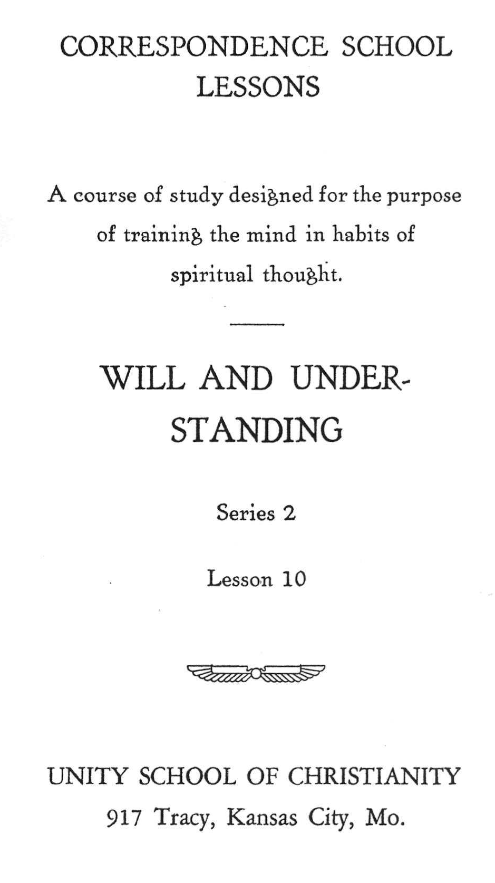
Lesson for Will and Understanding
(Source: Unity Correspondence School Course Series 2 Lesson 10)
Divine Will and Human Understanding
What is will? What is understanding? What is the relation of will to understanding?
1. As we study the faculty of will and the faculty of understanding, we learn that each is a divine idea in God Mind, a spiritual power, a spiritual pattern or principle to be used by man. Each is a mental faculty operating in man’s consciousness and manifesting as a part of his body organism. The will is the executive idea and the understanding is the “knowing” idea, the reasoning principle. In the individual consciousness these two must always work together, according to the Christ standard, in order to produce harmony and fulfillment in one’s soul, body, and affairs. “The will is the executive power of the mind. ... In all systems of thought concentration and spiritual attainment, the will, the executive faculty, plays the leading part” (Keep a True Lent, page 156 and page 193).
What is the will of God and what is it to do the will of God?
2. Will is the power to act without restriction from any source; the privilege to use all the powers of God within, either in a constructive way or in a destructive way to fulfill all the desires an individual may have. The will is the power to affirm and deny, to say “yes” and “no.” “The will must be dealt with in every movement because it is the very essence of self-consciousness” (Metaphysical Bible Dictionary, Will).
3. Understanding is the power or faculty that enables one to know, to vision, to see, and to feel. It is the power that enables one to forget past mistakes and shortcomings of himself and others and come into a higher state of consciousness. Understanding provides the vision, and the will provides the motive power by which the vision can become manifest in one’s life. Understanding is expressed by and through the will. “Where there is no vision, the people perish” (Proverbs 29:18). Without understanding of the Source of our good and how to attain that good, we could not live. Without the motive power to act (will) upon the vision, we should perish.
4. “There is a knowing quality in Divine Mind. God is supreme knowing. That in man which comprehends is understanding; it knows and compares in wisdom. Its comparisons are not made in the realm of form, but in the realm of ideas” (Christian Healing, page 112).
5. Man, created in the image and after the likeness of God, is endowed with divine freedom and the power to exercise that freedom as he chooses. Man’s heritage is all the ideas of Divine Mind—all the powers of Being, all the qualities of God—thus making man a special unit in universal life. He may enter into and live the life universal wherein he places himself consciously in unity with all the good that is provided by his Creator for his unfoldment and well-being. Or he may feel separate from God, from his fellow man, and from his fellow creatures and try to live that way. God never forces Himself on man, therefore man is left free to use his powers either constructively or destructively. Man would be a mere machine had he not the privilege of making use of the powers that are inherent in him in whatso-ever way he may choose.
6. The right to exercise freedom of will was given to man in the very beginning. His misuse of this privilege brought upon the world all the burden of sin and of sorrow that it has since experienced. In the allegory in the second chapter of Genesis, we find man, as the first Adam, experiencing suffering through an ignorant use of his will for the sake of what he considered personal advantage. The second Adam, or Jesus Christ, “the resurrected Adam” (Talks on Truth, 137) stands His testing with regard to the righteous use of the will and by His victory lifts up the race.
7. This may seem contradictory to the statement that man has free will. If he must “give up” his will, is he free? To answer this correctly we must consider “understanding” in its relation to “will”:
8. The divine, universal will is good. “It is not the will of your Father ... that one of these little ones should perish” (Matthew 18:14). This text indicates the will of the Father toward His children. The Psalmist compares the love of God with the love of earthly parents and argues that God loves men and wills only good for them, even as fathers after the flesh “will” good for their children. An understanding of God as Father eliminates from man’s consciousness the error belief that God wills suffering for man. Any loving father or mother would be grieved to have a child think the parent willed suffering, and no child that persisted in such a thought would be considered normal. Much more should this be true in our relations with God. Bible texts that seem to indicate a supreme will of cruelty should not be accepted with such an interpretation.
9. Nature affords us valuable illustrations that help to make clear the question of God’s will. In nature there is an invisible power that continuously moves to bring into manifestation all its different elements in the same way that God moves to have His perfect ideas (elements) brought into expression. The one tendency of this power in nature is to produce perfect specimens of each species in order that beauty and harmony may abound. When a tree is scarred, the processes of nature heal the wound, barren places are covered with vegetation of some kind, dead stumps are covered with vines. As there is a great silent power in nature moving for complete expression of nature’s products, so there is a great moving activity in the universe that tends toward perfect expression. This universal movement is not anything apart from the movement in nature nor from the movement in man. The cause or source of this movement toward perfection in nature, in man, and in everything else in the universe, is what we call “the will of God.”
10. It has been found that some cases of illness do not respond readily to spiritual treatment because the belief has been fixed in the patient’s mind that God wills suffering. The patient should be treated to the end that he may understand that the divine will, God’s purpose for all His creation, is only good. When the patient accepts this premise, he experiences in his body and affairs the harmony that is “the will of God.” Another mistaken belief that man has in “giving up” to the will of God is that he must become negative or inert–waiting, as it were, for some outside power to impel him to action. God is omnipresent and, therefore, there is just as much activity in man as there is anywhere else in the universe.
11. “Giving up” to the will of God is not a negative process; it consists in accepting one’s deepest and truest impulses as the will of God and giving these impulses expression.
12. The next point to clear up in learning the right use of the faculty of will is the difference between the faculty of will and the personal use of this faculty. In man’s true estate he has understanding and wills to act upon that which is true and right. This is the will faculty functioning at one with the divine will. What is so often called the “personal will” is the ignorant, selfish use of the mental faculty that we call the will. It is this unrighteous use of the will faculty that is to be given up to the divine, universal will. Man is free only when he exercises his will faculty in divine understanding. He is in bondage when he allows the will faculty to be dominated by selfish desire. When one is following Spirit and seeking to do the will of God, he should count all his experiences as stepping-stones to good.
13. One must be willing to give up limited desires of the personal man in order to enter into the joys of the universal. When manifest man is unenlightened, his life is largely devoted to unworthy aims and his thoughts are welded to the material only. Yet this renunciation of limited concepts of self can be and must be made before man can enter into the realization of what the “will of God” is. If one does not give up willingly, the law itself seeks to bring about an adjustment.
14. When the individual will faculty is consciously one with God through spiritual understanding, then is fulfilled the promise, “If ye abide in me, and my words abide in you. ask whatsoever ye will, and it shall be done unto you” (John 15:7) “Ask whatsoever ye will” is the privilege of men who pray in the understanding of themselves as the Christ of God.
15. The righteous use of the faculty of will is the open door to the fulfillment of all the promises of God. The Scriptures confirm this in the following verses: “If ye be willing and obedient, ye shall eat the good of the land” (Isaiah 1:19). “If any man willeth to do his will, he shall know of the teaching” (John 7:17). “He that doeth the will of God abideth for ever” (1 John 2:17). Every blessing is for men when they will to do the will of God, therefore “be ye not foolish, but understand what the will of the Lord is” (Ephesians 5:17), and “that ye may be filled with the knowledge of his will in all spiritual wisdom and understanding” (Colossians 1:9).
16. Throughout His ministry Jesus taught the Father’s will; but something more is needed than just to know the “letter” of His teachings. Spiritual quickening is necessary. “But there is a spirit in man, And the breath of the Almighty giveth them understanding” (Job 32:8).
17. An intellectual comprehension of Truth only does not meet the full requirement of exercising the faculty of will in spiritual understanding. “Intellectual knowledge comes first in the soul’s development, then a deeper understanding of principles follows until the whole man ripens into wisdom” (Keep a True Lent, 155). The Lord appeared to Solomon in a dream and said, “Ask what I shall give thee” (1 Kings 3:5). Solomon replied, “Give thy servant there-fore an understanding heart to judge thy people, that I may discern between good and evil” (1 Kings 3:9). The Lord was pleased because Solomon had asked for wisdom instead of riches and honor, and said, “Behold, I have done according to thy word: lo, I have given thee a wise and an understanding heart ... And I have also given thee that which thou hast not asked, both riches and honor” (1 Kings 3:12, 13). Understanding has, therefore, been called the “key to all good.” Solomon chose that which he most desired—understanding–and because he chose wisely, the Lord bestowed great riches upon him. So, it is with us: understanding is our “key to all good” for understanding opens the door to health, prosperity, love, and happiness. Often we seek for understanding in the outer or through other persons rather than in seeking for it within ourselves. As we endeavor to understand others, then we find the fulfillment of our own desire for understanding.
18. It was immediately after this occurrence that two women appealed to Solomon to decide whose child it was that they both claimed. “And the king said, Fetch me a sword ... And the king said, Divide the living child in two, and give half to the one, and half to the other. Then spake the woman, whose the living child was, unto the king, for her heart yearned over her son, and she said, Oh, my lord, give her the living child, and in no wise slay it. But the other said, it shall be neither mine nor thine; divide it. Then the king answered and said, give her the living child, and in no wise slay it: She is the mother thereof” (1 Kings 3:24-27). This is a fine example of intuitive understanding on the part of Solomon. Instead of the usual taking of testimony and the various methods of proving the case by witnesses, Solomon appealed directly to the heart and got the truth instantly. No amount of exoteric testimony would have accomplished what the appeal to the heart of the mother brought forth instantly. Some Truth students become so enamored of the revelations through the head that they fail, to go on to the unfoldment of spiritual understanding that comes from God through the heart.
19. To “do the will of God” is to think and to express oneself in harmony with the Truth of Being (God). As stated before, Jesus taught the Father’s will. He put Truth into simple form for our benefit when He gave His commandments–”and his commandments are not grievous” (1 John 5:3); they are the way to life. When they are interpreted according to the “letter,” some of them seem indeed like hard sayings but to one in spiritual understanding, interpreted according to the “spirit that giveth life” (2 Corinthians 3:6), they are a lamp to the feet and a light upon the way, rejoicing the soul.
Understanding and Mental Resistance
Explain the Scripture “Resist not him that is evil” (Matthew 5:39).
20. The necessity of a clear understanding of the words of Jesus may be illustrated by this commandment: “Resist not him that is evil” (Matthew 5:39) or, as the margin reads, “Resist not evil.” Two men may have an equally great desire to “do the will of God” in the matter of taking the right attitude toward evil and may accept this command as their light. However, one may interpret it literally, while the other interprets it in spiritual understanding. The one who follows the literal interpretation finds himself becoming negative, and error conditions grow larger and larger, threatening to overthrow him. The other holds himself in tune with Spirit, and while he does not resist evil conditions, he takes a positive attitude toward good and thus overcomes all beliefs in evil as a creation of God. Through ignorance the one fails to exercise his will, the other exercises his will in spiritual understanding.
What does a state of mental resistance indicate?
21. A state of resistance is always evidence of an unyielding personal will or limited use of the faculty of will. When consciously linked with God, man increases his capacity to use his will righteously, and his life becomes more Christlike in manifestation.
22. The Old Testament narrates that Joseph had two sons. “And Joseph called the name of the first-born Manasseh: For, said he, God hath made me forget all my toil, and all my father’s house. And the name of the second called he Ephraim: For God hath made me fruitful in the land of my affliction” (Genesis 41:51, 52). The oldest son, Manasseh, had power to forget–to erase through an understanding of Truth–all the accumulated burden of negative thoughts, even those of heredity. Understanding here denotes the ability to deny, the passive or receptive activity of mind. The other son, Ephraim, could add to or make fruitful the “land” that seemed to be a place of affliction. Manasseh represents “understanding,” and Ephraim stands for “will.” The will is the positive or affirmative quality, the affirmative attitude of mind. These two sons of Joseph inherited his allotment in the Promised Land, which represents the redeemed and perfected body’. Their allotment was together; they were never separated. These processes in consciousness are symbolized in the body by the front brain, which is their field of operation. When the will is working strongly, we corrugate the brow, and the quick understanding causes the eyes to flash. The first step that a beginner in Truth takes, is to set up a new and better state of consciousness, based on the Absolute (God). He forgets or denies reality to the not-good, and brings into vivid remembrance the good by affirming it alone to be the real. These two mental processes should go hand in hand as shown “by the joint ownership by Manasseh and Ephraim in the Promised Land. All that we realize, all that becomes part of our character, must enter our consciousness through these mental processes. We must know for ourselves and our knowledge must come through conscious understanding; then it must be expressed by the will. The understanding and will faculties should be especially active in the one who would control the sensations of the body.
How does man exercise control of his faculties and their expression?
23. In the New Testament, Matthew and Thomas represent will and understanding.
Matthew—gift of Jehovah ... given wholly unto Jehovah. ... represents the will faculty in man. The will always enters into man’s decisions. The will makes the final choice to give up all and follow Jesus. This lesson on the surrendering of the old beliefs and conditions, that the greater increase of good may come into one’s life, is based on Matthew because Matthew represents the will. ... Under the spiritual law, the will becomes a producer. ... When the individual will has become a disciple of the Christ, spiritual I AM, the schooling of the man begins. (Metaphysical Bible Dictionary, Matthew)
Thomas is the disciple of Jesus Christ who represents the understanding faculty in man. ... “Among the disciples of Jesus, Thomas stood for the head, representing reason and intellectual perception. Jesus did not ignore Thomas’ demand for physical evidence of His identity, but respected it (Metaphysical Bible Dictionary, Thomas).
24. Some have called Thomas “doubting Thomas” because he sought proof upon which to base his faith. But it must be conceded that he had an inquiring mind, one that sought the Truth about all things. Thomas had a strong, positive faith like Peter’s, and in some ways it manifested itself like Peter’s faith. However, Peter’s faith seemed more optimistic than that of Thomas. Thomas is thought by many Bible students to have had a pessimistic streak in him, although probably most of this supposition is based on one incident.
25. Thomas, the earnest one, the disciple who was determined to understand so that he could carry out whatever was expected of him, asked the question that probably was in the minds of others, “Lord, we know not whither thou goest; how know we the way?” (John 14:5) Here Thomas represents reason functioning in the realm of sense, seeking to discern the things of Spirit through outer signs. The truth contained in Jesus’ answer to Thomas, ‘I am the way, and the truth, and the life: no one cometh unto the Father, but by me,’ (John l4:6), is, that the I AM in man, or the Christ, is the open door to the Kingdom of God” (Metaphysical Bible Dictionary, Thomas).
26. The above statement, which has meant so much to Christians through the centuries, was made because Thomas, the disciple who sought to understand, dared ask his question. Now, thanks to Thomas’ question and Jesus’ answer, we may know the way. The I AM in man, or the Christ, is the open door to the kingdom of God. To what extent do we have control over our faculties and their expression? As spiritual beings we have inherited dominion and authority over every faculty and its expression. However, we have not always recognized, accepted, and used our right to control mind activity, and adverse conditions have been formed in our body and affairs. In order to exercise control over the faculties and their expression, we must begin to exercise the will faculty in spiritual understanding. We begin with the recognition and acknowledgment of the Christ Mind in us, the realm of pure knowing. This realm is the realm of divine ideas or patterns for our thinking. Then, through denial, affirmation, meditation, prayer, and the practice of the Presence in daily living, we align our thoughts with the Christ Mind, thus “bringing every thought into a harmonious relation to eternal unchangeable principles” (Metaphysical Bible Dictionary, Thought). By aligning the conscious phase of the mind (intellect) with the Christ Mind (Superconscious) only that which is good and true is given to the subconscious phase. Thus, a perfect mind action is established and control over our faculties and their expression is exercised in divine order.
27. That which is stored in the subconscious phase of mind is “subjective.” The tape recorder is a good illustration of this. The recorder never stores up music or sounds of any kind except as they are “spoken” into it. The tape record, when once made, can, under right conditions, be repeated any number of times or its impressions erased. Whatever is accepted by the conscious phase of mind is stored in the subconscious, and the subconscious “makes” or produces the conditions of the body and the environment in which we live. The subconscious phase of mind may seem to be beyond the control of the conscious phase, but control is always within reach of the one who exercises his faculty of will in understanding. If we let all kinds of thoughts into our conscious phase of mind, we will store them in our subconscious phase. “If we sing a song, or give a groan, it is all recorded within. This accounts for every condition that we experience. Sometimes we wonder why we find ourselves in the midst of certain conditions, not understanding that they are reactions or the “sounding forth” of the records that have been impressed on our subconscious.
Free Will and Human Freedom
How should children be taught in their formative years to use will and understanding?
28. We must make unity in understanding with the great knowing Mind. In Divine Mind there is no such thing as ignorance. We should never say, “I do not know.” When we say this, we draw a cloud of ignorance over our consciousness. Children are sometimes kept in bondage by parents and teachers holding them to be dull and slow of comprehension. We may help such children by declaring for them, “God is your intelligence.”
29. The will of children should never be broken but should be strengthened. Children should be taught to do right because it is right and good, instead of being forced to follow the will of others. We must make clear to children that all good comes through obedience to spiritual law and that it can come in no other way; that conscious, deliberate, and wholehearted observance of known laws will ensure success and happiness. Children should be shown the results that follow from making a wrong choice, from using the will to bring about results that are selfish and unwise. Right understanding of their relation to God’s laws should be pointed out to children so that they may see how to exercise their will faculty righteously (through understanding) thus making wise and loving decisions in matters that come to them for action.
30. The underlying principle of life is God, Absolute Good, and all of man’s calculations in life should have their beginning in this truth. Man’s life will become stable only when built upon this principle. God is Spirit, and the things of God must be spiritually discerned. Through discernment we understand God; through understanding God we become wise in the application of God’s ideals or powers in us. Through the right use of these powers we come into knowledge of God and of who and what man is.
31. In Lesson Three of Series Two [Fillmore Wings Lesson 8] it was explained that:
Ideal man is I AM; manifest man is I will. I AM is the Lord God, Jehovah, of the Scriptures, and I will is the Adam. One represents the inner man, and the other the outer or formed man. It is the I AM that forms and breathes into the I will man ‘the breath of life’ ... In the realm of the ideal, we are I AM; when we are expressing and interpreting the ideas of Divine Mind in our thoughts and in our acts, we are I will.
Why is it unwise for one individual to dominate another?
32. Everything centers about the will, therefore, nothing should ever be done that interferes with the freedom of one's own will or the will of others.
“Like a fountain that never faileth,
My life and will are free;
Therefore whatever belongeth to God
Rightfully belongeth to me.”—Selected.
33. Those who submit themselves to hypnotism and mediumship weaken the will faculty; instead of exercising the will in the right way themselves they surrender it and gradually lose conscious dominion. The whole consciousness is thrown into disorder because the will faculty, having been denied its rights, has lost its hold and can no longer control the processes of thinking and feeling.
Free Will and Wholeness
What has free will to do with expression?
34. In all the affairs of life the will should be respected. We should never try to compel friends and relatives to follow our patterns of living of what is right, even in small matters. Parents should never dominate children but guide them; husbands should never dominate wives; wives should never dominate their husbands. Children should be taught the laws of life and obedience to Truth, but they should be allowed freedom to express their spiritual powers. The will directs the other faculties of the mind and must be free to do this. Impulses arise within the individual in the form of good motives, good intentions. Without free-will they cannot be expressed, and this results in loss of some form of manifest good to the individual and to the community. Repression of the will faculty causes suffering because the spiritual qualities such as life, love, and wisdom cannot come forth to produce the “abundant life” of which Jesus spoke.
35. A text in the Authorized Version of the Bible reads, “The kingdom of heaven suffereth violence, and the violent take it by force (Matthew 11:12 A.V.). A more reasonable translation is given in the German, which makes the passage read thus: “The kingdom of heaven is open to invasion by the resolute will, and the resolute will taketh it by assertion.” This is so clear that it scarcely needs comment. All students of Truth have experienced the taking of the kingdom by assertion or affirmation, and they know that it often requires a very resolute will because of the negative states of consciousness that have formed through neglect or ignorant exercise of the will faculty.
36.There is a great difference between entering into the realization of life, strength, power and merely receiving suggestions of these qualities. Suggestion is from without, and it may be based on either Truth or error; spiritual realization is from within and is always Truth. Truth is first “suggested” to the individual, but for it to be realization he must let Spirit within reveal the Truth back of the words that were “suggested. Statements of Truth spoken in understanding quicken the mind to an abiding consciousness of the Truth of Being, and permanent health and happiness is the result.
What has the will to do with the forming of a perfect physical "body?
37. “Other foundation can no man lay than that which is laid, which is Jesus Christ” (1 Corinthians 3:11)—the perfect man. Building is expression; it is the work of the will using the creative power of God. When built in spiritual understanding, the structure will not fall. The will working without understanding has (through the sub-conscious phase of mind) built many error conditions into the body, making it a tabernacle instead of an everlasting temple. These errors are pictures made by the imaging faculty. There must be understanding as to what change is to be made in the image, and there must also be the faith that it can be changed, and the will to carry the change into effect. When these errors and the tabernacle-states-of-consciousness that they have formed are dissolved by denial, then “we have a building from God ... eternal, in the heavens” (2 Corinthians 5:1) that is, a spiritual consciousness. Then are we clothed with the perfect Christ body.
What is it to "be reconciled to God? Give three affirmations that have helped you to bring about this reconciliation in your own consciousness and in your body and affairs.
38. “Be ye reconciled to God” (2 Corinthians 5:20) means “Be willing that His will be done.” Submission to the divine will is not a negative giving up to circumstances and conditions but a blending of man’s use of will with God’s through the understanding that back of all that appears is the great universal will, willing only good.
39. What we really will to do, that we do. Sometimes we think we will to do when we merely have a desire or a longing or a wish-to-do. Desire is more of a reaching out of the soul for satisfaction. When the will acts in accord with the desire, then we do the thing we want to do. To will is to do, and the power must come from within. We may will to do a thing we do not desire to do, or we may very much desire to do something that we do not will to do. We may desire to be well and strong, but before this is accomplished in fact, we must will to be well and make active our powers to that end. We must will until we have retrained the subconscious in the ways of Spirit, and then automatically we shall express in mind, body, and affairs the perfection which the I AM is. “Willing” is not a hard personal effort. It is only so when the unenlightened man is trying to carry out some of his ambitions. The will in its true estate acts easily and accomplishes wonders without apparent effort. In divine order it works from within, from the I AM, instead of from the outer consciousness. When man learns to go within and make himself consciously one with the Supreme Will, he will be able to control and direct all the functions of the body as well as the activities of the mind and the heart (i.e., thinking and feeling).
40. The following statements may be used in establishing conscious union with the divine will:
Not my will, but thine, be done.
I will to do the will of God.
I am free to do the will of God.
I delight to do Thy will, 0 God.
I exercise power, mastery, and dominion through Jesus Christ and not through the limited use of the will faculty.
Solomon’s Counsel
41. My son, if thou wilt receive my words,
And lay up my commandments with thee;
So as to incline thine ear unto wisdom,
And apply thy heart to understanding;
Yea, if thou cry after discernment,
And lift up thy voice for understanding;
If thou seek her as silver,
And search for her as for hid treasures:
Then shalt thou understand the fear of Jehovah,
And find the knowledge of God.
For Jehovah giveth wisdom;
Out of his mouth cometh knowledge and understanding:
He layeth up sound wisdom for the upright;
He is a shield to them that walk in integrity;
That he may guard the paths of justice,
And preserve the way of his saints.
Then shalt thou understand righteousness and justice,
And equity, yea, every good path.
For wisdom shall enter into thy heart,
And knowledge shall he pleasant unto thy soul;
Discretion shall watch over thee;
Understanding shall keep thee.
—Proverbs 2:1-11.
This lesson was transcribed on April 20, 2021 by Coy Brock.
Annotations for Will and Understanding
Here are the Annotations for Series 2, Lesson 10, Will and Understanding. These questions and answers were used to “grade” papers and so they represent the “correct answers.” We’ve included them in this course guide to provide a second look at what the Fillmores wanted their students and ministers to know.
Divine Will and Human Understanding
1. What is will? What is understanding? What is the relation of will to understanding?
Like other spiritual powers of man (as the lesson emphasizes), "will" is an idea in Divine Mind — the idea of action toward a specific end. Will is the executive power of the mind, the mental faculty that has the privilege of using all the spiritual power within. It is the will faculty that gives one the ability to affirm, to say "yes" or to deny, to say "no," to accept or reject. Even though the faculty of judgment may choose, evaluate, discern, the will must act in order to bring a desired result. God never forces His will (plan) upon us. If He did, our spiritual powers would never be developed. Man is a son of God, becoming self conscious. Righteous use of his faculty of will enables man to express his spiritual powers (mental faculties).
Understanding is also a divine idea. It is the idea of "knowing," as the lesson points out. As a mental faculty it enables one to see mentally, to know. It is the "know-how" for anything in the universe. Sometimes when the truth about something is revealed we exclaim "Oh, I see!" This is not a physical "seeing" but a mental comprehension.
Study of this subject reveals the close relation of "will and understanding"; will needs understanding so that it does not act contrary to divine law; understanding needs will in order that the individual may move out of the theoretical into the practical fulfilling of God's laws, and it takes will to add "feet" to understanding to produce manifest results.
2. What is the will of God, and what is it to do His will?
It is good for us to realize at the outset of Truth study that the "will of God" is actually His plan of perfection for every species of creation. That is, a certain species of seed comes forth as a particular tree; the flower seed as a rose, a buttercup, etc.; and the animals, reptiles, birds, fish, all according to their own plan. We must also recognize the Truth that God's will for man is His plan of perfection, for man was created in the beginning in God's image and after His likeness.
God's will is also His purpose, design, and intent of Absolute Good for man and all creation. In man, God's will can also be called the I AM identity in him, for it is the perfect law of mind action that produces only good.
To do the will of God means to cooperate consciously with the law of mind action in thinking, feeling, word, action, and reaction. When man recognizes that the will of God is the operation of the law of mind action, and trains himself to think, feel, speak, act, and react in accordance with this law, plan, design, and purpose of God, then it can be said that he is doing the will of God.
"Man is the executive power in Being and only through his willing cooperation can the designs of the true God be carried out. These designs are based on principles that cannot be changed, and man must come into such close touch with the wisdom of God that he will consciously cooperate in bringing the perfect creation into existence" (Keep a True Lent 61).
(For further information on the "will of God" see How I Used Truth Lesson 1 Annotation 9)
Divine Will and the Promises of God
3. Is it God's will that man should suffer? Give reasons for your answer.
It is not God's will that man should suffer. The will of God is an exact principle of good, or else all would be in chaos, and man would have no foundation for his faith, no workable law for his unfoldment.
The exactness of the law gives each man an equal opportunity, and the results that one experiences in his life show whether he correctly applies the law of love to his life or not. Man makes mistakes through the ignorant use of his freedom of will and brings suffering on himself. When he learns how to use this freedom in the right way, to harmonize his faculty of will with the divine will or purpose of good for all, then he draws to himself a good manifestation.
4. What has the will to do with the fulfillment of God's promises?
The will has a great deal to do with the fulfillment of God's promises. The promises of God are statements of the universal law of God, which tell how His laws operate in the lives of men. In Lessons In Truth Lesson 6 Annotation 7 we read:
"The 'promises of God' are declarations of eternal unchanging laws or truths, whether they are found in the almanac, in the physical universe, or in the Bible."
If man's understanding is spiritually illumined, he may place his faculty of will in line with the universal will (plan), and all the "promises of God," or the results of following the law, will automatically become an harmonious part of his life. If he wills to work against the universal law because of his ignorance of the law, he may do so; in that case the law that can fulfill the "promises" will still work, but not to bring the desired fulfillment.
Biblical References
5. What have the sayings of Jesus to do with the development of the will?
The sayings and the commandments of Jesus not only reveal the will of God but they show man how to cooperate with this will.
"The will is the executive power of the mind. The commandments of Jesus teach the Father's will. Those who keep them are therefore at one with the will of God" (Keep a True Lent 156).
As one ponders over the sayings and the commandments of Jesus, he comes into a knowledge of what the divine will for man is, for Jesus taught that the will of God is good. When man consciously accepts the truth that God's will or plan means all good and harmony for him, then he is willing to be guided by the will of God, and he can say with Jesus:
"Nevertheless not my will, but thine, be done" (Luke 22:42).
(Additional references to this subject may be found in Jesus Christ Heals 91, 92, and 95.)
6. Explain the scriptural passage “resist not him that is evil” (Matt. 5:39 A.R.V.).
To explain the statement "resist not him that is evil" (or, as the Revised Standard Version reads, "Do not resist one who is evil"), one must understand the meaning of "evil." If God is Absolute Good, it stands to reason that He could not or would not create something unlike Himself. What man terms "evil" is therefore an appearance of error which has resulted from the wrong application of thought power.
"'Evil" represents error thought combinations; that part of consciousness which has lost sight of true principles" (Mysteries Of Genesis 39).
These "error thought combinations" have produced inharmonious conditions that cause man pain. "Evil" is not real and enduring because God did not create it. Mankind is endowed with the power to form mind essence into concepts, beliefs, circumstances, conditions and things and then name them according to the pleasure or pain they bring to him. What man has formed by negative thought, he can change or reform by good thought. He does not need to fight or resist these formations, or even the person who seems to be responsible. He needs to understand these negative formations and take the right attitude toward them. Then, using his faculty of will, he may reform error formations through right thinking, right feeling, right words, and right conduct.
In taking a positive attitude toward the good, we are giving our attention to the One Presence and One Power in the universe, God, the Good Omnipotent.
The greatest disintegrating element in the human consciousness is resistance. Beware of every form of fighting, and of all thoughts of a destructive character (The Revealing Word, Resistance).
Will, Understanding and Consciousness
7. What does a state of “mental resistance” indicate?
A state of mental resistance indicates that one is undisciplined or untrained in the use of his faculty of will. It shows that the will faculty is working independently of the faculty of understanding, because of personal willfulness, stubbornness, or the determination to have one's own way. We might say that resistance is another name for willfulness.
A mental state of resistance indicates an unyielding personal will. Evil has no power except that which man gives it by his thought. Resisting evil is a way of affirming its power (The Revealing Word, Resistance).
Little is accomplished by a person in this state of consciousness, but when he becomes willing to let the divine will express through him, he yields himself to God and thus becomes adaptable to the universal good. There is then no limit to his accomplishment.
8. What faculties are represented by Ephraim and Manasseh?
Ephraim represents "will" and Manasseh represents "understanding," brothers, and sons of Joseph. They must work together in perfect harmony to attain perfect results, symbolized by their allotments being joined in the Promised Land.
These two—will and understanding—are especially active in one who would fulfill his mission of expressing and manifesting his Christ Self, showing forth the image-likeness of God in his daily life. When these two faculties express in harmony, divine order is established. They have their centers of activity in the head, and both function through the front brain.
9. What phase of mental action is illustrated by the tape recorder?
The subconscious or subjective phase of mind is illustrated very well by the tape recorder. By the conscious phase of mind (intellect), that which is put into the subconscious phase of mind is impressed or recorded there. As we play the tape those beliefs and feelings (good, bad, indifferent) come to the surface of our life and are acted out in our everyday experiences.
The subconscious phase is equally as sensitive as the tape recorder, which picks up sounds not consciously intended to be recorded. However, the unwanted impressions can be erased from the subconscious in the same way that the impressions on a tape are erased – by the use of different ideas, thoughts, feelings, and worde. There are times, however, when it is best to erase the unwanted beliefs by the process of denial, and immediately follow by affirming what we really want to be established in the subconscious, and eventually in our outer life.
10. How does man exercise control of his faculties and all their expressions?
Man exercises control of his faculties (abilities) and their outer expression when the will faculty has been educated and trained by understanding to cooperate with the will (plan) of God. “Not my will, but thine, be done” (Luke 22:42).
As already mentioned, the will is the executive power of the mind, and thus the director and controller of the various faculties and their outer expressions. In order to exercise this control in a righteous manner, the will must function consciously with understanding and always under the guidance of the Christ, or I AM.
When the will functions apart from the faculty of understanding, we experience adverse conditions in our life. Ignorant thinking on our part forms the substance of mind and body into inharmonious states of consciousness, which result in similar outer conditions.
Thought control is established by aligning the thoughts with the mind of Christ, bringing every thought into harmonious relation to eternal, unchangeable principles (Metaphysical Bible Dictionary, Thought).
On the other hand, when the will faculty functions with understanding, it works in cooperation with the will of God. Then divine wisdom becomes the guiding light and all our faculties are able to express in divine order.
Will and Human Freedom
11. How should children be taught in their formative years to use will and understanding?
The formative years are very important in the lives of children, and understanding, through wisdom and love, should be exercised by those entrusted with their care. A child should be taught that he is a spiritual being, a divine creation, a son of God endowed with abilities or powers (ideas) that enable him to live his life according to the Christ standard. It then becomes the responsibility of those who care for children to teach them the Christ standard of living, and show them how they can use this standard in all that they think, feel, say, and do. In this way they come to understand the true standard and are willing to do what is right.
No attempt should ever be made to break a child's will or bend it to fit that of another individual. Rather the child should be guided and directed in his use of the will faculty by those who are willing to follow the Christ standard themselves. Children should be taught that the intelligence and love of God express through them when they think, feel, speak, and act in loving manner.
"Train a child in the way he should go, and when he is old he will not depart from it" (Proverbs 22:6).
12. Why is it unwise for one individual to dominate another?
It is unwise for one individual to dominate another because the one who dominates is cultivating an unyielding personal will, and the one who is being dominated is weakening his own use of the will faculty.
In a situation of domination of one person by another, there is always a sense of injustice on the part of the one being dominated. However, there has to be some yielding or fear on the part of that one before another can dominate him.
The Christ within each person is expressed through thinking and feeling, but unless there is freedom of expression, there can be no complete development of the individual's powers (faculties). Thus when one dominates another, his thinking and feeling are obsessed with this and he closes himself to the expression of his Christ Self; when another allows himself to be dominated, he is so taken up with the frustration of being dominated that he is a closed channel. As with the one who dominates, the Christ nature is prevented free expression through the mind (conscious and subconscious). Both individuals suffer because of inability to express their true nature.
13. What has free will to do with expression?
Free will is essential to perfect expression of the divine qualities (ideas) that are man's birthright. Without free will man cannot bring forth fully the powers of his being, which function as faculties in his mind. When these powers are prevented from coming forth in natural unfoldment there is repression, which eventually manifests in a form that is less than good.
The absolute freedom of the individual must be maintained at all hazards. God is the one principle; we are all as free to use God as we are free to use the principles of mathematics or of music. The principle never interferes, but if it is to be rightly applied we must develop understanding (Charles Fillmore Christian Healing 112).
Sometimes we forget that free will is not necessarily doing what we humanly want to do, but it is allowing the faculty of will to carry out the plan of God. Unless there is freedom, we are unable to follow the guidance that God gives us during our quiet moments of prayer, so there is no ready channel through which this guidance may come forth.
Too often we confuse "free will" with "freedom of will." In the first case, the will is free within the laws of God; in the second case, the will faculty has freedom at the discretion of the individual. This may not always be in full understanding of the consequences should he use his will faculty contrary to the laws of life.
14. Explain the text “the kingdom of heaven has suffered violence, and men of violence take it by force” (Matthew 11:12).
The kingdom of heaven is an expanding consciousness of the Kingdom of God (realm of divine ideas) producing harmony in mind, body, and affairs. Due to the many negative states of consciousness in which man has allowed himself to indulge, he is able to attain this harmony or peace of mind only by making very positive affirmations of Truth.
The root meaning of violent is "strength, force." We have added the thought of "unpleasantness" to this word in our language use. As the lesson brings out, the German translation interprets this text as concerned with the strong, positive assertion by the will. Only through willing to be spiritually minded are we able to train our thinking and feeling phases of mind (soul) to be strong and positive. The subconscious (feeling) phase of mind is reeducated and thus able to produce that which is good and true, so the whole man is brought into a state of spiritual fulfillment.
15. What is the difference between mental suggestion and spiritual realization?
The lesson material (page 8) goes deeply into this subject, and there is little more left to be said. The following quotations may be enlightening for this question:
Realization means at-one-ment, completion, perfection, wholeness, repose, resting in God. A realization ... brings to the consciousness an inner knowing that the divine law has been fulfilled in thought and act. (Jesus Christ Heals 40)
To a metaphysician realization is the conviction that a person gets when he has persistently concentrated his attention upon an ideal until he feels assured of the fulfillment of that ideal. (Jesus Christ Heals 45)
Suggestion is systematically used in the business world, and unless you are strong in your own convictions as to what your needs are, you will be loaded up with many things for which you have no use. The remedy is to establish yourself in the spiritual law. You will come under one or the other of these laws, the man-made or the spiritual, and it is for you to choose which is best. (Jesus Christ Heals 188)
Will, Consciousness, and Wholeness
16. What has the will to do with the forming of a perfect physical body?
A perfect physical body is the outer structure or manifestation of a consciousness of perfection, the result of right thinking and feeling guided by the Christ spirit within. It is the creative power of God which builds all structures, and in mankind this power is used by the will faculty, the executive or directive power of the mind, according to the discretion of the individual. As the lesson points out, the will functioning without understanding has produced many limited conditions in the body. We can see, therefore, that when the will works in conjunction with the faculty of under standing, undesirable conditions in the body can be erased by denial, and health, vitality, strength built in by affirmation. This is not a mental process but true spiritual healing which fills the "letter" of the denial, and affirmation with the "spirit that giveth life" (II Cor. 3:6 A.V.). Each individual must be willing to do the mental work but also go beyond it to acceptance of God's power moving through every cell to restore it to its true estate.
In divine order the will acts upon the body center from within; in the average person this action is through reflection from without. In practice we live outside our body instead of within it (Christian Healing 37).
17. What is it to be reconciled to God? Give three affirmations that have helped you to bring about this reconciliation in your own consciousness and in your body and affairs.
Webster defines the word reconcile as "to restore to friendship, harmony or communion; adjust, settle." To be "reconciled to God" means to come again into a conscious, harmonious relationship with Him; a relationship in which one is open, receptive, and obedient to God's will, plan, purpose for all men.
To be "reconciled to God" means that we come into an understanding that God's will (plan) is the law of perfect mind action whereby all good is brought into one's life, and then we use the will faculty to live in accordance with that law. It means that we learn to adjust our whole being to the principle of Absolute Good — that is, to consciously merge our human consciousness (thinking and feeling) with the divine; to blend our will faculty with the will of God.
Affirmations that will help to bring about this reconciliation with God can be either in the meditative form (speaking about God) or in the form of an actual prayer when we speak to God, knowing ourself reconciled to Him through love:
I will to consciously open my mind and heart to God's Presence and Power, and I will to practice it moment by moment.
Dear Father-God, I acknowledge Thy Presence in me, making me healthy, harmonious, and prosperous.
Dear Father-God, Thy guiding, comforting, healing Presence now harmonizes all my affairs, and I am healthy and prosperous.
18. What is the difference between desire and will?
Desire is an activity in the subconscious phase of our being. It is a state of mind resulting from adding feeling to thinking about a specific need, or rather the fulfillment of some need, made apparent through a sense of incompleteness in some area of our being. The book Charles Fillmore Prosperity 27 gives an interesting definition of "desire":
Desire is the onward impulse of the ever-evolving soul.It is a feeling after something, a longing or a craving for some good in order to satisfy a need. In the book Lessons In Truth, in the chapter on “Faith” we read:
Desire in the heart is always God tapping at the door of your consciousness with His infinite supply — a supply that is forever useless unless there be demand for it.
Will is the faculty in us that enables us to make the demand based on this desire. The will is first of all an activity in the conscious phase of mind (intellect) which may accept or reject, say "yes" or "no" to the good that God offers to His children.
Desire governs the shape of our good, but the will accepts or rejects it. One may desire some good but until he wills to accept it, it does not manifest in his life.
If you desire a thing you set in motion the machinery of the universe to gain possession of it, but you must be zealous in the pursuit in order to attain the object of your desire (Charles Fillmore Twelve Powers of Man 131).
19. What is it to be reconciled to God? Give three affirmations that have helped you to bring about this reconciliation in your own consciousness and in your body and affairs.
Recommended Reading
Christian Healing, Will and Understanding, Charles Fillmore.
“I Consent,” Will and Understanding, Newton Dillaway, Unity Magazine, July 1969.
Downloads
© 2025. TruthUnity Ministries. All rights reserved.
 The Fillmore Wings Study Program is a study program based on the Correspondence School Lessons published by Unity School of Christianity from 1912 to the mid-1970s. This program is licensed under a Creative Commons Attribution-NonCommercial-NoDerivatives 4.0 International (CC BY-NC-ND 4.0) License, except where otherwise noted. You are free to download the work and share it with others as long as you follow the license terms: https://creativecommons.org/licenses/by-nc-nd/4.0/legalcode
Contact TruthUnity Ministries for permission to adapt and/or republish.
