


Judgment and Justice


Download the Fillmore Wings Course Guide for Lesson 17 Judgment and Justice:
(8.5x11) for printing one page/sheet on letter sized paper
Introduction to Judgment and Justice
Introduction not yet available.
Lesson for Judgment and Justice
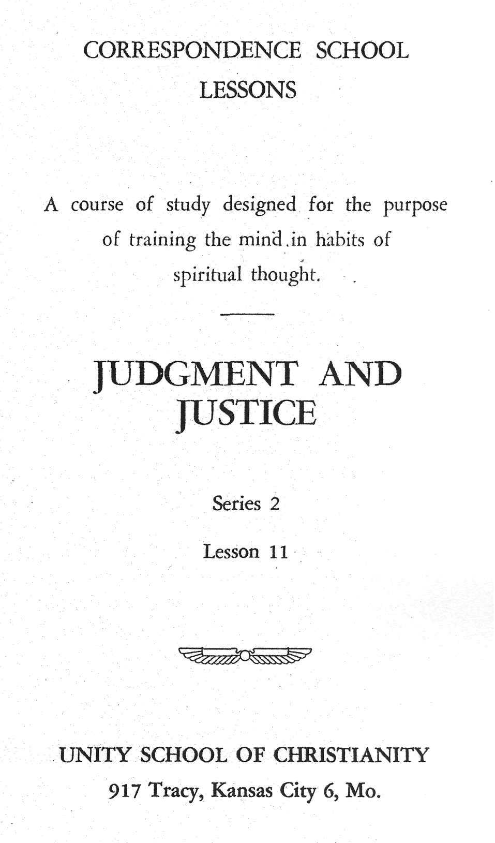
(Source: Unity Correspondence School Course Series 2 Lesson 11)
What Is Judgment?
What is judgment? Explain the Scripture, “Judge not according to the appearance, but judge righteous judgment” (John 7:24 A.V.).
1. In Lesson Seven [Lesson 13 in Fillmore Wings] on “Spirituality, or Prayer and Praise,” we learned about the twelve powers of man or the twelve faculties of mind. These are also called “the twelve mind centers in the conscious-ness” of each individual. In the following lessons we then took up certain of these faculties for specific study, and now in this lesson we come to the power, or faculty, of “judgment.”
2. All previous study and prayer has revealed to us that these powers of man are primarily ideas in Divine Mind. Thus, we see "judgment" as an idea in Divine Mind, therefore a principle that covers a certain action of mind, and one of the twelve faculties of man's mind.
3. Jesus said, “For judgment I came into this world, that those who do not see may see” (John 9:39). James, the son of Zebedee, is that disciple of Jesus Christ who represents the faculty of judgment in individual consciousness. In the body, this faculty has its seat of activity or expression in the lower part of the nerve center called the “solar plexus.”
What is meant by the term “righteous judgment”?
4. In God, righteousness refers to the right relationship of ideas inhering in Divine Mind. In man, righteousness refers to the right understanding and right use of these ideas under the direction of the indwelling Christ. Exercise of the faculty of judgment enables us to determine the right place and the right use for everything. All the powers of man must be understood and used in a righteous manner. Jesus admonished us to “judge not according to the appearance, but judge righteous judgment” (John 7:24 A.V.)—the Revised Standard Version reads: “Do not judge by appearances, but judge with right judgement.” “Righteous judgment” is the right use of the judgment faculty or judging from the law of Absolute Good.
5. The faculty of judgment functions in the mental realm in operations that involve comparison, discrimination, discernment, evaluation of ideas, things, people, circumstances, and situations. One of the definitions from Webster is: “the operation of the mind involving comparison and discrimination, by which knowledge of values and relations is mentally formulated.” Rightly used, this faculty arrives at right conclusions; it enables us to determine the right place and use for everything. Thus, we come to see that good judgment involves balance. While the faculty of “order” had to do with right relationships, it takes the faculty of “judgment” to decide on these relationships so that all might be put in balance, or order.
6. We are constantly using the judgment faculty in all phases of our life. The good taste we exhibit in the things we do at any given time exercises this faculty. The ability to taste our food is related to this faculty, for we judge whether it is fresh, good to eat, or even if it is the right time to eat it. This ability gives us protection from many dangers that occur in daily living; we are able to discern whether gas is escaping; whether anything is burning; we discern noises in our homes, in our cars, in the outdoors, all because the judgment faculty is heeded.
7. When Jesus told us we were not to “judge by appearances” He knew that to rely only on the evidence of the five senses would give us a distorted picture. For example, one being interviewed for a position might give evidence in appearance that he is well suited to the work, but when the faculty of judgment is based upon Truth, a revelation might come in a very simple way, showing this one to be unsuited for this particular position. On the other hand, another individual, judged by appearances, might not seem to be the desired employee, but a deeper evaluation might reveal that he has qualities that in the overall picture would fit him very well for the work. There is little in our life that does not come within the scope of our judgment faculty, but its use must be founded upon understanding, love, and faith, in order to produce “righteous judgment.”
8. When we judge from appearance only, our use of the judgment faculty often becomes biased and prejudiced. We criticize and condemn, and usually fix some penalty by thinking of a form of punishment which should be meted out to the guilty one.
9. He may be guilty or not guilty; decision as to his guilt or innocence rests in the divine law, and we have no right to pass judgment (Christian Healing 122).
10. In the wrong use of our judgment faculty we produce thought forces that will react upon us.
11. "The metaphysician finds it necessary to place his judgment in the Absolute in order to demonstrate its supreme power. This is accomplished by one's first declaring that one's judgment is spiritual and not material; that its origin is in God; that all its conclusions are based on Truth and that they are absolutely free from prejudice, false sympathy, or personal ignorance"(Christian Healing 121).
12. Jesus said, “Judge not, that you be not judged. For with the judgment you pronounce you will be judged, and the measure you give will be the measure you get” (Matthew 7:1, 2).
13. Goodness is man’s natural expression; thus, his true judgments are always good. His goodness can be expressed, however, only when he is set free from limited concepts of justice. Obedience to the eternal principle of Absolute Good, which includes the moral law (high principles of human conduct) lifts man into a higher state of consciousness than does just the obedience to the moral law alone, the interpretation of which is given through Moses.
14. We find these quotations in the Scriptures:
Surely there is a reward for the righteous; surely there is a God who judges on earth (Psalms 58:11).
The Lord reigns . . . righteousness and justice are the foundation of his throne (Psalms 97:1, 2).
Thy steadfast love, 0 Lord, extends to the heavens . . . Thy righteousness is like the mountains of God, thy judgments are like the great deep; man and beast thou savest, O Lord (Psalms 36:5, 6).
15. These quotations may be interpreted spiritually as well as literally. Spiritually, “the earth” represents formed substance, a God-consciousness, created and established throughout the universe. The universal principle of causation, Mind, includes all principles. Among these principles of Being, the Lord God or Jehovah God is the creative life principle that originates and sustains all life, all consciousness, from the highest to the lowest levels of intelligence. In the mental and physical states of Being, the Lord (Jehovah) operates as a causative force, the formative power of thought, forming ideas in the consciousness of mankind and shaping bodies in the physical world. Thus, the Lord or Jehovah represents the forming and shaping principle of Being.
16. In these forms and shapes the Lord (Jehovah) inheres and expresses Himself to make God manifest according to the degree of intelligence ruling in the form or body. The Lord (Jehovah) judges in the earth, the formed realm.
17. In the first three chapters of Genesis this principle is called the Lord God (in the Authorized and Revised Standard Versions) or Jehovah God (in the American Standard Version). Beginning with the 4th chapter of Genesis, the word God is omitted, and thereafter this principle is referred to simply as the Lord or Jehovah. This shows that the power to accomplish results has externalized or descended from the Absolute state, where it functions as the creative principle producing only that which is perfect, to the mental realm, in the human consciousness, where it functions as the mental law of cause and effect.
What Is Justice?
What is justice? What is the sure way to establish justice in one's affairs?
18. The word justice is associated with law. It is the “administration of law ... according to the rules of law or equity” (Webster). Justice is the divine law of balance, the equalizing law of good in action, brought about by righteousness.
19. Spiritual laws are eternal verities and must work out according to Truth. A principle inevitably demonstrates its own exactness as a rule of action. Justice is a divine law that tolerates no violation. Justice decrees for man health, happiness, and abundance. But justice does not bring forth figs from thistles. If man disobeys the rules of health, harmony, or supply, ^the law of compensation becomes manifest. Misuse of the power that makes him well, happy, and prosperous when correctly and intelligently employed, reacts according to principle in sickness, inharmony, and poverty (Richard Lynch, Know Thyself, 131, 132).
20. Divine justice is God's love and mercy in action and is well expressed on pages 120, 121 of Christian Healing as follows;
“As God is love, so God is justice. These qualities are in Divine Mind in unity, but are made manifest in man’s conscious-ness too often in diversity. . . . When judgment is divorced from love, and works from the head alone, there goes forth the human cry for justice.”
21. Justice is often represented by the figure of a blindfolded woman holding in her hand a balance scale. It thus suggests that justice is impersonal and impartial. May we not say that it also suggests that the eyes must be turned inward, where true spiritual principles I are at work, and not outward, toward appearances? True spiritual principles express impartially. We read further in Christian Healing, page 122:
“Whatever thought you send out will come back to you. This is an unchangeable law of thought action. A man may be just in all his dealings, yet if he condemns others for their injustice, that thought action will bring him into unjust conditions; so, it is not safe to judge except in the Absolute.”
22. Systems of law differ in different countries and among different people. Also, man-made laws constantly undergo change so that what is considered “just” at one time is not so considered at another. Therefore, it is clear that human laws may fail to provide for the highest justice; they are more for the purpose of insuring an orderly system of social relationships.
23. We can establish justice, order, and prosperity in our personal affairs by invoking directly the divine principle of justice, which will continually work out for us the problems of life.
If you think that you are unjustly treated by your friends, your employers, your government, or those with whom you do business, simply declare the activity of the almighty Mind, and you will set into action mental forces that will find expression v-« in the executors of the law„ This is the most lasting reform to which man can apply himself. It is much more effective than legislation or any attempt to control unjust men by human ways (Christian Healing 126).
24. Instead of fighting for our rights we may get them easily by mentally declaring words to this effect: “I ask nothing in selfishness, and my own comes to me through divine law.” We must be willing, however, for the principle of justice to work both ways. It is necessary not only that we should desire to receive justice ourselves but that we should also be willing to grant it to others.
25. The fact that there are courts of justice shows that in mankind there is an inherent recognition of law and that an effort is being made to establish justice. Human effort alone to establish justice, however sincere, may not always be effective. Only through spiritually quickening and exercising the faculty of judgment according to the standard of Absolute Good can men judge righteously.
26. Condemnation and jealousy are forms of misjudgment. When they become fixed habits of mind, they cause mental and physical inharmonies, which are classed as diseases by those who study only effects. Jesus warned against these adverse mental states and in the form of commands gave instructions for overcoming them. Those who would do spiritual healing must follow Jesus, and when persons suffering from the effects of exercising unjust judgment come to the counsellor, they shall be treated definitely for the purpose of freeing them from the habit of condemnation of self and of others.
27. The counsellor may begin the treatment with affirmations such as these:
I do not condemn anyone, and I am not condemned." "There is no criticism or condemnation in me, for me, or against me.
28. Such statements are acknowledgments of a just law. An affirmation of Truth places one in the attitude of obedience to the law. Faithfulness to the Truth will dissolve the state of consciousness that the habit of condemnation forms, however firmly established it may have become. Finish the treatment with an affirmation of the forgiving love of Jesus Christ, and there will be a cleansing and renewal of the whole man.
The forgiving love of Jesus Christ sets me free from the mistakes of the past and the results of the mistakes of the past.
29. Persons who ascribe evil or selfish motives to others or grieve over real or fancied wrongs sometimes let the belief that they are unjustly treated become so firmly imbedded in their mind that their whole life is embittered by it. Timid persons also often feel that life is unfair to them. They feel that they are being elbowed out of their just rewards by more aggressive people who push forward and take what they want whether they are worthy or not. These attitudes, however, are not discerning of the Truth. They are not based on understanding of or faith in divine justice, and they prevent a person from claiming his own good. Active faith in the justice of God puts the law of justice into operation for the individual. The habit of condemning persons who seem to enjoy undeserved success is erased by everyone who looks back of appearances and sees the unchanging, eternal Principle of Absolute Good, God, as always operative.
Judgment and Justice In Scripture
Explain the Scripture “Forgive us our debts, as we also have forgiven our debtors” (Matthew 6:12).
30. “Forgive us our debts, as we also have forgiven our debtors” (Matthew 6:12). This principle of righteousness is at the foundation of all right relations between men. Forgiveness and mercy are included in the idea of divine justice. If we desire forgiveness and justice, we must first grant them to others. We cannot expect a just God to forgive us our sins while we are missing the mark of the right use of our judgment faculty by condemning others. There must be balance.
31. The word debt as used in the Lord’s Prayer is used more in the meaning of transgress or trespass. Each of these words indicates a passing from one standard to another when used in this manner. Because an individual is conscious of some offense, he must learn to forgive, but we find that “forgiveness” is first of all what takes place in the person’s own consciousness. By forgiveness an individual sets himself in right relationship to God, and then he automatically is set right with his fellowman. When Jesus referred to our need for forgiveness before the Father could forgive us, He was being very scientific. Whatever we hold in our own mind is a part of our consciousness, of us; and until we release an error from consciousness, there is no room for the Truth to come into our mind. We can see, therefore, that condemnation closes the door of our mind to God’s Truth, and we are unable to use our judgment faculty “righteously.”
What is the “day of judgment” and where is the judgment seat? What is chastening?
32. It is written in the Scriptures that “he has fixed a day on which he will judge the world in righteousness” (Acts 17:31), but we must also remember “with the Lord one day is as a thousand years, and a thousand years as one day” (2 Peter 3:8). We do not consider the “day” of the Scriptures to be the same as our twenty-four-hour day.
33. Spiritual enlightenment reveals that “days” are symbols of the state and the action of universal Mind. These Biblical texts about judgment have nothing to do with “time,” The “day of judgment” is no specific date, because every day is a “judgment day,” for every thought, feeling, and action brings its own reaction or judgment, its own experience in the manifest realm.
34. The “judgment day” is a time of fruition, the time when the effect or the result of some cause or causes has reached maturity and produced a condition or circumstance in mind, body, or affairs, whether good or bad. As we unfold spiritually, we come to recognize and understand the “day of judgment.” We realize that there is a law of Being at work in us that cannot be violated in the slightest degree without causing suffering. We find that we experience conditions or demonstrate (show forth) according to our knowledge of this law and we seek to learn more about it and the way it works in our life.
35. God is law and God is changeless. If we would bring forth the perfect creation we must conform to law and unfold in our mind, body, and affairs as a flower unfolds by the principle of innate life, intelligence, and substance (Prosperity 58).
36. We come to see that the “day of judgment” is not a day in time when God sends us to eternal bliss or to everlasting punishment. It is, rather, an activity within our own consciousness wherein we begin a separation between the true and the false states of mind that have been built up and become secondary-producing laws in our life.
37. The “day of judgment” to us is any day that we get the fruit in body and affairs of some thought or word that we have expressed (Jesus Christ Heals 161).
Quote at least four commandments of Jesus, giving Bible references, that will help one to overcome the tendency to unwise judging.
38. God is the source of judgment “We shall all stand before the judgment seat of God” (Romans 14:10).
39. Thus the “judgment seat” is God within, the Son-of-God consciousness in each of us. It is this spiritual consciousness that enables us to decide what is right, and every day we are judged according to the kind of judgments we make. Many unhappy, seemingly unaccountable experiences that men have are simply results of unwise judgment at some time in man’s life experiences. These “judgments” can be a blessing if they are accepted as such, as is shown in texts such as the following:
When thy judgments are in the earth, the inhabitants of the world learn righteousness (Isaiah 26:9).
"Judgment was given for the saints of the Most High, and the time came when the saints received the kingdom" (Dan. 7:22).
“He brings justice to victory” (Matthew 12:20).
“He will faithfully bring forth justice” (Isaiah 42:3).
40. All persons who resist “judgments” (experiences) instead of over-coming through them turn “justice into poison and the fruit of righteousness into wormwood” (Amos 6:12), for “they err in vision, they stumble in giving judgment” (Isaiah 28:7).
41. Those whose “mouth does not sin in judgment” (Proverbs 16:10) are the obedient ones who do not complain when they receive the reactions to their judging but rejoice and look upon the “judgments” as opportunities to overcome and to gain a better understanding of what is right.
42. The concept of a God who chastens has been a stumbling block to many. The Bible explains that “when we are judged by the Lord, we are chastened” (1 Corinthians 11:32), or we might truly say we are chastened by the mental law of cause and effect.
43. “Chastening” is a process of mind action that takes place in man’s consciousness when he “comes to himself,” as the prodigal son did in the parable found in Luke 15:11-32. This process is not punishment sent by God upon His beloved son. It is a cleansing and purifying process that begins in man when he turns his attention and interest toward the Father within himself. This process is exemplified in the steps that were taken by the prodigal son as he “came to himself,” then arose, and went toward his father’s house. Every step in that direction made him cleaner and purer in mind and heart (in thinking and feeling). When he reached his father, he was chaste, that is, he was refined, he was free from every thought and feeling that had debased, defiled, or cheapened him in any way; he was free from the desire to be in the “far country.”
44. We find many statements in the teaching of Jesus that help us to overcome the tendency to judge unwisely:
Judge not, that you be not judged. For with the judgment you pronounce you will be judged, and the measure you give will be the measure you get (Matthew 7: 1, 2).
Be merciful, even as your Father is merciful. Judge not, and you will not be judged; condemn not, and you will not be condemned; forgive, and you will be forgiven (Luke 6: 36, 37).
And as you wish that men would do to you, do so to them (Luke 6:31).
Why do you see the speck that is in your brother's eye, but do not notice the log that is in your own eye? (Matthew 7:3).
45. The doctrine of eternal torment has no foundation in the Bible. The word hell is from the Anglo-Saxon word helan, meaning “to conceal.” There is nothing about the word to suggest a place or torment. Anything that conceals our good from us is “hell.”
46. A word in the Bible most commonly translated as hell is “Sheol” in the original Hebrew. Sheol originally meant grave or pit. Later it came to mean the place or state of quietness in which the spirit of the dead rest, awaiting resurrection. Sheol never had the meaning of a place of torment.
47. When the Old Testament was translated into Greek (in The Septuagint) the word Sheol was translated as Hades. In classical mythology Hades is the kingdom of the dead. To the pagan Greeks and Romans it contained Elysian Fields for the good, as well as a place of torment for the wicked, but Christian thought removed the abode of the good to another region; thus it came to mean a place for the wicked. The authors of the Bible, of course, had no such place in mind.
What is the meaning of “fire” as spoken of in the Scriptures?
48. The writers of the Bible, and Jesus also, did believe that the wicked experienced torment, but they knew that its purpose is not to punish eternally but to purify and refine. They chose the word Gehenna to describe it. This word does not refer to a hell, as it has been translated, but to the valley of Hinnom, Ge Hinnom, a deep ravine near Jerusalem that was used as a dumping ground for rubbish, garbage, and dead animals. To consume this refuse a fire was kept burning.
49. “Hell-fire” is not for the destruction and torment of men but for the burning up of dross.
50. For no other foundation can anyone lay than that which is laid, which is Jesus Christ. Now if any one builds on the foundation with gold, silver, precious stones, wood, hay, stubble—each man’s work will become manifest; for the Day will disclose it, because it will be revealed with fire, and the fire will test what sort of work each one has done. ... If any man’s work is burned up, he will suffer loss, though he himself will be saved, but only as through fire (1 Corinthians 3:11-15).
51. God is a devouring fire (Deuteronomy 4:24), consuming not men but their sins and errors. The fire cannot be quenched. It must utterly consume every root and branch of wickedness. This is the work of the Holy Spirit, which is God in action in man’s soul, body, and affairs. When man recognizes this activity in him and becomes open and receptive to it, he does not need to strain and use mental effort to rid himself of false beliefs, wrong concepts, and destructive attitudes and habits. He only needs to give his interest and attention to it and cooperate with it in all his thoughts, feelings, words, and actions, and it does the work of cleansing, refining, and purifying him. “The chaff he will burn with unquenchable fire” (Matthew 3:12).
52. The widespread belief in “heaven” and “hell” as actual places to which souls are consigned for eternal bliss or punishment is due, first, to the influence of Greek mythology and Oriental mysticism and, second, to the fact that most people have thought of God as a “person.” As long as this belief is held, it is natural to believe in heaven and hell as actual places, one the abode of God, the other the abode of His adversary; but the knowledge that God is Spirit and that “the kingdom of God is within (Luke 17:21 A.V.), brings the freeing realization that “heaven” and “hell” are states of consciousness that will become manifest in the outer.
Explain the “unpardonable sin.”
53. In considering the subject of judgment and justice let us not neglect the subject of “blasphemy against the Holy Spirit.” “He who blasphemes against the Holy Spirit will not be forgiven” (Luke 12:10). Because Jesus pronounced this sin as unforgiveable, it has come to be known as the “unpardonable sin.”
54. In the light of all of Jesus* teaching we find that He did not consider it blasphemous to mention the name of God (as it was considered under the old Jewish law) or to claim the same attributes. He Himself claimed oneness with God. Over and over He mentioned God as His Father. “I and the Father are one” (John 10:30). “Do you not believe that I am in the Father and the Father in me?” (John 14:10). We accept Jesus’ interpretation of “blasphemy against the Holy Spirit” as being an “unpardonable sin” only so long as man fails to claim his oneness with God, the Father, and begins to act like a son of God.
55. As long as man fails consciously to recognize, accept and respond to the Holy Spirit (God in action in him), he is in an “un-pardonable” state of mind. He is not claiming his divine birthright as a son of God and he is not exercising the spiritual dominion that was given to him in the beginning. He is in bondage to inclinations and tendencies to believe in two powers, to believe in a separate self; and he exercises his will in opposition to his divine nature. In this state of mind, he closes the door of his consciousness to the activity of God in him, thus bringing adverse judgments upon himself. God can only do for man what He can do through him. “Behold, I stand at the door and knock; if anyone hears my voice and opens the door, I will come in to him and eat with him, and he with me” (Revelation 3:20). The moment that man turns to the Spirit within himself, in faith, in that moment he becomes an open channel through which the perfect work of the Holy Spirit may be done. In that moment he is “pardoned.”
Affirming Justice
Give three affirmations that will help to quicken one's faith in divine justice.
56. In conclusion, it is well to keep in mind that in any consideration of judgment and justice, the forgiveness and love of God are freely extended to us at all times. The love of God transcends the mental law of cause and effect. The great teaching of Christianity is: The love of God is so great that when we trust Him, respond to His love, and accept its activity in us, this love becomes a “saving grace” in us and justice is established in our life.
57. As previous lessons have stated, it is well to repeat again that the “grace of God” is the love of God for man. It is more than a quality, for it is the law of love in action, meeting man’s every need. As we respond to the action of this love, we are aware that it is a “saving grace” in that it reveals the good ready to fulfill our life upon our acceptance. Because “grace” reveals the Truth of our relation to God as His beloved, it “saves” us from continued wandering away from principle in our thinking, feeling, acting, and reacting. Our judgment becomes truly “righteous judgment,” and we are thus saved from making mistakes that would result in difficult experiences in our life.
What is the “saving grace” of God?
58. All of the God qualities given to man as his divine inheritance are “gifts” and cannot be earned; yet in another sense man must “earn the right” to use these “gifts” by preparation of his consciousness as a worthy vehicle for their expression. God’s “grace,” the fullness of His love, cannot be earned, for it is a gift, yet each son of God must consciously lay hold of the gift by his acceptance in thought, word, and deed. It is for this reason that prayerful study of each power or faculty reveals its nature and the right way to use it.
And God is able to provide you with every blessing in abundance, so that you may always have enough of everything and may provide in abundance for every good work. As it is written, ‘He scatters abroad, he gives to the poor; his righteousness endures forever (2 Corinthians 9:8, 9).
When Infinite Wisdom established the rule of right and honesty, He saw to it that Justice should be always the highest expediency.—Wendell Phillips.
This lesson was transcribed on April 20, 2021 by Coy Brock.
Annotations for Judgment and Justice
Here are the Annotations for Series 2, Lesson 11, Judgment and Justice. These questions and answers were used to “grade” papers and so they represent the “correct answers.” We’ve included them in this course guide to provide a second look at what the Fillmores wanted their students and ministers to know.
Who Judges?
1. Explain how Jehovah is the "judge" of all the earth. What is the "earth"?
Jehovah, Christ, I AM, is the creative principle in the universe which operates in man's mental realm as his "formative power of thought" that man, as God's son or representative, has been given as his divine heritage. When we think of the word judge we automatically think of law; the judge being one who is invested with authority to try or judge someone or some circumstance. One meaning for judge is "to govern" or "to rule." When we think of Jehovah as judge, we think of the governing power, the ruling principle acting through man's consciousness to form conditions, circumstances, consciousness in the earth. The "earth" means formed substance, that is, consciousness and manifestation. It is the realm of formed things, including the consciousness of man. Jehovah is not only the law of each man's being, but also the law of the species, the law of the rest of creation — the idea or spiritual pattern back of each form. So Jehovah is the "judge," governing, discerning, and evaluating the manner in which the form must grow.
2. Why is Jehovah sometimes regarded as a God of wrath and vengeance, and sometimes as a God of loving-kindness and tender mercy?
Jehovah is sometimes regarded as a God of wrath and vengeance and sometimes as a God of loving-kindness and tender mercy, depending on the consciousness and the outpictured circumstances of the one writing or speaking about Jehovah.
Jehovah (The Lord), as Judge, was thought sometimes to punish His children, sometimes to defend, vindicate, and, deliver them. Man has looked to Jehovah as God or law outside himself, as giving the law through His holy men, such as Moses. When man does not recognize the law of God as being the law within himself, he considers it according to the "mental law of cause and effect," as a form of punishment. When man goes contrary to the law of his own being (Jehovah, Word, Logos, Christ, I AM, divine pattern) he suffers and then thinks God is a Being of wrath and vengeance — instead of blaming his own deviation. The same thing occurs in reverse: if all is well and good, man thinks God has changed to loving-kindness and tender mercy. The idea of God as love is important to the Truth seeker and to all who would come into the consciousness of themselves as "overcomers." With the idea of love being God, and God being love, comes the thought of being approved of God and blessed by Him for conforming not to some outer ritual but to the Christ righteousness that is man's nature and destiny.
3. What is righteousness as applied to Jehovah? What is righteousness as applied to manifest man?
Righteousness is the quality or state of being righteous, or making right use of divine ideas. Righteousness as applied to Jehovah (spiritual man) is the right relationship of ideas (laws or qualities) in the Son-of-God consciousness. In Jehovah (spiritual man) we have the Christ standard of love, mercy, wisdom, understanding; all that is right, honest, just; all that conforms to the spiritual principle of Absolute Good; all that is impersonal, impartial; all that can be equitable in action. Righteousness as applied to Jehovah is the right relationship of ideas that sustain all life, all consciousness on all levels of intelligence.
Jehovah (the Lord) represents the forming or shaping principle of Being, but manifest man must consciously do the actual forming or shaping through the right use of ideas. "Righteousness" as applied to manifest man is the right use of the ideas of Divine Mind under the guidance of the indwelling Christ, the I AM. When manifest man understanding lets the I AM guide and direct his thinking, he then conforms to the divine standard of the right and the just. Divine ideas in right relation to each other express in a peaceful, orderly, and harmonious way through him as right thinking, right feeling, right desiring, right willing, right speaking, and finally right doing or action.
What Is Judgment?
4. What is judgment? Explain “Judge not according to appearance, but judge righteous judgment” (John 7:24).
Judgment is an idea in God-Mind, one of man's spiritual powers, functioning as a mental faculty. As an idea, judgment is part of man's divine inheritance.
Judgment means discrimination, discernment, evaluation, choice. It is the faculty of mind by which we estimate, weigh, and measure qualities of value. Through it we evaluate the relationship of the workings of man's mind with the activity of God Mind, or universal Mind; thus understanding, the knowing quality, is awakened. Judgment is the discerning function of mind by which we are able to observe what is true and what is false, after which the will is free to act upon what the judgment has chosen.
When we judge according to the appearance, according to the standard of the world, we judge from the viewpoint of human limitation and thus we bind ourself to the limited thoughts of the outer world. When we perceive (faith), the Christ within ourself and within every other man and receive the "light which lighteth every man that cometh into the world" (John 1:9) through the discerning power of judgment coupled with the power of love, we are able to recognize (understanding faith) the "real" that is back of every appearance. This is judging "righteous judgment."
5. What is righteous judgment and what effect does it have on the organism of the person judging righteously?
Righteous judgment is actually the right use of the judgment faculty, or judgment from the law of Absolute Good. By making a practical application of the law of judgment in our own life, we cease faultfinding, criticizing, condemning, dictating, and judging others by our own limited concepts of right or wrong. Our organism is thus freed from the snares of the limited, personal expression of the will faculty which has held the body and its functions in bondage. The result is that the more abundant life flows from the depths of our being to the outer or the physical organism. As we broaden our vision, see, and judge according to this broadened vision, we not only bring about wholeness in mind and body but help to raise the whole race consciousness, the accumulated thoughts and beliefs of all mankind.
What Is Justice?
6. What is justice?
Two definitions from Webster's dictionary are enlightening here: "The maintenance or administration of that which is just"; "The principle of rectitude and just dealing of men with each other; also, conformity to it; integrity; rectitude." Justice is really the divine law of balance, the equalizing law of good in action. Thus justice can be said to be that which results in the outer from "righteous judgment" or the right use of the judgment faculty. God's justice is already established, for He is Absolute Good; but men need to know the Truth, use their faculty of judgment to discern this Truth, then actually let the law of justice work in their lives.
Conditions of justice result from the action of the law of balance, when man looks within for the ideas that will help him to bring this balance about in his life in a just and orderly manner. When man knows that his justice comes from the Lord, or law of his being, he can implicitly trust that law to bring about just and equitable conditions in all areas of his life and in the world of affairs.
Justice is really the result of God's love (grace) in action — it is the good result that comes from "fulfilling the law."
7. What is the sure way to establish justice in one's affairs?
The sure way to establish justice (the condition of rightness, balance) in one's affairs is to quicken love in the consciousness; to conform one's thoughts, words, and actions to the law of love, the principle of Absolute Good, the Golden Rule. When a man is just, he conforms to spiritual law, being righteous before God. He is "impartial, equitable, right, upright, precisely exact." Because justice is the principle of absolute goodness, this principle must be expressed eventually by all men, and will be expressed by and through all men when they take their eyes from the outer appearance and center their attention on the divine law of justice within. This divine law worked yesterday, is working today, and will work forever to bring about order and balance in all things. God will reveal to each one how he is to "judge righteous judgment" or learn how to use his judgment faculty in a way that brings blessings rather than condemnation.
8. How may the belief in injustice be overcome?
We will learn to overcome the belief in injustice by knowing that our Father is both love and justice, and that these two qualities are ours by divine right as His offspring. "He will judge the world in righteousness, He will minister judgment to the peoples in uprightness" (Psalms 9:8). When we learn to "judge righteous judgment" then we can no longer accept the belief in injustice. When the divine law of justice is recognized in love and understanding, it will silence the claims of every adverse belief, for it will be good judgment operating in the consciousness. By knowing God as justice and by seeing Him in every condition, in all things and in all persons, belief in injustice is erased from the consciousness. We should learn to place all our affairs under the government of the divine Judge, God the Absolute Good, knowing that love casts out all fear of injustice, and that each man is forever one with his good, the good that is his by divine right.
9. How do you help those who come to you suffering from seeming injustice?
Those who would help others must first treat themselves for a right mental attitude and the right ideas regarding the situation or condition. If you were a teacher of mathematics and someone came to you for help because he was getting the wrong answers, you would go over his work and show him where he was "off the track" in his calculations. Then you would show him that he had strayed from the principle involved and thus got the wrong answers. We follow the same procedure in spiritual counseling. When someone comes for help, suffering from seeming injustice, we take him back to principle. We deny the belief in condemnation, criticism, faultfinding, injustice. We bring to his attention the basic teaching of Unity:
- "There is but one Presence and one Power in the universe,
- God, the good omnipotent";
- God works throughout His creation under law and order;
- Man is learning to work with God.
We may have been brought up to believe that someone or something can take our good from us. Now we learn that our good comes to us through the perfect action of God when we conform to His laws. As we learn to hold to God as Principle, bringing our thoughts, words, and deeds into conformity with the goodness of God, this goodness flows into and through us to bring forth every needed outer good. We need to realize that there is no principle or law underlying injustice or conditions that to us seem unjust. A condition of injustice results from the chaotic use of spiritual ideas by our thinking and feeling. We experience a condition of justice when we learn to use ideas in right relationship through keeping our facultltes of thinking and feeling centered in divine love and justice.
Justice and Forgiveness
10. Explain the Scripture, “Forgive us our debts, as we also have forgiven our debtors” (Matthew 6:12).
The law underlying "Forgive us our debts, as we also have forgiven our debtors" is the law of balance, which acts in man's consciousness in various ways to produce love, justice, judgment, release, and recompense. Without the fulfillment of the law, the principle of Absolute Good is unable to carry out its divine purpose.
No forgiveness can be complete without love. A person cannot expect forgiveness if he fails to forgive himself and others who have fallen short. Each of us needs to "give" the Truth "for" the error or shortcoming (debt). Every person has at one time or another incurred "debts" to God, to himself, to mankind. These he can erase by forgiveness. In order to forgive, one must give up the belief that originally caused the "debt" or shortcoming of himself or another, then he must give in to the idea of love.
When we forgive another person, we erase from consciousness the sense of wrong that we have held over him, and likewise we forgive ourself, for as we forgive, we are ourself forgiven. Sometimes it takes a great deal of discernment (judgment) to learn how to forgive, for what we need to forgive is often hidden from us, nursed in the secret recesses of the subconscious (feeling) nature.
As we forgive and are forgiven, we are conscious of being established in the principle of Absolute Good. The justice of the forgiving love of Jesus Christ sets us free from all indebtedness, whether spiritual, mental, emotional, physical, moral, or financial. The way is thus opened for the outer fulfillment of the Scriptural injunction,
Owe no man anything, but to love one another: for he that loveth another hath fulfilled the law (Romans 3:8 A.V.).
11. What is "the day of judgment" and where is the "judgment seat"?
The "day of judgment" is not a specific date, because every day is a judgment day; each thought, feeling, and action brings its own judgment. We can think of the day of judgment as the time of fruition, the instant when the effect of some cause or causes in consciousness has reached its maturity — or in other words, the instant when past thinking has produced its result in mind, body, or affairs, whether good or bad.
The following quotation from Charles Fillmore The Twelve Powers of Man, 43-44, has some interesting points on the “great day of judgment“:
"The 'great day of judgment' — which has been located at some fateful time in the future when we all shall be called before the judge of the world and have punishment meted out to us for our sins—is every day. The translators of the Authorized Version and of the American Standard Version of the New Testament are responsible for the 'great judgment day' bugaboo. In every instance where judgment was mentioned by Jesus, He said 'in a day of judgment,' but the translators changed a to the, making the time of judgment appear a definite point in the future, instead of the repeated consummations of causes that occur in the lives of individuals and nations."
The "judgment seat" is the term used to indicate the "place" in man that is occupied by the law of man's being, the spiritual law of life called the I AM or the Christ. Man's thoughts, feelings, words, and acts are continually being set before this Presence in man to determine if they are in harmony with Truth and if they can bring forth fruits in accordance with God's law of Absolute Good. Our Scripture puts it this way: "By their fruits, ye shall know them" (Matt. 7:20).
When we become consciously aware of the inner spiritual activity and are open and receptive to its guidance, our consciousness can be trained and guided in the right and wise use of the faculty of judgment. We will learn to estimate, weigh, and measure the quality of all our thoughts, feelings, words, deeds, and we will see that they are in harmony with the highest good for ourself and for all creation. We will be able to discern (judge) for ourself where in the past we failed to comply with the law of our being (I AM, Christ) and thus brought about conditions in our outer life that were not harmonious. When we learn to make the right use of our judgment faculty, a new way of life opens for us, a new way of thinking and feeling, of speaking and acting — a way of righteous judgment.
Justice and Chastening
12. What results follow resistance to judgment? What is chastening?
Resistance to judgment increases our unpleasant experiences. Those who complain and resist judgment give power to the negative and simply make for themselves worse conditions which they have to meet. No man can evade the effect of a cause that has been set in motion except as he abandons his position for another "cause." Resistance to judgment impedes spiritual unfoldment, and those who resist miss the opportunity to be free from error by learning how to judge wisely. They miss the experience of blessing that comes with judgment and understanding. When we do not resist judgment, we open ourself to divine guidance; we learn to work joyously with the law of our being (Christ or I AM) and then we move into experiences that are wholly soul-satisfying.
Webster's dictionary gives two meanings for the word chasten:
- To punish, to discipline with a lash or rod and the like;
- To purify or refine by freeing from faults, excess and the like; to make free from all taint of that which defiles, debases or cheapens.
The concept of a God who punishes has been the stumbling-block in the path of many persons who would like to know God consciously, not merely know about Him. Unity accepts the teaching of Jesus Christ that God is love and that it is His good pleasure to give His children the good of His kingdom. Unity does not accept the belief that God as Principle, Spirit, or Divine Mind punishes or reprimands His beloved children, the human family. Rather Unity seeks to teach that the activity of Principle, Spirit, or Divine Mind is the will of God, the law of God, the law of Absolute Good which is ever moving throughout the universe to bring the very highest good into manifestation in and through all mankind and all creation. Part of our spiritual growth includes becoming conscious of this activity and then experiencing good in our life as a result.
In our growing-up and unfolding process, we are not always conscious of spiritual activity in us and we become as the "prodigal son" described in the parable of Jesus as recorded in Luke 15:11-32. We use our substance in "a far country," wasting it in "riotous living." We make the wrong use of the powers of our being through our limited thinking, feeling, acting, and reacting. We begin to form wrong concepts about ourself, about God, and about the universe in which we live. We begin to believe that we are separate from God, that there are two powers (good and evil) operating in our life; that we get sick, grow old, and die. Thus, we find ourself living in an unbalanced state of mind that "defiles, debases or cheapens" our consciousness of ourself as a son of God.
In the parable, the prodigal "came to himself," and when he did, he said, "I will arise and go to my father" (Luke 15:18). He recognized a higher way of life and he began to move toward it; he began to prepare himself to live in accordance with it. As we recognize and respond to the law of God working in us, we become conscious of His activity within. This sets, into operation a process that will purify or refine our thinking and feeling and free us from all "taint of that which defiles, debases or cheapens" the consciousness of ourself. This activity is called "chastening." It is not punishment for us, but is rather the salvation which brings us consciously back to Principle, back to a balanced state of mind.
We cooperate with the activity of God in us through denials, affirmations, meditation, prayer, and entering the Silence.
13. Why is it important to take the right attitude toward the so-called judgments of the Lord?
In our freedom to think, we consciously or unconsciously (ignorantly) make our own concepts, and by the law of mind action they in turn bring results that correspond to the character of our thoughts — pleasure when we are in harmony with spiritual law, but pain when we transgress spiritual law. These results are termed the "judgments of the Lord." They point out the exactness of the action of the law of our being (our Lord, the Christ, or I AM) in bringing to us the fruits of what we have been thinking and feeling — "like begets like." Scripture tells us, "The judgments of the Lord are true and righteous altogether" (Psalms 19:9). These operate as the divine law of justice to bless us when we take the right attitude toward them, and are obedient to the law of our being (the I AM, the Christ).
To assume an attitude of defiance to the "judgments of the Lord" if they seem harsh as a result of our own adverse judging is only to increase our difficulty. The power lies with us to think, feel, act discerningly, harmoniously, and righteously. When we understand that by meeting and overcoming inharmonious experiences in the right attitude of mind we are working with the laws of God, and that the "judgments of the Lord" will bring only good, we shall move further along in the unfoldment of our spiritual life.
14. What line of thought will overcome fear of these so-called "judgments"?
There must be a willingness to let the old states of consciousness pass away (through denial) and a willingness to let the new states of consciousness be formed and established (through affirmation). This can be done by realizing that God is love and justice.
When we know that justice is to be attained by each man for himself, each act for itself, then we no longer fear "judgments" but we look upon them as the lawful and orderly outworking of mental causes that have been set into operation. As we understand the nature of the law of mind action, we overcome fear of "judgments," for we take from past judgments and experiences what they have to offer us in the way of understanding and blessing and begin to exercise control over the character of our thoughts, the mental causes which are responsible for the harsh judgments or effect that cause us so much misery.
The Cost of Judgments
15. Quote at least four commandements of Jesus, giving Bible references, that will help one to overcome the tendency to unwise judging.
Judge not, that ye be not judged. For with what judgment ye judge, ye shall be judged: and with what measure ye mete, it shall be measured unto you (Matt. 7: 1,2).
Judge not according to appearance, but judge righteous judgment (John 7:24).
Ye judge after the flesh; I judge no man. Yea, and if I judge, my judgment is true; for I am not alone, but I and the Father that sent me (John 8:15, 16).
What is that to thee? follow thou me (John 21:22).
Be ye merciful, even as your Father is merciful. And judge not, and ye shall not be judged: and condemn not, and ye shall not be condemned: release, and ye shall be released: give, and it shall be given unto you; good measure, pressed down, shaken together, running over, shall they give into your bosom. For with what measure ye mete it shall be measured to you again (Luke 6:36-38).
And as ye would that men should do to you, do ye also to them likewise (Luke 6:31).
16. What is the meaning of "fire" spoken of in the Scriptures?
"Fire" or the "hell of fire" spoken of in the Scriptures is a misinterpretation of words that mean purification or cleansing, and has no reference to punishment. The "hell of fire" symbolizes soul cleansing or purification of the accumulation of limited concepts, wrong thoughts, false beliefs, error feelings and actions. As the soul grows in understanding there comes a period when it is necessary that the soul free or cleanse itself of the dross that it has gathered in its progress toward consciousness, expression, and manifestation of the pure and perfect Christ life. In the old symbology this cleansing was represented by "fire." The Holy Spirit moving through the soul can dissolve or consume what error beliefs may be fixed there.
17. Give the meaning of the words translated "hell" in the Bible.
"Hell" as used in the Bible represents a state of consciousness, a state of mind. The word hell is derived from the Saxon verb helan, which means to cover or conceal, and contains no meaning of a place of torment. The word hell was translated also from Gehenna, "the Valley of Hinnom," a ravine where fires were kept going all the time to burn the refuse of Jerusalem.
We have the word Sheol from the original Hebrew, meaning a grave or pit. Later it came to mean a place of quietness in which the souls of the dead rest, awaiting resurrection, and not a place of torment or punishment. Sheol was translated into Greek in the Septuagint as Hades, which had the Greek classical meaning of "kingdom of the dead."
All of these terms have given rise to the popular misconception that the dead writhe in flames, tormented for their sins, unforgiven and forgotten by the God of love and of Absolute Good!
18. Explain the "unpardonable sin."
The "unpardonable sin" is resistance to the Spirit, consciousness of good and evil. This has reference to man's opposition to the action of the Holy Spirit, the movement of God in and through his consciousness; resistance to any good. As long as man is not willing to accept the leading of Spirit, as long as he refuses to accept the truth that he is a son of God, a spiritual being, the image-likeness of God, he must suffer and atone for his transgressions.
As long as man recognizes and gives power to evil, he will continue in any unforgiven state in his own consciousness and will have to meet conditions produced by the error that he has held in his own mind. Resistance can keep man from being free; thus the fault for his bondage lies within himself. No sin need remain unpardoned because the love of God for man, His beloved son to whom He has given His own Spirit, is always available. God is always ready and willing to forgive man his mistakes. However, when man is not ready or willing to accept forgiveness from God, then his sin (short-coming) remains unpardoned — actually only by himself, because God as love has already forgiven the sin and the sinner! We have the assurance of Jesus Christ, "For if ye forgive men their trespasses, your heavenly Father will also forgive you" (Matt. 6:14). We have also David's praise for Jehovah's mercies in the words:
Bless Jehovah, O my soul, And forget not all his benefits: Who forgiveth all thine iniquities; Who healeth all thy diseases; Who redeemeth thy life from destruction (Psalms 103:2-4).
Trusting In Divine Justice
19. Give five affirmations that will help to quicken one’s faith in divine justice.
The following are five suggested affirmations. Bear in mind, however, that to "quicken" one's faith it is necessary to go beyond an intellectual statement of Truth into the realm of direct communication with God. Note that the first four affirmations following are statements of Truth that begin to bring the Truth to the soul's attention; the last affirmation, however, is direct communication with God (our part of the conversation; God's part will be to quicken our faith in the Silence as we listen to His still small voice):
I have faith that divine justice regulates and blesses all my affairs.
My faith in divine justice establishes me consciously in the goodness of God.
I give thanks for divine order in my life and affairs.
God's law of justice is at work in my life, bringing about a harmonious adjustment in every situation.
Father, Thy divine law of justice balances my life and my affairs in perfect order, and I live joyously today.
20. What is the "saving grace" of God?
The word grace stems from the Latin gratus, meaning "beloved" or "dear." And in a very real sense the "saving grace" of God is the "saving love" of God. Grace dwells in the soul of man by virtue of his son-of-God heritage; the action of the love of God takes place in man by virtue of the son-of-God consciousness.
Paul spoke extensively of grace; Jesus Christ, of love. Grace is favor, kindness, mercy, love. The love of God implies the forgiveness of God in all situations, circumstances, conditions. It is the power within man that saves him from the effects of his past false thinking, feeling, and acting when he turns from the limited to the unlimited wisdom and love of God. Love enables man to see himself and all other men as sons of God, heirs to good and only good.
To be really "saved" by the saving grace or love of God, we have to be "saved" or made safe, redeemed, in our thinking (conscious phase of mind), our feeling (subconscious phase of mind), in our body, in our actions, from every tendency toward sin, and the effect of past sin (missing the mark of perfection). We have to be "saved" from all belief that there is a power opposing God; from all belief in duality in every area of our being.
The "saving grace" of God is the forgiving love of Jesus Christ active in mind, body, and affairs. Through this activity we are freed into love and justice, and thence into right action. The "saving grace" of God is never imposed upon man; rather it is a gift to the son of God, the Christ or I AM, who speaking through Jesus Christ said, "I am the way, the truth, and the life; no man cometh unto the Father, but by me" (John l4:6).
In order for God's love to be "grace" we have to respond to it, as brought out in our lesson. God's love is always there but we experience its greatest benefits only as we consciously accept it. The Prodigal Son is an excellent example of man's acceptance of the "saving grace" of God. (See Lessons in Truth Lesson 11, Annotation 9; How I Used Truth Lesson 8, Annotation 7.)
Recommended Reading
Christian Healing, Judgment and Justice, Charles Fillmore.
Downloads
- Download the 1971 edition of this manuscript in PDF format
- Download Charles Fillmore's personal copy of this manuscript in PDF format
- Download an early booklet edition of this manuscript in PDF format
- Download the Annotations in PDF format
- Read and download Judgment and Justice, an article by Arthur D. Hall from Unity magazine July 1912. This article was the initial iteration of this lesson 11 of the Correspondence School. It was also published in April 1916 as a Unity tract.
© 2025. TruthUnity Ministries. All rights reserved.
 The Fillmore Wings Study Program is a study program based on the Correspondence School Lessons published by Unity School of Christianity from 1912 to the mid-1970s. This program is licensed under a Creative Commons Attribution-NonCommercial-NoDerivatives 4.0 International (CC BY-NC-ND 4.0) License, except where otherwise noted. You are free to download the work and share it with others as long as you follow the license terms: https://creativecommons.org/licenses/by-nc-nd/4.0/legalcode
Contact TruthUnity Ministries for permission to adapt and/or republish.
