


Imagination

Download the Fillmore Wings Course Guide for Lesson 15 Imagination:
(8.5x11) for printing one page/sheet on letter sized paper
Introduction to Imagination
Introduction not yet available.
Lesson for Imagination
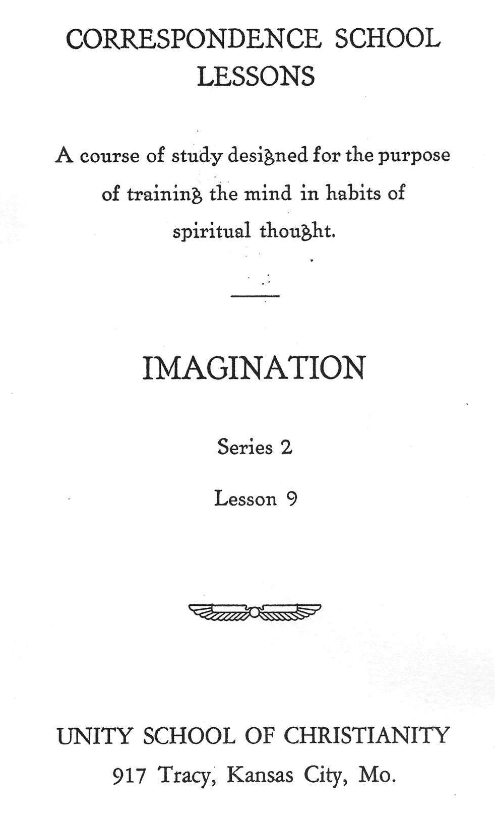
(Source: Unity Correspondence School Course Series 2 Lesson 9)
He Is Here
God is afar off, do you say?
I saw Him in the fields today
Painting the leaves of the maple and oak,
Sumac and woodbine with master stroke.
So deftly still in the autumn hush
The colors flowed from His magic brush;
Orange, crimson, golden green
On each passive bough were seen.
I saw Him in the clover bloom
And the pensive lance of the willow plume
Reflected in the loitering stream
As peaceful as a vagrant dream,
And I heard His step in the winds that pass
In drowsy waves through the meadow grass;
And the flaming disc in the autumn sky
Was the glory of Him passing by.
God is afar off, do you say?
I saw Him in the fields today.
–Jocile Webb Pearson, in Unity.
What is Imagination?
What is imagination? Show how imagination is the third step (day) in the creative process.
1. Every student of Truth should understand Spirit in all its expressions and be able to interpret the symbolism or parables of the Scriptures. Truth cannot be adequately conveyed by language, but the allegories written by those who have spiritual discernment can be understood by the student who takes the universal key of mind and applies it to these writings.
2. The 1st chapter of Genesis is an allegory; each day’s creation represents the expression in Divine Mind of a fundamental idea and its associated thoughts. Seers have discerned that the universe is a representation of a “grand man” with stars and planets as the cells of his body. Back of this is Mind, with its faculties. This Mind—Spirit—is the origin of everything, and it creates or expresses itself in orderly, sequential steps (“days”). These steps (“days”) are not evolutionary, but they are the involution of the mind in a thought process that afterward comes forth in evolution.
3. Involution as described in this chapter of Genesis is the enfolding or enwrapping of the divine idea, the enveloping or concealing of all the qualities of God, all the ideas of Divine Mind in its seed idea, the Word. Evolution is the unfolding or unrolling of a great scroll, reading what has been written there by the hand of the Almighty, and interpreting aright what the plan or will of God is for man and the universe. The first movement (“day”) of Mind is the expression of conscious intelligence, described in Genesis as “light.” “And God said, Let there be light: and there was light” (Genesis 1:3) Without intelligence there is no thinking; it is simply mind drifting. In everything that he thinks man’s mind should move in the same order as the events in the story of creation.
4. The second movement is faith (covered comprehensively in [the last lesson], Lesson 14, Faith). Faith is a substantial, abiding confidence in innate intuition for it is the power or faculty of perception.
5. The third movement is imagination. After our intelligence has grasped a subject, and our faith perceives or shows us that the subject is worthy of our consideration, then we turn our imagination upon it and try to see it from all sides, from different angles.
6. Imagination is primarily an idea in Divine Mind; a divine principle; one of the twelve powers of man, thus one of the twelve faculties of man’s mind.
7. Imagination is the mental picture-forming faculty described in Genesis as the bringing forth of the “dry land” which God called the earth. Imagination is the faculty that “beholds.” With this faculty we form first in mind and then in substance the shape of that of which we are thinking. Imagination is the faculty of mind which “lays hold of” spiritual ideas and translates them into material forms, or in other words, externalizes them. It also “beholds” material forms in their spiritual essence, or reality; that is, as ideas in mind. Imagination is the great symbol interpreter of the mind.
8. God answers our prayers in ideas, thoughts, words; these are translated into the outer realms, in time and condition (Christian Healing 78).
9. Prayer is the cumulative action of the soul. It accumulates ideas from the One Mind, the storehouse of ideas.
10. The ancient Greeks took advantage of the mental law of imagination and surrounded their prospective mothers with beautiful pictures and statuary believing that the unborn child received from the mother’s mind the impress of beauty that she beheld in these outer forms.
11. Jesus Christ demonstrated the law of imagination in a higher way because His imaging faculty was established in Truth. His mental pictures were based on the perfection of the ideas inhering in the One perfect Mind.
What Should We Imagine?
Where does one get the “pattern” that enables him to demonstrate perfection in body or affairs?
12. A clear understanding of the imagination, the imaging faculty, is necessary, because in order to demonstrate perfection in soul (mind), body, or affairs, we must go to the fount of wisdom, the Father-Mind, to receive the perfect idea of that which we desire to manifest. With a clear understanding of the working of mind, we then proceed to carry out the idea in thought, feeling, word, action, and reaction. The imaging must be clear, uninfluenced by negative impressions from the senses. Our vision must be based on Spirit, and we are to hold to it steadfastly in order to allow the spiritual idea to come into manifestation. By this we do not imply that all sense reactions are wrong, but to accept the edict of the senses as final is to accept a basis that is subject to change.
13. All things, including the mind, work from center to circumference. A knowledge of this fact puts man on his guard and causes him to direct that his imagination shall not create things in his mind that have been impressed upon him from without. This does not imply that the outer world is all error, or that all appearance is the creation of finite mind; it means that the outer is not a safe pattern (Christian Healing, 100).
14. In the building and the furnishing of the tabernacle Moses was commanded: “See that thou make them after their pattern, which hath been showed thee in the mount” (Exodus 25:40). “The mount” represents the high place of spiritual understanding, the realm of divine ideas, the kingdom of God within man. God as Divine Mind contains all ideas necessary to express His divinity perfectly in every thought, feeling, word, and action of man. We are the image of God and through Spirit within us we have as our foundation all divine ideas. The activity of these ideas produces the functioning of our soul, body, and affairs.
15. For us to understand our spiritual foundation it is necessary for us to focus our mind (conscious phase) and heart (subconscious phase), in “the mount” or high place in consciousness in order to find the source of our being. When we draw upon the spiritual realm, instead of the realm of appearances, for the patterns of thinking, we form in righteousness, in our faculty of imagination. Our formations are then true and abiding. All divine ideas are in this “mount” or “secret place of the Most High” (Psalms 91:1). We cannot get the vision of perfect ideas by looking without. Revelation must come to us from within.
16. We are the Idea of God, the Son Idea. This Idea must be expressed in the human consciousness, because we are destined to make manifest God’s image-likeness, Jesus Christ, in the flesh, here and now. The perfect body will be demonstrated through a “beholding” of the perfect, eternal, living, glorified Christ body. Now we are ready to externalize, or work out, this perfect body-idea into every cell of our physical organism.
17. It is the privilege of everyone to choose the kind of mental pictures he will form with his faculty of imagination. Therefore,
Whatsoever things are true, whatsoever things are honorable, whatsoever things are just, whatsoever things are pure, whatsoever things are lovely, whatsoever things are of good report; if there be any virtue, and if there be any praise, think on these things (Philippians 4:8).
18. If the blessing of plenty seems to be lacking, it is because mental images of lack have been allowed to form until they have become objective. You cannot change conditions by working in the external; you must go back to the mental images from which the conditions were produced. Put a new slide into your magic lantern and you will throw a new picture upon the canvas.
The Effect of Imagination
How often is the physical body renewed?
19. Every thought is generative and produces after its kind. Erroneous thoughts produce inharmonious conditions in the soul (mind), body, and affairs, and true thoughts produce good conditions in these three realms. The body is in a continual state of renewal. When the imagination is trained continually to behold the perfect pattern of the body-idea in “the mount” then we can say:
I am the ever-renewing, the ever-unfolding expression of infinite life, health, youth, and beauty.
20. The truth is that it is the human consciousness that needs renewing daily in order that it may be filled with ideas that will be imaged forth in beauty and wholeness. The consciousness is renewed by thinking such thoughts as these:
I charge my mental and physical atmosphere with life, health, strength, energy, vitality, and power.
21. Man’s body and his world are the result of what mankind individually and collectively thinks, believes, and accepts. A large part of humanity believes in old age and death, and as a result these beliefs are being worked out in the race day by day. When man changes the trend of his thoughts, sees life as abundant, beautiful, and eternally, he will outpicture such thoughts in his human experience.
What effect does spiritual treatment have on mental pictures of error?
22. Spiritual treatment erases inharmonious mental pictures from the imagination. The substance of our faith which was put into these untrue concepts must be withdrawn. We cease to feed them or nourish them by thinking, speaking, or listening to anything that pertains to them. We deny reality to the conditions such concepts produced. Thus, we are able to erase from the imagination the error thought-form, the wrong belief that we have been holding in our consciousness. The trained metaphysician lays hold of power through meditation and prayer to enable him to erase (deny) the wrong beliefs from his own consciousness. He affirms by constantly beholding the perfect Christ body and thus he himself attains spiritual understanding. Such spiritual understanding will enable him to quicken the consciousness of faith in the mind of the one in whom the erasure is to be made, when that one is open and receptive to the spiritual treatment being given.
23. When our mind accepts a new picture, we consciously or subconsciously let go of the wrong mental picture. The negative thought form, obedient to the law of mind action, will disappear. We mentally see ourselves as free from the negative condition and in divine order the condition itself is dissolved.
24. It is no longer a mystery how an individual’s appearance changes for the better–sometimes miraculously–when he changes the mental pictures he has been holding in his mind (thoughts and feelings). A new light then shines from the eyes; a new radiance glows in the countenance; and a “new creature” in Christ comes into manifestation.
Explain the importance of the imagination in the forming of character.
25. Man’s character is the total of all that has been built into his consciousness. Webster’s Dictionary gives the root meaning of the word character as “to engrave.” Thus, whatever is “engraved” upon the imagination by the law of mind will form the character as well as external conditions. “Ye therefore shall be perfect, as your heavenly Father is perfect” (Matthew 5:3). An understanding of mind and how it works reveals to us that to realize our perfect estate we must claim it in faith and steadily picture ourselves as the image of God becoming in actuality (outer form) the likeness of God. The man with understanding ideates himself as the image of God, God’s perfect idea of Himself in visibility. He sees himself as one with divine love. He beholds himself as having and exercising divine judgment and justice in all ways. With the faculty of imagination, he sees himself as God’s representative, one with unlimited power. He keeps his interest and attention on the orderliness of all that he touches. He images himself as Godlike so that he brings into expression the ideas, qualities, or attributes of God, thus knowing himself as a true son of God–perfect as God is perfect. By the right use of the faculty of imagination one may form a perfect character, a perfect body, a perfect world.
26. It is well for us to understand the law of mind action, for we meet its manifestations on every hand. The imagination, which is an integral part of this mind action, has often been belittled. Because imagination has not been understood, it has been described as belonging only to daydreams. Now it is known to be one of God’s gifts to man, one of the fundamental faculties in our makeup. We must learn to use the imagination righteously if we would reap a harvest of good in mind, body, and affairs.
Cleansing Our Imagination
How may anxious thoughts be overcome?
27. Anxiety and fear are caused by man’s false belief in a power opposed to God, the good omnipotent; by false sense perceptions of something considered unpleasant; by conclusions based on unwise judgment; by negative reactions. This means that man is letting his imagination run riot or remain undisciplined. Man has the ability to direct and to control his thinking and feeling through staying his mind on Truth. “Thou wilt keep him in perfect peace, whose mind is stayed on thee” (Isaiah 26:3) Man must use the I AM power, mastery, and dominion by centering his attention in the I AM or Christ consciousness. Having exercised that power, man’s mind will image or picture the good and be at peace. Each person should take possession of the “throne” and judge his twelve powers, symbolized by the twelve tribes of Israel. He is the judge of what shall be imaged by him and he should carry out his dominion in thinking, feeling, speaking, acting, and reacting.
28. Our thinking must be positive along the lines of what we want to be and to experience. An understanding of Divine Mind and its powers (ideas) will help us to remain faithful to our goal–conscious oneness with God and manifestation of our divine heritage. Our faith should be established in God, Absolute Good, thus eliminating all negative feelings, doubts, and beliefs. By having our vision (imagination) on the high and the true, the one Presence and Power, by becoming consciously established in the Spirit of Truth, our desire will be for the expression of Truth, thus only good will come forth in our life. Man is master of every situation when he is master of his thoughts, feelings, words, actions, and reactions.
Why is it unwise for one to give himself to excessive daydreaming?
29. All forms in the mental or soul realm are the result of concepts and do not of themselves have real power. Just daydreaming is not conducive to well-being. Individuals who indulge excessively in daydreams, and are “carried away” by beautiful visions, are often impractical. This is a misuse of the power of imagination, through lack of discipline of the faculty of imagination. By letting the mind run loose, control over it is weakened and for the time being it cannot be used effectively to bring forth good demonstrations.
30. Everyone has a purpose in life, whether he is aware of it or not, and it is only by a disciplined or trained mind that this purpose can be discovered and acted upon. One who is given to excessive daydreaming is not inclined to make purposeful use of his imagination, or formative power of thought. Such a one needs to develop a greater consciousness of faith in his ability to act and to achieve that which results in his well-being.
31. Man’s purpose is to make his vision (imaging) of Truth actual in the realm of manifestation. To bring forth an idea requires faith not only that the idea is possible of accomplishment, but that within us is the power and ability to bring it forth into manifestation. Then faith must be proved by our acting accordingly. Our faith should be so great that every conscious power and ability is set in full motion toward the fulfilling of the idea. Without faith and action, the idea remains only on the mental screen of the imagination. The practice of daydreaming carried to excess weakens one’s ability to concentrate and leaves the faculty of faith in idleness. Man is here to release and exercise all the powers of Divine Mind (Being) through which he attains dominion. He must keep ever before him this one thought: The foundation of everything is mind, and manifestation is effect. Forms are the manifestation of ideas. An important work of the imaging faculty is the formation of clear pictures of divine ideas in man’s imagination. This is accomplished through thinking right thoughts, assembling those thoughts in right relationship, until the divine ideas are firmly established in the consciousness as productive principles. All power is given to him who understands the imagination, or formative power of thought. He makes his understanding substantial with faith and feeling and is thereby master of ideas and of his own destiny.
Is there any power outside of man to harm him?
32. There is only one Presence and Power in the universe, God, the good omnipotent. This one Presence and Power is omnipresent Absolute Good, therefore there is no power outside of man to harm him. However, man has been given the freedom to think, feel, and form mental images as he chooses. If he is not in spiritual understanding and if he does not use his powers and abilities according to divine law, he may have dreams that frighten him and cause him to believe that there is a power outside of him that is working against him. But such thoughts, feelings, and mental images are not true. They have their origin in man’s limited understanding. Man has the power to choose the kind of thoughts and feelings that he desires. Therefore, he harms himself by giving power to pictures of imperfection. Every mental picture represents a thought, a concept, or a belief that is based upon man’s understanding (be it great or small) and his use of divine ideas. To interpret dreams correctly one must have clear understanding of divine ideas and their relation to the symbols in the dream.
33. Joseph of the Old Testament represents the faculty of imagination active down in Egypt, the subconscious. Joseph did not interpret dreams literally but showed that they are symbolical and represent certain ideas, thoughts, beliefs, concepts, at work in the consciousness either of the individual, the nation, or the race. Each person has the ability to get the meaning and truth of his own dreams. Identical dreams may have entirely different meanings for different persons. Only Spirit can reveal the import of the dream to the individual. When the imaging faculty is developed under divine law and is in harmony with Spirit, we shall get true pictures in our consciousness. Then we shall know how to interpret them for our safe direction and well-being.
Why should children be taught to be fearless?
34. The habit of frightening children and telling them that there is something outside of themselves to harm them is a negative way to train children and may be detrimental. Such training suggests mental images of fear, with the mental and physical results of fear. Fear has no rightful place in the human consciousness. Of all the false concepts, harmful emotions, nothing has been so injurious as fear. These concepts held in the imagination are sometimes impressed so forcibly upon the child that he has them to deal with when he becomes an adult, long after they were introduced into his consciousness. A mind possessed by fear conjures up false mental pictures that temporarily render the mental faculties ineffectual in their functioning.
Beholding the Perfect Pattern
What relation does “beholding” bear to the work of transforming man?
35. We are transformed and transfigured by “beholding.” Whatever we persistently “behold” (Imagine) that we manifest. Only as man’s character is transmuted by the attuning of his thoughts, feelings, acts, and reactions to Truth can he be said to be “transformed.” We build conditions in human experience by “beholding” whether it has to do with outer conditions or with spiritual consciousness.
36. We all, with unveiled face beholding as in a mirror the glory of the Lord, are transformed into the same image from glory to glory, even as from the Lord the Spirit (2 Corinthians 3:18).
37. Some translators of the text use the words “from character to character” instead of “from glory to glory.”
38. The perfect pattern for us is Jesus Christ, the perfect man, originating in each one as the seed idea of perfect man. The expression of this perfect idea in the character of the individual transfigures the body of flesh into the exalted, glorified Christ booty. Jesus represents the correct use of the Christ principle bringing forth into manifestation the Christ idea in man. “Look unto me, and be ye saved, all the ends of the earth” (Isaiah 45:22). Such Bible expressions have a deep spiritual meaning when studied in this connection. “Christ ... shall appear a second time ... to them that wait for him, unto salvation” (Hebrews 9:28). Christ shall appear to them that look for Him. Those who look for and find the indwelling Christ of God and steadfastly “behold” His perfection and glory shall be transmuted, transformed, and transfigured into His likeness.
39. Jesus lived so close to the Father within that He constantly “beheld” God individuated in Himself and “he was transfigured before them; and his face did shine as the sun, and his garments became white as the light” (Matthew 17:2). As we live day by day with His image ever before us, desiring with all our mind and heart to express Jesus’ character and nature in all that we think, feel, say, and do, a great change comes over us—we are transformed.
40. There is a pattern in heaven that he who chooses may behold, and in the beholding may set his own house in order (attributed to Plato).
41. We know that the “pattern in heaven” or in the realm of divine ideas that we are to behold is the Christ, the I AM, the divine ideal which is God’s Idea of Himself made manifest as man. Also, we need to remember that every good manifestation has a divine idea “in heaven” that has made possible the visible thing or condition.
42. It is interesting to observe that the quotation states “he who chooses may behold, and in the beholding may set his own house in order.” When we “behold” that which is good and true, it is then our choice as to whether we shall begin to set our own consciousness (“house”) in order that it may be based only on Truth. Denial and affirmation play a vital part in setting the mind in order so that the imagination may have a receptive consciousness upon which to impress the mental pictures of God’s good. By beholding the pattern of innate perfection, we transform our lives for that which is pictured or imaged consistently in the imagination becomes manifest in our body and affairs. One Truth teacher expressed this same thing in these words, “Whatever we put our attention on we force to come into our life.”
43. If we constantly see (behold) ourselves as essentially good, we will manifest goodness. When we consistently see ourselves as happy, comfortably situated, with many friends, loved and being loved, we must inevitably bring such conditions into our experience. If we see the opposite, just as certainly will we manifest undesirable conditions. We form and build the conditions, circumstances, and situations in our own world, just as we form and build our consciousness of spiritual values. When we hold in our mind (in our imagination) the picture of Truth, divine order, perfection, and sustain such a mental picture with our thinking and feeling, then we may be sure that Truth, divine order, and perfection will be made manifest in our life and surroundings.
44. We must “behold” or take hold of with our faculty of imagination that which we would be or do. We must not only take hold of it, look it over, but we must hold to the idea firmly and constantly. We need to “behold” the pattern (idea) first with our conscious phase of mind (thinking) and allow it to be accepted by the subconscious phase (feeling nature) so that it may bring forth the likeness in body and affairs. In this way the mind is renewed—”Be ye transformed by the renewing of your mind” (Romans 12:2).
45. Perhaps the following words, by a religionist of the nineteenth century, give some idea of the value of our faculty of imagination,
"The soul without imagination is what an observatory would be without a telescope."
This lesson was transcribed on April 20, 2021 by Coy Brock.
Annotations for Imagination
Here are the Annotations for Series 2, Lesson 9, Imagination. These questions and answers were used to “grade” papers and so they represent the “correct answers.” We’ve included them in this course guide to provide a second look at what the Fillmores wanted their students and ministers to know.
Steps In the Thinking Process
1. What steps are taken in the process of thinking?
The steps that are taken in the process of thinking are similar to and correspond to the "steps" (movements) taken by God in the process of creation, as recorded in the first chapter of Genesis, when Divine Mind ideated the universe, including man.
All the ideas about which man can think inhere in Divine Mind, and man has access to these ideas. God, in His love and wisdom, has also given to man the faculty with which to think — his intellect.
We have learned that all life is movement toward consciousness. The first step in thinking is the conscious use of intelligence. No thinking can be done without self-consciousness exercising to a degree the thinking faculty in intelligent movement of mind (cerebration) upon ideas.
"Let there be light" (Gen. 1:3). Light represents intelligence. When an individual thinks, light or intelligence "shines" in the mind. An idea enters the consciousness through inspiration, and the individual begins to think about the idea. It becomes a nucleus (seed) around which a state of mind or consciousness is built, and a productive principle is thus expressed.
The second step in the process of thinking is faith, or the development of faith, represented by the "firmament." "Let there be a firmament" (Gen. 1:6). Because faith is the perceiving power, we must have faith in God (perceive that He is the source of all good) and in the idea we are contemplating, as a starting point. There must be the recognized possibility in the idea, and faith in its being worked out; that is, expressed and made manifest. Faith establishes a "firm" starting point or foundation in consciousness.
The third step in the process of thinking is the action of the imagination, imaging or picturing the idea as it will appear when expressed and made manifest. The imagination is the picture-forming power or faculty of the mind. It forms the vision of the idea, changing it from the unformed into the form or shape, in thought.
"And God said, Let the waters under the heavens be gathered together unto one place, and let the dry land appear: and it was so" (Gen. 1:9).
"Waters" here represent unexpressed capacities, the unestablished elements of the mind out of which all is produced.
The formative power of mind is the imagination, whose work is here represented by the dry land (Mysteries of Genesis 18).
Faith and imagination divide the certainty from the undesired instability and thus prepare the mind for a decision to be made.
The fourth step in the process of thinking is the action of choice based on understanding, will, and the perceptive faculties.
"The fourth step in creation is the development of the 'two great lights,' the will and the understanding, or the sun (the spiritual I AM) and the moon (the intellect). These are but reflectors of the true light; for God had said, 'Let there be light: and there was light' — before the sun and the moon were created. ...
The ‘stars’ represent man’s perceptive faculties including his ability to perceive weight, size, color, sound, and the like (Mysteries of Genesis 19, 20).
The fifth step in the process of thinking is the action or movement of the faculties of discrimination, discernment, and judgment. We must judge the contemplated idea in its right relation to other ideas. We need to clothe the idea with the right kind of "thought stuff" — thoughts that correspond in nature and character. This movement of thought upon the idea results in an agreement between mind and heart necessary to bring it into form.
The sixth step in the process of thinking is the intelligent action of life and substance. They enliven ideas and bring them forth "after their kind" (Gen. 1:11). In other words, in this "step" ideas are fulfilling the purpose for which they were created.
The seventh step in the process of thinking is the realization that the law has been fulfilled. It is "resting" in the assurance that the thought process has been completed in logical, sequential steps, thus, in divine order. The seventh step in thinking appears to be of less activity than the first six, but there is no evidence to prove that the mental process is any less active during the seventh step than in the preceding six steps.
Making use of these "steps" in the process of thinking, assures man that his thinking will be on a high level. Following this pattern of thought, the expression and manifestation of ideas will be complete and satisfying.
Defining Imagination
2. What Is Imagination?
In Divine Mind, imagination is the idea of conceptual imagery. In man, the imagination is the thought-forming ability within the human consciousness, the human mind. The imagination is the power to give form to specific thoughts out of the universal, unformed substance or Mind essence.
The imagination has been said to be "the scissors of the mind" (The Game of Life and How To Play It, page 2) — the scissors that cut the shape for anything. When the use of imagination is based on Truth it enables the individual to form a clear-cut concept based on a divine idea. The imagination is responsible for the outpicturing of ideas in accord with the character of man's thoughts in his attempt to interpret divine ideas.
The imagination is the faculty of mind that is capable of giving form to ideas that will come forth as things. However, the imagination has to be linked with faith in order for the ideas to be translated into tangible, visible things, usable in the world of form. Man's mind must be attuned to Divine Mind for an influx of creative ideas to find expression in him and made manifest in his outer world. Charles Fillmore has said, "Faith is the perceiving power of the mind linked with a power to shape substance" (Charles Fillmore Prosperity 43). That power is imagination.
When one has recognized that an idea is worthy of further attention, the faculty of imagination begins the work of producing or forming. Turning the idea over and over, as one does in meditation, reflection, using the thinking process, the imaging ability in man makes pictures in mind of how the idea can be worked out into manifestation. One "sees" with the mind's eye the shape of that about which one is thinking. The faculty of imagination then produces that shape in substance. Thus, the imagination is the bridge between the spiritual and the material realms. But the imagination has another function — it also translates material forms back into their spiritual essence (ideas) so that they may be re-formed according to a perfect pattern.
3. Give original illustrations of the power of the imaging faculty.
Here are some stories of the efficient use of the imaging faculty.
A woman needed a new place in which to live. She began giving thanks for the perfect place already prepared for her, and she felt secure about the place being provided. After a church service she was led to speak a friendly word to a stranger who introduced her to a friend, also a Truth student, who wanted someone to live with her. The woman who needed a new place to live was thus guided to her new home, a household of peace, beauty, and quietness.
The story is told of Luther Burbank, the horticulturist, taking home a prickly, thorny cactus and transplanting it in a "garden of love." Daily he blessed the cactus, telling it it had no need of spines and thorns for protection as it was now in a "garden of love." The spines fell away one by one, and a lovely plant remained.
This story appealed to a woman who had a cantankerous woman friend. Mentally the first woman, a Truth student, placed her cantankerous friend daily in a "garden of love" in her heart, and daily she blessed her. The attitude of both women changed, and a great change came into the life of the woman who had had the "barbed" tongue. She became happy and people noticed the change in her. The Truth student kept the secret of her constructive use of the imaging faculty, the imagination.
A woman often lay awake at night worrying about her son who traveled. She recalled the story of the baby Moses being placed in an ark of bulrushes and left in the hands of God. She decided to do the same thing in prayer with her son. In her thought she safely surrounded her son with love, wisdom, and protection, forming a mental "picture" of his being guarded and brooded over by the Presence of God, She placed her son in his "ark" every night, and she slept serenely.
A young man's mother was experiencing a mental breakdown. He was inspired with the idea of imaging her as she had been when he was a half-grown boy. When he prayed for his mother, he saw her in his mind's eye as relaxed and smiling, her brow smooth, and her body free from tension. She became receptive to God's healing power, and in a few months' time she was relaxed, happy, and healthy.
A man desired very much to go to Europe for advanced study. He prayed, "The Spirit of the Lord goes before me and prepares the way for my coming." He had, however, no definite conviction about making the trip. During a period of meditation and prayer he "saw" himself sitting on the deck of a ship. Then he felt assured that his plans were working out in divine order. The trip, the period of study, and vacation were manifested and were completely satisfying and rewarding.
Imagination and Images
4. What is the first thing necessary in demonstrating perfection in body or affairs?
The first thing necessary in demonstrating perfection — be it a perfect mind, body, work, vacation, home, or whatever one may desire of perfection — is to form a picture or mental image of perfection in mind. Then one must hold (sustain) that image in mind, constantly giving thanks that it is being brought forth in divine order. One must perceive the possibility of the idea as an actuality in one's experience. Then through desire to experience the fulfillment of that idea, one must give it substance through faith in it, thus, forming it in the faculty of imagination. Thoughts and feelings must accept the idea as a reality even before there is evidence of its being demonstrated or made an actuality in visible form.
We must remember that in demonstrating perfection the perfect mental image or picture of perfection is essential. This image or picture is conceived in mind and "born" in the illumined human consciousness. Since perfection is our heritage and our destiny through our Christ nature, we must think, work, act, and live as though that perfection were manifest here and now. Otherwise, we will put off demonstrating it indefinitely.
5. Where does man get the ideal images?
Man gets the ideal images from the one Source of all perfect mental images, ideals, and ideas: the one perfect Mind, Divine Mind, dwelling in man as the Christ Mind. However, he sometimes blurs the ideal images with a "double exposure" of the photographic substance of his limited consciousness. He sometimes misinterprets an idea, thereby producing an imperfect mental image. The consequent result is the outpicturing of both good and evil in mind, body, and affairs.
The imagination is like a two-edged sword that is held in the hand. So long as man grasps it by the handle and securely controls it, it will do him no harm, but if he loses control the consequences are disastrous to himself and others. The right interpretation of ideals, and the control of the use of imagination bring forth right conditions in mind, body, and affairs.
The imagination is a very powerful faculty, and we must learn to discipline it if we would make it practical in serving our highest good. By following the inspiration of the supermind or Jehovah consciousness we can control the imagination and direct its work to practical ends (Mysteries of Genesis 296).
Imagination and the Body
6. How are diseases harbored indefinitely in the body?
Diseases are harbored indefinitely in the body because the image of health and perfection is not established in the consciousness of man by the action of the imagination. The imagination must impress the subconscious phase of mind with the image of health and perfection in order that man may manifest these qualities.
Man's mind is ever active. Thoughts are generative. The product of our settled beliefs is either health or disease according to whether these beliefs are in line with Truth or out of line with it. Continuous thinking along one line or another forms currents of thought that act as constructive or destructive agencies in the organism. When we consciously connect our thinking with a disease atmosphere that has been generated, we are susceptible to its effects. Fear in us increases the generation of any particular disease on which we concentrate. Fear causes a deep impression on our subconscious. Until the error belief is removed, the conscious and subconscious phases of mind react to the disease, keeping it active in us. Any thinking that is adverse to Truth is forming patterns in the imagination and thus held in the subconscious. These will later manifest as inharmony in body and environment.
7. How often is the physical body renewed?
There is no definite knowledge as to how often the physical body is completely renewed. Scientists, doctors, and physiologists are in disagreement about the length of time, some saying a year, some saying, three months, others saying other lengths of time. By the process of metabolism, renewal is constant and continuous. But, if the imagination holds the same old pictures, the idea of being "made new" is not accepted. The truth is that the mind, the consciousness, needs renewing daily. When the mind is filled with right ideas, the imaging will result in renewal of the body. When we make the right application of this understanding, we will never grow weak or sick or decrepit.
I am the ever-renewing, ever-unfolding expression of infinite life
is an affirmation that answers this question. The physical body is constantly being renewed in a process that is unending, because every cell is filled with the continuing sense of life. Consciousness is the constantly renewing pattern of all that one has thought and experienced, and it is never static. There is no "time" in Spirit, and the flow of life, substance, and intelligence momently refreshes and revitalizes mind and body. Just as unneeded thoughts must be replaced by new ideas, so must old cells in the body be replaced by new cells composed of light, life, and substance. Man is given all power through the Word so that he may use his faculty of imagination in order to accomplish the work of restoration.
8. Why do scars and deformities often remain if the body is being continually made new?
Scars and deformities often remain, even though the body is continually made new, because the memory of the experience which caused the scar is still embedded in the subconscious phase of mind. The individual may change the false mental picture to that of perfection through the right use of the imagination.
It is the subconscious phase of mind that builds and sustains the physical body. When the subconscious is given the right ideas, thoughts, and words by the conscious phase of mind then through feeling, the right pictures are impressed upon the imagination. Scars and deformities will no longer appear in the body for there will be no negative pictures (mental patterns) to sustain them. "Ye therefore shall be perfect, as your heavenly Father is perfect" (Matt. 5:48)
Cleansing the Imagination
9. What effect does spiritual treatment have on pictures of error?
Spiritual treatment erases pictures of error from both the conscious and the subconscious phases of mind, i.e. thinking and feeling. With the mental causes removed the error conditions of body and affairs are changed.
The subconscious phase of mind, which neither sleeps nor rests, is the center from which all functions, activities, control, and operations of the body are carried on. The subconscious is subject to the conscious phase of mind, especially to the action of the will. It is vital that an individual learn to discipline his will faculty so that he may control the faculty of imagination.
Denial withdraws the substance of faith from the error thought form. In its place is put a new thought form which by faith is filled with divine substance. In order to erase erroneous pictures, one must have sufficient spiritual understanding to know the impermanency of them and have knowledge of the right way to replace them.
Spiritual treatment is primarily for the purpose of making man conscious of himself as a son of God. This necessitates changing the thinking, feeling, speaking, doing, so that man may act and react only from the standpoint of his true nature. The consciousness of Truth eliminates all error that has been held in the mind. Manifestations of error also disappear when man rediscovers who he truly is: a son of God; where he is: in heaven here and now; where he is going: back in consciousness to the Father to be the divine likeness in actual physical manifestation.
10. Explain an individual's improvement in appearance through the changing of his mental pictures.
When through the use of imagination an individual changes his mental pictures his appearance changes. The processes of release and renewal, or denial and affirmation, play a vital part in this transformation.
By a correct understanding of mind, its laws and methods of operation, we see that all adverse conditions are caused and sustained by our mental states. When the mental state is true, it overrules and dissipates any opposite state. When the individual concentrates in using the imaginative faculty to see the Truth he accepts a new picture of himself as a radiant, beautiful, healthy, harmonious son of God. Thus, the perfect picture replaces the imperfect, and a change in appearance is sure to result.
As we set the law of mind into motion by agreement between thinking and feeling we give the mental image substance and power to bring forth after its kind. And the law never fails.
Imagination and Overcoming
11. Explain the importance of the imagination in the forming of character.
The imagination is a most important character-forming attribute or faculty of the mind. Under the control and direction of the I AM, the imagination is capable of forming perfect character; capable of giving perfect expression to the ideas of God for which man is the channel; capable of bringing into manifestation the visible good that those ideas embody.
The word character comes from a Greek word meaning "to engrave." What our imagination "engraves" in the soul will form our character. Webster's Dictionary says of character
A sign or token placed upon an object as an indication of some special fact, as ownership or origin; a mark, brand, or stamp. ... The aggregate of distinctive qualities belonging to an individual or a race; the stamp of individuality impressed by nature, education, or habit.
Character is that which an individual really is, while reputation is what people think he is.
To form good character we must have before us the image of perfection, the Christ, God's idea of Himself. We must claim this idea of perfection for ourselves and accept it, for it is the real of us. This can only be done as the Truth of perfection is allowed to become a picture in our imaging faculty. God gives us the perfect pattern that was "showed thee in the mount" (Heb. 8:5). We are in manifestation what our imagination tells us we are. If it tells us we are weak, fearful, inefficient that is what we will manifest. If the Truth has been accepted by our soul, then the imagination will tell us we are strong, courageous, efficient, and successful. We cannot rise any higher than the mental picture we are holding in our imagination.
In Truth we are of the same character or nature as God, Absolute Good. This is the "stamp" that God has placed on man as His image, but the forming of character is an individual matter. Man "forms" what he images. The type of man that he images and sustains in his consciousness, he will manifest.
12. How may anxious thoughts be overcome?
Anxious thoughts may be overcome by keeping the mind stayed on God and His Truth; by imaging the right kind of thought pictures with the faculty of imagination.
Anxious thoughts, in fact, worries of all kinds, are caused by our permitting pictures of error to impress themselves on the imagination. We know that we have been given dominion over our thoughts and feelings, but we have failed to exercise this dominion. Many times we allow our imagination to run riot, and it brings to us many fearful things which were at first only pictures in the mind (consciousness) and need not have manifested in body or affairs. Our work in Truth is to cast out by denial the false beliefs that caused the error pictures before they become established in the subconscious phase of mind as a working pattern. Once established, a more rigorous program of denials and affirmations may be necessary.
We overcome anxious thoughts and their results by having faith in God, the good omnipotent, and knowing that that good is the only Presence and the only Power in our life. When we sense something considered unpleasant, we need to declare the Truth and see the good back of the situation or circumstance. We draw right conclusions about the trouble by using wisdom and good judgment in our thinking, speaking, and acting. We use our imagination constructively and sustain only positive reactions in our thoughts and feelings. We face the negative condition or situation with Truth. We do not deny the fact of its existence, but we do deny its reality. Through prayer we seek God's guidance in handling it. We no longer see it as something too difficult for us to solve but as an opportunity to call forth our spiritual resources.
It matters not if the problem is one of ill-health (in ourselves or others), lack in finances, inharmony in human relations, or failure in some undertaking. Through prayer we impress the imagination with health, plenty, harmony, success, and the outer condition changes in an orderly way. The Psalmist sings, "My soul, wait thou in silence for God only; For my expectation is from him" (Psalms 62:5). Jesus Christ lovingly admonishes us, "Be not therefore anxious" (Matt. 6:31).
Practical Concerns
13. What explanation is there for the appearances of ghosts?
The term "ghosts" is a name that is applied to error thought forms, phantoms of an unenlightened mind, resulting from distorted and misguided imagination. The meaning of the word ghost shows us the thing that it is intended to designate — an indefinite, unstable, foggy specter floating about in the realm of man's mentality.
Beliefs in ghosts are illustrations of the unreliability of an uncontrolled imagination. When the imagination becomes active, it forms mental images that correspond to negative thoughts. These mental images become mind projections, sometimes appearing as ghosts. Ghosts are very real to some persons, and they are actually seen; or the imagination of the persons tells them that they are seen, but they have no reality or power and can be denied away with a word of Truth.
14. Why is it unwise for one to give himself up to excessive daydreaming?
It is unwise for one to give himself up to excessive daydreaming (uncontrolled use of the imagination) because the mental habits that one forms through excessive daydreaming are not conducive to good concentration. Excessive daydreaming prevents constructive thinking.
A daydream is a "reverie filled with pleasing, often illusory, visions or anticipations" (Webster's Dictionary). There are daydreams that are but a purposeless rambling of the imagination; hollow, meaningless shells without substance. They are not usually founded on a specific idea or plan, on any desire to accomplish something through effort of the dreamer, or through necessity for some particular thing.
Indulging excessively in daydreams and letting the mind wander become a habit which, if persisted in, brings undesirable consequences, because the imagination is not being used in constructive and creative channels. Mind is ever active, but man must direct its activity. Through the imagination one can project an image of an object without, or of ideas within. An idea has to be repeated and used many times before it is thoroughly established in the subconscious phase of mind where it becomes a reproductive pattern.
To indulge excessively in daydreams is often pleasant, but more often profitless. In this practice man's thought forces are frequently scattered and the focus of his attention and interest wanders to such an extent that he later finds it hard to think logically, creatively, and profitably along useful and purposeful lines of thought.
Instead of giving himself up to excessive daydreaming, one should use the formative power of thought, especially the imagination, to form clear mental pictures of divine ideas. Then, knowing that he is the all-wise, all-loving, all-conquering son of God, man should use his faith, understanding, will, and imagination to help himself to act and to achieve.
15. Is there any power outside of man to harm him?
There is but one Presence and one Power in the universe, God, the good omnipotent.
Therefore, there is no power outside of man to harm him. However, he harms himself by giving power to the imperfect pictures that the imagination projects in the mental or psychical realm.
Man has freedom of choice and may choose either the divine ideas or the human concepts upon which to think. If he does not use his God-given power of dominion and allows idle or vagrant thoughts to register in his mind, he has to deal with them. While nothing outside of man can harm him, he can allow himself to become receptive to outside influences and circumstances. It is man's thoughts and feelings that he must watch and govern, for they bring about the conditions of his life. His reactions and attitudes toward those conditions formulate and shape the conditions of the future. Jesus Christ assures us in Luke 10:19:
Behold, I have given you authority to tread upon serpents and scorpions, and over all the power of the enemy: and nothing shall in any wise hurt you.
Man is not intended, however, to attempt deliberately to test these promises in order to prove his immunity and spiritual power. "Thou shalt not tempt the Lord thy God" (Matt. 4:7 A.V.). Man is intended to exercise wisdom and good judgment in all the conditions and circumstances of his life and affairs. He must know that God is indeed within him and with him, and that through the indwelling Spirit — I AM, the Christ — he has all authority.
Man's awareness of the presence of God assures him of instant and constant protection at all times. The following statement from Emilie Cady Lessons in Truth 55, held in mind will help free man from the belief that there is any power outside of himself to harm him:
I am Spirit, perfect, holy, harmonious. Nothing can hurt me or make me sick or afraid, for Spirit is God, and God cannot be sick or hurt or afraid. I manifest my real self through this body now.
Imagination and Dreams
16. What is the cause of "bad dreams"?
The cause of "bad dreams" could be said to be confusion and a sense of insecurity in the consciousness.
Apparently "dreams" have played a vital part in the spiritual unfoldment of many persons. If the key to them is understood, and the message they convey is obeyed, then dreams become part of a person's soul development. Charles Fillmore makes this statement in Mysteries of Genesis 139:
The teacher is the Holy Spirit, and all get their lessons in their own way, some through inspiration, some through dreams, some through visions, some through flashes of understanding. Spirit uses the avenue most accessible and open to the student.
When the conscious phase of one's mind is inactive, as during sleep, the subconscious phase (always at work with the pictures or images man has stored therein) finds opportunity to slip into the "projector" the images or mental pictures previously turned over to it by the conscious phase and flash them upon the mind's screen. If the picture is of inharmony or imperfection, and not properly interpreted, the person may be so startled that he cannot get the meaning and, thus, he experiences what he terms "bad" dreams or nightmares during sleep.
Through studying the subconscious phase of mind one can more clearly see how dreams reveal the state of mind of the dreamer. Whatever is imaged in consciousness sooner or later comes to the surface, expressing all the characteristics of the image. When the conscious phase of mind is inactive, the subconscious phase reflects or brings to the surface those images. Since dreams are caused by mental pictures coming to the surface, it behooves man to feed the "soil" of the subconscious with Truth ideas, thoughts, and feelings. Only then can true pictures be formed by the faculty of imagination and become established mental patterns in the subconscious.
We now see how important it is that the subconscious be cleansed, so that the ineffective and undesirable pictures may be done away with. Only then will good be available for projection. The imagination will begin to form happier, better pictures for filing in memory's storehouse — the subconscious phase of mind. Thus, there will be no more experience of "bad dreams."
17. Which of the sons of Jacob represents the imagination?
In the symbology of the Scriptures, Joseph, the favorite son of Jacob, represents the imagination. Interpreting the narrative of Jacob and his sons metaphysically, we see an account of the unfoldment of the natural man before the soul is wholly illumined by spiritual understanding. In this account, most of the physical and mental faculties are developed (ten sons) before the imagination (Joseph) is brought into expression.
Joseph had dreams and visions and was able to tell what they stood for, but the other faculties, his brothers, were skeptical, doubtful. So our several faculties sometimes object when our imagination declares the possibility of betterment in our condition. They cast doubt on the feasibility of letting faith go to work with the image of good that can assure our greater happiness, health, and success.
Joseph represents the imagination, because he had sufficient imagination to become an interpreter of dreams. He understood that the picture symbols appearing in dreams represent certain ideas, beliefs, thoughts, or concepts at work in the consciousness of an individual, a nation, or a race. He understood dream symbology as being something personal and pertinent to the dreamer.
Among the primal faculties of mind Joseph represents imagination. This faculty has the power to throw onto the screen of visibility in substance and life forms every idea that the mind may conceive (Metaphysical Bible Dictionary, Joseph).
When the imaging faculty is developed under divine law, we will get true mental pictures, whether in dreams or during our waking hours. Through spiritual understanding we will learn how to interpret such mental pictures so that the results will be only good.
18. How should all dreams be interpreted?
All dreams should be interpreted according to the ideas they seek to present and according to the consciousness of the dreamer. Identical dreams do not usually mean identical things to different dreamers. It is virtually impossible to give a symbology that will prove true for all people, because all people do not picture ideas in the same manner. There is, however, a similarity in the thinking processes of all persons. This often leads to similar dreams but different interpretations.
One way a person can learn to understand and interpret his own dreams is if he will immediately upon awakening ask the indwelling Father for the meaning. If it is essential to know or have an interpretation, spiritual contemplation in quietness and in confidence will always bring the needed answer. An individual seeking in this way will be given whatever guidance is necessary to take any outer steps to regulate his life and affairs.
When a person has developed the Joseph state of consciousness and can give vivid form to his ideas by using his imaginative faculty, he does not take his dreams or visions in a literal sense, He rather unclothes the dream of its form by using the same power that he has of clothing ideas with form. Then he clearly sees the idea hidden behind the forms and symbols of his dream (Mysteries of Genesis 317).
Imagination and Fear
19. Why should children be taught to be fearless?
Children should be taught to be fearless because fear has an unnerving effect and temporarily renders ineffective the use of the mental faculties. If children are taught to be fearless they will not form mental images of anything that will harm them or that will produce the emotion of fear in their thoughts and feelings.
Every man ever aspires to freedom of spirit, soul, and body, and whatever produces a sense of fear is a limiting, binding, constricting force.
There is but one Presence and one Power in the universe, God, the good omnipotent.
Therefore, not only children but adults also should always be free of fear for as children of God we are constantly going to meet our good. Fear shackles, hobbles, inhibits us, and holds us back from accepting our good. Fear has no rightful place in the human consciousness for it feeds the imagination with that which is not true. Of all the false imaging and harmful thinking that have been carried on in the mind, nothing has done as great harm as fear. The individual full of fear becomes a pitiable creature. Children trained in fear live unfulfilled lives until they are able to release themselves from it. "There is no fear in love: but perfect love casteth out fear" (I John 4:18).
The readily receptive and plastic consciousness of a child takes impressions quickly. These can remain in the consciousness all his life, producing results "after their kind" (Gen. 1:21). However, either good or bad impressions can be altered or replaced, but the longer they remain the deeper they cut their groove in the mind, with resultant stronger reproduction as time goes on. Fear held in the imagination often makes us lose the good we might have, because we fear to venture toward good undertakings.
In childhood the faculty of imagination is very active, but the faculty of judgment is not usually as well developed. The childish mind seizes, on whatever is offered it and knows not what to reject. We should be very careful what we tell children, or allow others to tell them, that might cause fearful images to become impressed on the subconscious. These fearful images can affect the whole life of the child until they are understood and their power denied.
It is, therefore, highly desirable and important that a child be taught Truth so that he may grow happily, freely, conscious of the wonders of his spirit, mind, body, and surrounding world.
For God hath not given us the spirit of fear; but of power, and of love, and of a sound mind (II Tim. 1:7 A.V.).
20. What relation does "beholding" bear to the work of transforming man?
To behold means "to look upon or at; to view; to see; to hold; to observe." To transform means "to give a different form to; to change; to change the form of; to transmute." The relation between "beholding" and "transformation" is that of cause and effect.
Beholding is a basic requisite In the work of transforming man. Beholding from a metaphysical standpoint means to keep in sight the transforming power in man, because we become in experience and manifestation like that which we behold in our thinking; like that picture we hold in our consciousness through the use of the imagination. Beholding precedes the working of the imagination. It is what we look at, behold, that becomes the pattern from which the imagination will work.
A marvelous transformation takes place in the mind, body, and affairs of man as a result of his "beholding" in the imagination the pictures of ideal conditions, in mind, body, and affairs.
Beloved, now are we children of God, and it is not yet made manifest what we shall be. We know that, if he shall be manifested, we shall be like him; for we shall see him even as he is. And every one that hath this hope set on him purifieth himself, even as he is pure (I John 3:2,3).
Recommended Reading
Christian Healing, Imagination, Charles Fillmore.
Geneviève Behrend, Your Invisible Power, 1921.
Downloads
© 2025. TruthUnity Ministries. All rights reserved.
 The Fillmore Wings Study Program is a study program based on the Correspondence School Lessons published by Unity School of Christianity from 1912 to the mid-1970s. This program is licensed under a Creative Commons Attribution-NonCommercial-NoDerivatives 4.0 International (CC BY-NC-ND 4.0) License, except where otherwise noted. You are free to download the work and share it with others as long as you follow the license terms: https://creativecommons.org/licenses/by-nc-nd/4.0/legalcode
Contact TruthUnity Ministries for permission to adapt and/or republish.
