


Five Ways Ministry Will Transform the Social Order
Return to the Fillmore Institute landing page.
Hi Friends —
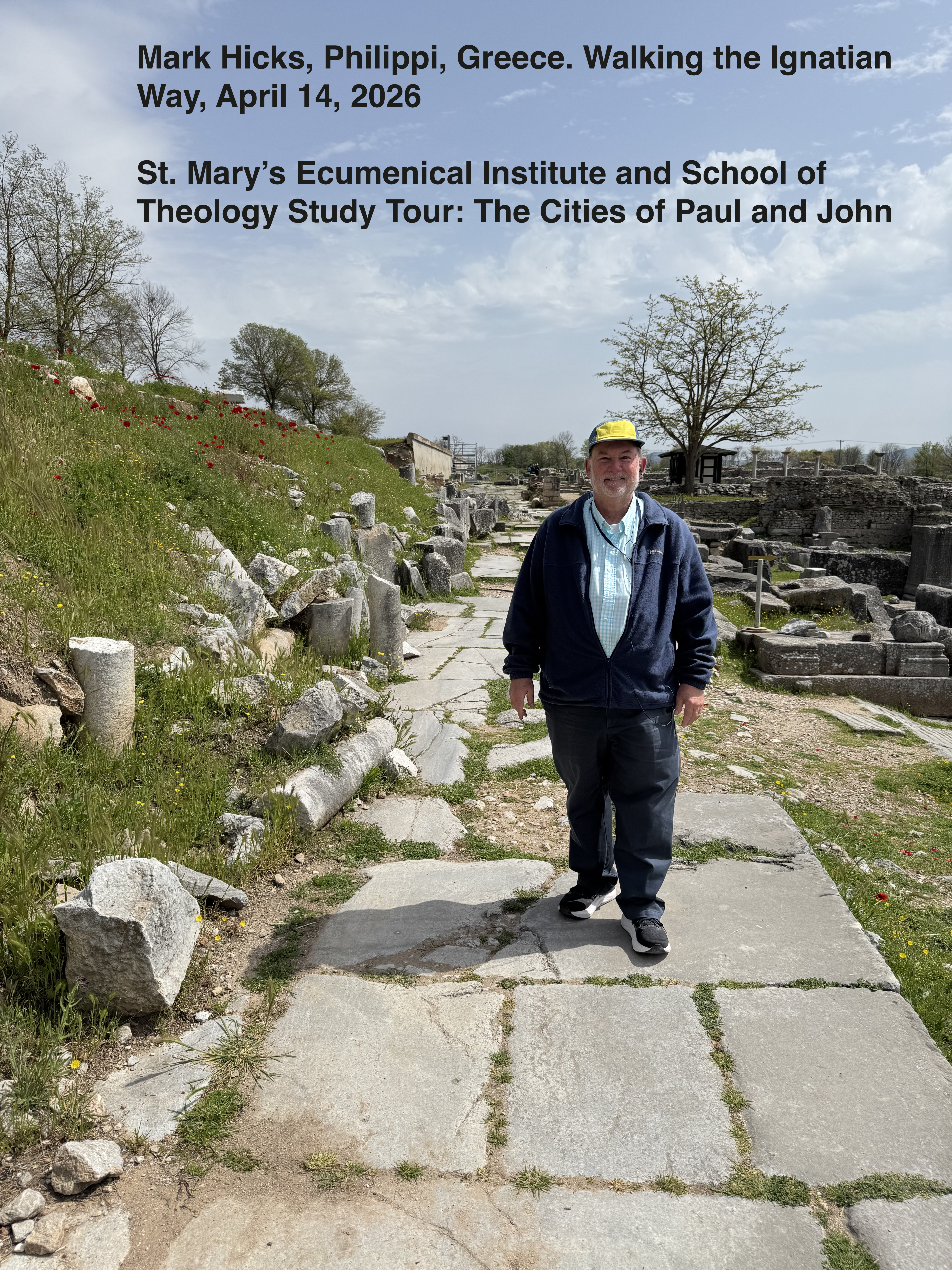
That's me in the picture, walking east to west in Philippi, northern Greece, on the Via Egnatia, the Roman road used by the Apostle Paul just before he got run out town for disrupting pagan norms in the Roman empire. I was on a tour of Turkey and Greece (and a day in Pompeii, Italy), with faculty, students, and friends of a well-known seminary in Baltimore. Our tour was exhausting: 35 people, 14 days, 20 visited sites, seven airline flights, and ten hotel stays. We were an older crowd, many active and retired clergy, a few older students, and six Catholic seminarians who, compared to most of us, were like puppies.
To receive academic credit, I had to write a paper, which follows, and is attached as a PDF. The title and theme of my paper is Paul’s Disruption of the Pagan Marketplace. The consensus of most historians and theologians today is that Paul and Christianity overcame the Roman Empire and Roman Imperial Religion. A few very liberal scholars, but a significant number, conclude that the same is happening today, only that the empire is our government and the imperial religion is traditional Christianity. I challenge that consensus.
John Dominic Crossan opens his wonderfully written In Search of Paul portraying St Paul walking the same patch of road as me in this photo, 100 years after the Battle of Actium had led Octavian becoming Caesar Augustus and led Marc Antony and Cleopatra to their retreat back to Egypt. Crossan’s point is that historians forget that sometimes a bowlegged, bald, and powerless nobody will walk into the aftermath of climatic events and bring about a complete disruption of the social order. That is true. My paper explains how to identify the true Empire and the true Imperial Religion of today. It also identifies how everyday people, like you and I, can disrupt the social order.
It’s a long paper. If you want the context, read this and the following two paragraphs. If you want the thesis, read this and the following five paragraphs. But, most important, if you want to know how to transform the social order, follow these five suggestions:
- Ask “who is the unserved flock?”
- Ask “how can the Gospel be conveyed to those with limited time, money or education?”
- Ask “how can we keep the focus on the need of this person instead of focusing on the benefits of my ministry?”
- Ask “how can this person be served without raising money, getting permission to serve, or condemning the system?”
- Ask “am I willing to proceed regardless of what others may say?”
I hope these suggestions are helpful. We happened to have a retired Catholic priest on our tour who is a sociologist, recently retired from Purdue. Thank you, Father Tony, for your encouragement and suggestions.

Sunday, June 14, 2026

Paul's Disruption of the Pagan Marketplace
Mark Hicks
May 15, 2026
Context and Thesis
One day, as we were going to the place of prayer, we met a slave-girl who had a spirit of divination and brought her owners a great deal of money by fortune-telling. While she followed Paul and us, she would cry out, “These men are slaves of the Most High God, who proclaim to you a way of salvation.” She kept doing this for many days. But Paul, very much annoyed, turned and said to the spirit, “I order you in the name of Jesus Christ to come out of her.” And it came out that very hour.
But when her owners saw that their hope of making money was gone, they seized Paul and Silas and dragged them into the marketplace before the authorities. When they had brought them before the magistrates, they said, “These men are disturbing our city; they are Jews and are advocating customs that are not lawful for us as Romans to adopt or observe.” – Acts 16:16-21 NRSV
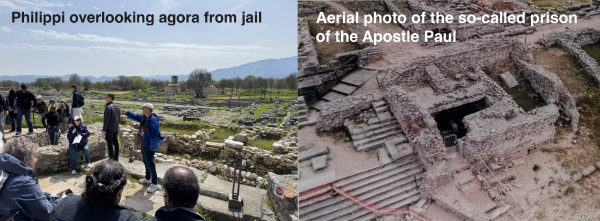
My intended focus for this academic study tour of the cities of Paul and John was to understand how Paul’s missionary activity appeared to Jews in the diaspora. That, I thought, would provide the backdrop or foil to better understand Paul’s missionary journeys. The tour shifted my thinking: I saw little of diaspora Judaism, but Hellenism and Roman imperial religion were everywhere, and nowhere more prominently than in Philippi: the Via Egnatia where Paul walked in, the Agora and Bema where Paul was accused and judged, the jail where he was purportedly imprisoned, and the octagon-shaped church (very ‘hellenistic’) where Christianity eventually flourished.
Halfway through the tour, I was encouraged to read Larry W. Hurtado’s Destroyer of the gods: Early Christian Distinctiveness in the Roman World. Hurtado’s understanding of Paul was guided by Rodney Stark, who formulated “ten features of successful religious movements.”(Hurtado, p.7) That gave me the idea for this paper, as I will explain further on.
Why should we care about whether the backdrop was diaspora Judaism or Hellenism and Roman imperial religion? We should care because the backdrop indicates who the real players were in the “religious marketplace” of the time. All too often, we try to understand the success of Paul’s missionary activity by examining the features or benefits of his message and its attractiveness to early converts in the Jesus movement. But a “marketplace” – religious as well as commercial – is far more complex. A deeper understanding of the marketplace includes “pricing”, “demand”, “supply”, and, perhaps most important, competitors.
In the spring of 2014, I completed an independent study in the Religious Studies department at the University of Texas at Austin entitled “Stark and Finke's Church-Sect Theory Reconsidered in Light of Christensen's Disruption Model.” (2. Absract: copyright https://www.truthunity.net/the-human-side-of-unity/disruption-and-religious-innovation/abstract-author-bio-copyright
PDF: https://s3.amazonaws.com/truthunity/assets/institute/papers/Mark-Hicks-2014-05-12-RS362-Independent-Study-Disruption-and-Stark-and-Finke.pdf) The study was based on Finke and Stark’s The Churching of America 1776-2005: Winners and Losers in Our Religious Economy. The book explained how the features of two religious movements, Methodist and Baptist, enabled them to overcome the entrenched mainline Protestant churches of the day. My study drew on a model I developed from the work of Clayton Christensen, a Harvard Business professor who developed a highly regarded model to explain how start-up enterprises, such as Southwest Airlines, dislodge established enterprises, such as Pan American Airlines. I applied the model to the Methodist and Baptist dislodging of established denominations in American religion as described by Finke and Stark in The Churching of America.
Hurtado’s use of features to describe the success of Christianity in remote areas of the Roman Empire is similar to Finke and Stark’s use of features to describe the success of Methodism in the frontier areas of America. My model should be applicable to Hurtado: What has been learned from Finke and Stark about the Methodist and Baptist churching of America might be applied to Paul’s “churching” of Galatia, Asia, Macedonia, and Achaia.
Christensen provides the business model. That is important because, typically, historians and theologians can explain the character of religious movements but cannot explain their cause, except by asserting that the movement has better ideas or is the work of the Holy Spirit. My explanation is a business model, something that can be applied to other businesses and to other contexts, such as religion. It is also falsifiable, as the model’s predictions may be challenged by the consequences that actually occur. The model, when applied to religion, is essentially sociological, neither historical nor theological. It is not a substitute for History or Theology, but it is a valid supplement.
This paper applies the same model to Paul’s missionary activity, focusing on what we observed in Philippi and the findings in Hurtado’s book. It asks, “Are there features of Paul’s missionary work that are not just explanations of ideas and events, but may also be testable and refutable explanations of why the features were successful?”
This study will explore four features of early Christianity that, according to Hurtado, were essential to its successful adoption: (1) a new understanding of God based on monotheism, (2) a new understanding of Jewish identity free from ethnicity, (3) a new way to convey spiritual truth based on written texts, and (4) a new form of spiritual practice based on ethical behavior. The method I will use to explore Hurtado’s assertions about early Christianity is to apply the model I developed and used in 2014 to examine Finke and Stark’s assertions about 19th-century Evangelicalism in America. I will add to the study findings from McKnight, Eliav, Segal, Oakes, and Stark, which are summarized below. My conclusions may be surprising.
Reading Review
I read several books before the trip. Scot McKnight’s A Light Among the Gentiles provided insight into the concerns of Jews in the diaspora about the importance of gentile relationships in their communities. While they did not actively proselytize Gentiles, they were open to friendly relationships with them, particularly those of high social and political status. Although McKnight does not delve into Paul’s motivations or Jewish perceptions of Paul, his study does highlight how Paul’s activity would threaten the relationships among Jewish communities in the Roman world.(3. Scot McKnight. A Light Among the Gentiles: Jewish Missionary Activity in the Second Temple Period. Minneapolis, MN: Fortress Press, 1991, 30-8) McKnight’s work also describes the “integrating tendencies” of diaspora Judaism toward Hellenism. The adoption of Hellenistic beliefs was far more prevalent than is commonly understood.(4. Ibid. 12-18.)
Yaron Z. Eliav’s A Jew in the Roman Bathhouse affirms the Jewish tendency to adopt Hellenistic ideas, which he calls “filtered absorption.” He writes, “Filtered absorption places Jews not on the exterior of the Roman realm but rather deep in its interior, embedded by the shared experience of those days and embracing many of its fundamental values and conventions: on many levels, they were part and parcel of the Roman milieu just like everyone else.”(5. Yaron Z. Eliav. A Jew in the Roman Bathhouse: Cultural Interaction in the Ancient Mediterranean.) Eliav’s chapter The Miracle of (Hot) Water was also informative for understanding the baths in Pompeii and the waters of Pamukkale (Hierapolis).
Most amazing and important for my study, is Eliav’s connecting the baths to quotations in the writings of the hakhamim, precursors of rabbinic Judaism, whom Eliav finds to be nonjudgmental and somewhat affirming of the baths.(6. Ibid. 12-14.) He claims that “the so-called ‘rabbinic movement’ did not create the Mishnah; rather, the creation of the Mishnah began to create the rabbinic movement.”(7. Ibid. 13.) This substantiates that the dispersion of Jews gave rise to what I will refer to further down as a “spiritual need of an unserved flock.” Having the oral law in written form served Jews in the diaspora; rabbinic Judaism emerged to teach the Mishna. This will come up again in Larry Hurdado’s discussion of Judaism as a “bookish” religion.
Eliav’s hakhamim reminds us Christianity and Rabbinic Judaism emerged approximately at the same time, a point Alan Segal wonderfully portrays in Rebecca’s Children. Segal says that there was a reason the oral law needed to be written down: it made the law more available to ordinary Jews. This represented life as most rural Jews knew it.” (8. Alan F. Segal, and Mazal Holocaust Collection. Rebecca’s Children: Judaism and Christianity in the Roman World. Cambridge, Mass.: Harvard University Press, 1986.122.) This is, again, indicative of a spiritual need of diaspora Judaism.
Eliav also confirms how Roman baths created the demand for slave labor as portrayed in Peter Oakes, Reading Romans in Pompeii: Primus, a common slave who keeps the bathhouse boiler stoked, has no opportunity for advancement and his only chance for mobility is manumission that “liberates Primus on to the streets as soon as he becomes too ill or weak to work.” (9. Peter Oakes. Reading Romans in Pompeii: Paul’s Letter at Ground Level. Fortress Press, 2010. 42-4.)
This insight into the desperation of many in the Roman world is directly addressed in Rodney Stark’s The Rise of Christianity: A Sociologist Reconsiders History, particularly his chapter Urban Chaos and Crisis: The Case of Antioch. Stark writes that Christianity arose in particular cities, where we find “extraordinary levels of urban disorder, social dislocation, filth, disease, misery, fear, and cultural chaos.”(10. Rodney Stark. The Rise of Christianity: A Sociologist Reconsiders History. Princeton, N.J.: Princeton University Press, 1996, 149.) This chapter is a stunning graphic of human misery and I found it difficult to understand after reading Peter Oakes’ portrayal of life in Pompeii. I have tentively concluded that the difference between Pompeii and Antioch might have been the availability of water and baths. If so, this might be an attractive course of study for understanding how Paul chose the cities he would evangelize. Is it possible Paul “learned ministry” in Antioch – a city portrayed by Stark as filth, disease and misery – and then proceeded to cities with similar urban characteristics? Why do the latrines in Ephesus appear so crude and the baths in Hierapolis appear so luxurious? Could it be that Paul looked for cities with great levels of despair?
Clayton Christensen and His Theory of Disruption
Clayton Christensen has written a series of business books (The Innovator's Dilemma and The Innovator's Solution) that explain why companies such as Southwest Airlines have been able to overcome the immense advantage of larger competitors. The following five points is a model I have developed based on "The Five Qualities of Catalytic Innovators" in Disruptive Innovation for Social Change by Christiansen et all.(11. Clayton M. Christensen, Heiner Baumann, Rudy Ruggles, and Thomas M. Sadtler, “Disruptive Innovation for Social Change,” Harvard Business Review 84, no. 12 (December 2006): 94–101. More about Christiansen’s work is available at https://www.christenseninstitute.org/theory/disruptive-innovation/)
1. A social group exists with identifiable religious needs that are unserved by incumbent providers (churches and their ministers). The process begins with an increase in complexity in existing offerings. Suppliers add more features to their offering because the new complexity shows better “performance.” In the graph below, see this “improvement in performance” as the incremental rise of the blue line. The improvements are incremental and called “sustaining improvements.” Examples of these “performance improvements” include more buttons on our channel changers and mobile phones, better food on our airline flights, and deeper understandings in our theologies. All is well if consumers have money, time, and education to purchase and use these improvements. Eventually, however, there will be a group of consumers “left out of the market.” What they want is the red line, which points to the median of a bell curve of desired complexity. They cannot use the new and improved offerings. I refer to these people as the “unserved flock.”
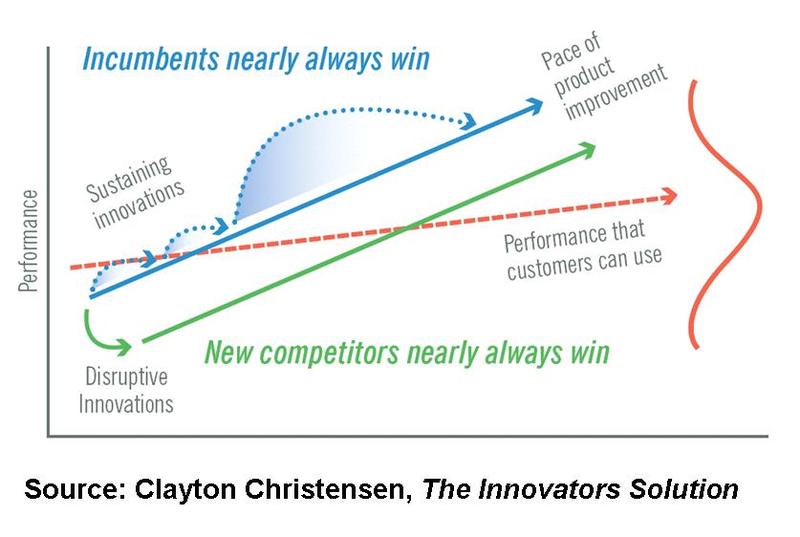
2. An opportunity exists to simplify the delivery of religious benefits and thereby make them available to those with limited money, time, or education. Eventually, someone comes up with a less-than-ideal offering that the unserved flock can afford and use. This is the start of disruption in a marketplace. In the graph, disruption is shown as the drop in performance from the blue line to the green line. Again, the disruptive offering is not excellent, but it is excellent enough. That is why the peanuts and soda of Southwest Airlines overcame the full-course meals of Pan American Airlines, and, all too often, why Fundamentalism overcomes sophisticated religion. Generally, however, disruption is a blessing. The rustic camp meetings of the 19th century brought Christianity to the American frontier, and 12-step programs get drunks out of ditches.
3. Viral organizations emerge that replicate and scale, delivering religious benefits without being immediately noticed or challenged. Even though there may be a simpler solution that will serve the unserved flock, disruption will not occur if no one offers it. Powerful, existing suppliers know this. So, in the early stages, the disrupting supplier must not attract too much attention from the existing suppliers. If they do, the powerful existing suppliers will quickly suppress them. It may be said that John the Baptist, Jesus, Stephen, James, and Peter stayed in town and caught the attention of the powerful, while Paul traveled quickly and lightly. In religion, I refer to these as “viral ministries.” Also, like the early Methodist circuit riders, these ministries must be easily replicated and, if successful, scalable to accommodate growth, like circuit riders leading to the establishment of meeting houses or house churches. Hicks p.7
4. The movement is able to provide significant religious benefits without requiring substantial secular costs, organizational control, or social status. For good reason, many disruptions are begun by those with “little to lose,” particularly teenagers in technology, immigrants in domestic services, and women in religion. Many reputable sources quote Mother Theresa as saying, “You'll never know Jesus is all you need, until Jesus is all you have.”
5. Because the simplified opportunity does not provide social or secular benefits, incumbent providers react with disdain, withdrawal, and even greater complexity, which then broadens the opportunity for the movement to grow. This is an essential condition for understanding the social dynamics of Paul’s missionary activity. Missionaries need to be clear about the unmet needs of their unserved flock. Sometimes they can know by observing who is most harshly criticizing their services. So we should ask: Who were the “incumbent providers” that Paul was disrupting? Were they diaspora Jews? Was it Roman imperial religion? Or was it something else? As I said in the thesis, my conclusions may be surprising.
Hurtado, Introduction.
Hurtado’s Introduction includes a section entitled The Birth of Christianity. He describes the criticism the Jesus movement received in early years, particularly by Jews, directed at other Jews who had adopted Christian beliefs. Their criticism led to periodic persecutions by Roman officials. That is understandable since, as McKnight has said, Paul’s activity might have threatened relationships among Jewish communities of the diaspora with their Gentile neighbors. But note that Jewish criticism was not motivated by concern for the purity of Jewish teaching; instead, it was motivated by protecting Judaism from ostracism in a pagan world. Pagans are the true threat.
Hurtado continues, “As Christianity grew and became more visible, the tensions it generated both socially and with civic and imperial authorities continued and exacerbated. As we will see in the next chapter, the dominant pagan view of Christians was negative” (p.4). Note that Hurtado refers to both social and civic criticism, and then refers to the dominant pagan view. Hurtado’s assertion is an important confirmation of statement 5 of our model: incumbent providers react with disdain. Who are the incumbent providers? Are they Jews? Are they Roman civic officials? Neither. They are social critics who are defending the dominant pagan view. Christian historians have been distracted by Jewish criticism, misunderstanding self-protection for theological condemnation. And they have also been distracted by the persecution of Roman civic officials. The incumbent providers who were most offended by Christian beliefs were dominant pagans.
Hurtado continues with a section entitled Historical saying he wants to “highlight some major features of early Christianity that made it distinctive, noteworthy, and even peculiar in the ancient Greek and Roman setting (p. 5-6). He draws from Rodney Stark’s list of “10 features of successful religious movements,” focusing on offering “distinguishing features that set it apart” while maintaining a balance of continuity and tension with its culture (p.7). Again, there is no mention of Judaism (not the dominant culture) nor of Roman imperial suppression. Again, the problem is with the culture of dominant pagans.
Hurtado, Pagan Criticism.
Hurtado’s opening chapter summarizes pagan criticism of Christianity: He writes, “These pagan critics were members of the cultural elite of the time, such as philosophers, rhetoricians, and literary figures, people from the Roman-era intelligentsia. So their views likely reflect, and were intended also to influence, the views of people of their own social levels.” (p.20)
There were pagan defenders of Christianity. Pliny’s criticism is focused on “economic effects of Christian withdrawal from the worship of the gods, or simply the fear of such effects” (p.23-4), and Galen has a “comparatively more positive view.” Hurtado notes that Galen, a physician, “may well be … the first pagan author to draw comparison between Greek philosophy and the early Christian movement” (p.27). He notes that Galen saw that Christianity was reaching “subelite social levels and not [the] philosophically trained.” Pliny focuses on economics, and Galen focuses on health. Neither is focused on elite levels of pagan philosophy.
But the stinging criticism of the incumant providers of pagan religion comes from Lucian, a pagan writer who “saw the great transgression of Christians as their refusal to honor the traditional dieties” and Celsus, another pagan writer and true believer in Greek philosophical notions who “portrayed Christians as simpletons” … “quack physicians, charlatans passing off simplistic teachings but unable to take part in a real philosophical debate” (p.31).
These statements confirm that a subelite social class of Christian believers comprised an unserved flock (distruption #1), that the Jesus movement was reaching them with “simplistic teachings (disrupton #2), and that the disdain of elite pagan writers, who may be seen as the incumbant providers of pagan religious understanding (disruption #5) was the true source of hostility to the Christian message.
Hurtado, New Kind of Faith.
Hurtado characterizes early Christianity as a “New Kind of Faith;” something that is “a different kind of religion, both in beliefs and in practices.” He notes that people in the first century thought of religion more as a practice than a belief: “We also need to recognize that for Roman-era people generally, what we call ‘religious’ practices—that is, primarily sacred/ traditional rituals—were more central and more characteristic, more obvious and explicit, than ‘religious’ beliefs.”
Quoting a highly regarded scholar, Hurtado acknowledges that “early Christianity lacked things that typically, and for most ancient contemporaries essentially, comprised ‘religion’: no altar, no cult-image, no priesthood, no sacrifices, and no shrines” (p.43). This shift is, in my words, a shift from religion as sacrifice (to multiple dieties) to a religion of worship (to one God): The practice of Baptism is a replacement for cleansing (pp.58-9); Proclaiming the Lord Jesus is a means of petition (pp.59-60); The shared meal is a means of honoring God (p. 60); and Prayer is a means of worship, both privately and publically (p.61). These new practices could be replicated anywhere and done so without attracting attention. They are indicative of the third quality of a disruptive movement: Viral organizations emerge that replicate and scale, delivering religious benefits. And, since it is a “new kind of faith,” the ministries emerge without being immediately noticed or challenged. Why is that disruptive? Because not everyone can sacrifice, but anyone can worship, including slaves, women, and Gentiles.
Hurtado, A Different Identity.
Hurtado’s chapter, A Different Identity, identifies the Christian refusal to worship idols as the result of Christians recognizing themselves as having an identity separate from, and therefore free from, one’s ethnic identity given at birth and defining their social status for life (pp. 77-8). He does acknowledge that some forms of religion provide transethnic identity – voluntary religion – but notes that they generally do not prohibit idol worship. Roman-era philosophical schools are one example (82-8).
However, the Christian prohibition of idol worship did more than limit one’s faith. It also freed the Christian from social status limitations based on one’s birth and from restrictive religious organizational control based on one’s religion. Gentiles need not worship the Emperor in order to survive in the Roman world (pp. 89-91) and need not be circumcised in order to be included in the Jewish covenant (pp. 91-94).
This demonstrates the fourth point in our model, The movement is able to provide significant religious benefits without requiring substantial secular costs, organizational control, or social status. Paul claimed to be an apostle, equal in standing with Peter and James. He rejected Peter’s organizational control in Antioch and the Judaizers’ in Galatia. He also lived within his means, receiving financial support when it came and always thanking God, even when it did not.
Hurtado, A “Bookish” Religion.
Hurtado offers a powerful description of how the writing, dissemination, and shared reading of written texts led to the growth of early Christianity. Aside from the fact that Judaism relied on scrolls, whereas Christianity preferred codex form, it is possible that Christianity and Judaism discovered the power of “books” in religion at the same time. As previously mentioned, Segal believes the reliance on written texts was needed to accommodate diaspora Judaism, and Eliav indicates that the same may be said for the rise of rabbinic Judaism. Regardless, the increased use of written texts is a clear demonstration of the second quality of a disruptive movement: An opportunity exists to simplify the delivery of religious benefits and thereby make them available to those with limited money, time, or education.
Further, many Christian texts were pseudepigraphal. The fourth quality of a disruptive movement is: The movement is able to provide significant religious benefits without requiring substantial secular costs, organizational control, or social status. This may differentiate Rabbinic Judaism from early Christianity. More importantly, we need to be careful in rejecting all books, blogs, and broadcasts by noname amateurs posting in today’s social media culture because, in many respects, they are similar to early Christian pseudepigrapha and they draw similar criticism, such as Celsus remark, quoted above, in Pagan Criticism: Christians are “simpletons” … “quack physicians, charlatans passing off simplistic teachings but unable to take part in a real philosophical debate.”
Hurtado, A New Way to Live.
Hurtado describes early Christianity as “a ‘religion’ with behavioral demands” (p.154). Stating that “‘religion’ in the Roman period typically focused on ritual actions” rather than “ethics,” he notes that it may look like early Christianity is “more like a philosophy than a religion.”
To the extent that this is correct about ethics, we should reject the belief that the early Christian movement disrupted Judaism. Even though Judaism was a religion with rituals, it was also a religion of ethical principles as strong as those in Christianity.
However, Hurtado’s view of ethics and philosophy should lead us to acknowledge that the people most threatened and disrupted by Paul’s mission and the mission of early Christianity were pagan philosophers. Christianity grew because it disrupted pagan philosophy.
What was wrong with pagan philosophy and its practitioners? Hurtado’s portrayal of those with pagan philosophical beliefs is somewhat gentle and kind. We have a letter from Hilarion to his wife, praising her and their family, but also telling her to expose their expectant child if it is a girl (144-5). Acknowledging that there were pagans who expressed reluctance to expose some infants at birth, Hurtado says:
beyond expressing such pronouncements and sentiments, neither these pagan moralists and philosophers nor others of the early imperial period made any serious effort to bring infant abandonment to a halt or sought actively to dissuade the wider populace from it ... So far as we know, the only wide-scale criticism of the practice, and the only collective refusal to engage in infant exposure in the first three centuries AD, was among Jews and then also early Christians (pp.147-8).
If we look at the NISB commentary for Acts 16:16, “we met a slave-girl who had a spirit of divination and brought her owners a great deal of money by fortune-telling” we will read: “The spirit of divination (Gr. pneuma pytho-nos; lit., ‘the spirit of a python’) refers to the python who both guarded the oracle at Delphi and was slain by Apollo.”(13. Barbara E. Reid, New Interpreter's Study Bible. 2003, p.1967.)
This passage is about a slave-girl, likely a member of the unserved flock identifying Paul as a fellow slave of the Most High God; it is about the banishment of the oracle at Delphi as the incumbent provider of religion/philosophy; it is about healing, the delivery of a simplified spiritual benefit, freely-given to one with little money, time, or education; it is about Paul, an unknown spiritual provider with no credentials, no status, and no money; and, most importantly, it is about incumbent providers reacting with disdain, seizing Paul and Silas and appealing to mob action and civic punishment. The mission of Paul and the rise of early Christianity disrupted pagan philosophy.
Conclusion.
What Paul disrupted was not Judaism, nor Roman imperial religion. His disruption was pagan religion, evident in nearly all the sites we visited during our recent tour of Turkey, Greece, and Pompeii. His unserved flock included women, Gentiles, and slaves. His message appropriated many themes from the Hellenistic worldview, freed from the complexity of elite pagan writers. The ministries he established in Galatia, Asia, Macedonia, and Achaia delivered real spiritual benefits long before they became threatening to Pliny and Roman authorities. The ministries might have encountered resistance, but they never wavered in their insistence on freedom from social, economic, religious, or civic control. Finally, the people he most aggravated – the elite pagan philosophers – were unwilling to follow until Julian the Apostate tried in the 4th century. But by then it was too late. Such is the pattern of disruption as demonstrated in our visit to Turkey and Greece and in Destroyer of the gods.
Bibliography
- Christensen, Clayton M. The Innovator's Dilemma: When New Technologies Cause Great Firms to Fail. Boston, MA: Harvard Business School Press, 1997.
- Christensen, Clayton M., and Michael E. Raynor. The Innovator's Solution: Creating and Sustaining Successful Growth. Boston: Harvard Business School Press, 2003.
- Christensen, C. M., H. Baumann, et al. (2006). Disruptive Innovation for Social Change. Harvard Business Review: 94-101.
- Eliav, Yaron Z. A Jew in the Roman Bathhouse: Cultural Interaction in the Ancient Mediterranean. Princeton: Princeton University Press, 2023.
- Finke, Roger, and Rodney Stark. The Churching of America, 1776-2005 : Winners and Losers in Our Religious Economy. 2nd ed. New Brunswick, N.J.: Rutgers University Press, 2005. Harrelson, Walter, ed. 2003. New Interpreter's Study Bible. Nashville, TN: Abingdon Press.
- Hurtado, Larry W. Destroyer of the gods: Early Christian Distinctiveness in the Roman World. Waco, TX: Baylor University Press, 2016.
- McKnight, Scot. A Light Among the Gentiles: Jewish Missionary Activity in the Second Temple Period. Minneapolis, MN: Fortress Press, 1991.
- Oakes, Peter. Reading Romans in Pompeii : Paul’s Letter at Ground Level. Fortress Press, 2010.
- Segal, Alan F., and Mazal Holocaust Collection. Rebecca’s Children: Judaism and Christianity in the Roman World. Cambridge, Mass.: Harvard University Press, 1986.
- Stark, Rodney. 1996. The Rise of Christianity : A Sociologist Reconsiders History. Princeton, N.J.: Princeton University Press.
