


Unity and Christian Ethics


Hi Friends -
Here is a paper I submitted today to complete a course in Christian Ethics at the seminary I attend. I've adapted it somewhat for display this web page. If you want a PDF of the original paper, see the link below.
When discussing Christian ethics, many people think about the Ten Commandments as being an important source for judging ethical behavior. However, I recently completed a course in Christian Ethics and, of the 54 readings assigned in the course, only five mention the Ten Commandments. Of the five readings, only two treat the commandments as a serious source of ethical authority.
This paper will review Metamorality: A Metaphysical Approach to the Ten Commandments by Eric Butterworth and assess whether his assertions about the Ten Commandments can provide new insight into the other 52 readings.
Summary:
Butterworth affirms that the Ten Commandments, interpreted literally as commandments of God, offer important guidance for making ethical choices. But he writes to stress that those who limit their interpretation of the commandments in a literal fashion miss insights that could lead to a much richer understanding of ethical choices, something he calls metamorality.
Non-literal interpretation of Scripture is often referred to as “figurative” or “metaphorical.” In Butterworth’s tradition, such non-literal interpretation is known as “metaphysical” interpretation because it seeks to find an essential idea (what we might call a virtue) behind the commandment. The commandment operates in the physical world, but behind it lies a metaphysical reality in which deeper understandings of moral behavior are made available to human beings. Again, Butterworth refers to these deeper understandings as metamorality.
It is important to note that Butterworth does not claim that metamorality supercedes, fulfills, or replaces moral behavior expressed in the Ten Commandments and interpreted literally. Rather, his claim is that human beings can do better than what is typically required if only they would extend their interpretation of the commandments in a non-literal way. These deeper insights lead to better consequences. He writes,
“The great need of every person is to understand his inherent spiritual nature, and thus that it is not a matter of what is being done, but what is the very best he can do … metamorality [is] the deeper meaning in the Ten Commandments.” (Introduction vi).
Analysis:
Point 1: Ethics as oneness with God. Several weeks ago, I would have agreed that Butterworth’s moral vision was based on virtue or character, which means one’s moral vision “begins from the insight that what one does, how one decides and acts in any given situation, is chiefly influenced by one’s character ~ the kind of person one is, the kind of people one belongs to, and who one aspires to be”. But I recently received a communication from a nearby Hassidic center where I know the rabbi and sometimes attend classes and services. It was entitled “Where Do Ethics Come From?” The communication presented three views on the origin of ethics, drawn from Western philosophy. These are ultra-orthodox Jews. They know their Scriptures. More accurately, they live their Scriptures. They declare that moral vision does not originate in command, virtue, or reason, but instead from a monistic relationship of unity with God.
Butterworth agrees. He writes, You are the very activity of God expressing as you. To creatively believe in God, then, is to believe from the consciousness of God. This believing energy is the continuation of the divine process that made you in the first place. Butterworth quotes Meister Eckhart, “As Meister Eckhart might put it, the need is to let God be God in you, and let God unfold as you” (p 26-7). The three paragraphs in the above Summary section make it difficult to place Butterworth in one of the three categories of moral vision. And we should be very cautious when placing Hassidic ethics in Western philosophical categories as well.
Point 2: Jesus, the new Moses. A section of JP II’s Veritatis Splendor is a refreshing portrayal of Moses and the Ten Commandments equal to, and not succeeded by, Jesus and the Sermon on the Mount. JP II says,
"There is only one who is good" … From the very lips of Jesus, the new Moses, man is once again given the commandments of the Decalogue … at the beginning of the "Sermon on the Mount"--a sermon which contains the fullest and most complete formulation of the New Law [is] clearly linked to the Decalogue entrusted by God to Moses on Mount Sinai. (paragraphs 88-97)
In a similar tone, Eric Butterworth offers an extended comparison of the I AM in Exodus 3 as conveyed by Moses and in John 8 as conveyed by Jesus:
The key to Moses' law was the "I AM." In the centuries later, the key to understanding Jesus' teaching is the same "I AM." (p 6)
We Christians need to acknowledge the Jews as our spiritual elders and as our spiritual partners in world redemption. This passage from JP II in Veritatis Splendor made my heart sing.
Point 3: Transcendental and categorical levels of ethics. Our course has 14 sessions. Starting with session 7, the readings have shifted from a general consideration of ethics to a study of ethics addressing particular issues, beginning with Howard Thurman’s Jesus and the Disinherited. Pinckaers offers an interesting perspective on these two ways of studying ethics. He describes how Catholic moral theology has also followed two ways: from ethics in general, which he calls ethics at a “transcendental” level, to specific categories of ethical issues, which he calls ethics at a “categorical level.” (p 46). He writes,
Is there a Christian ethics? If one considers Christian ethics from the perspective of general transcendental attitudes, the answer is yes. If, on the other hand, one considers it from the perspective of categorical behavior, the answer is no. Christian ethics, on the level of its material content, is merely a human ethics.
So Pinckaers believes the true Christian ethics is the transcendental kind and ethics at the categorical level is not Christian, but humanist. Eric Butterworth would agree. For him, ethics of the transcendental kind occurs in human consciousness, and only then is ethical choice expressed as moral behavior. He opens his book,
[T]he Truth [is that] we are never further away from transcendental solutions than the thought of God. We may be worried about the morality of our society and the integrity of people; but it is not a godless society, and the integrating power of God is within every person as the key to growth and change. (Introduction ii).
Butterworth refers to many moral choices of the categorical kind, such as adultery and war, but he does not pass judgment on the act itself. Butterworth’s judgment is directed toward the human consciousness which makes choices and leads to many varieties of moral behavior.
Application:
Although Eric Butterworth bristled at being placed in a category, it is evident that his Metamorality should be placed in HR Neibuhr’s Natural Law type: His church continues today in a prestigious location 100 yards from Carnegie Hall; his use of gospel passages is highly selective; his messages focus on culture at its ideal best; and, most importantly, he stressed harmony. Harmony is the key to understanding and applying Butterworth’s message because his tradition, the Unity School of Christianity, is accurately described in Sydney Alhstrom’s A Religious History of the American People as “Harmonial Religion”:
Harmonial religion encompasses those forms of piety and belief in which spiritual composure, physical health, and even economic well-being are understood to flow from a person’s rapport with the cosmos. [Sydney E. Ahlstrom. A Religious History of the American People. New Haven: Yale University Press, 1972, p. 1019.]
Alhstron sandwiches Unity between Mary Baker Eddy’s Christian Science and Norman Vincent Peale’s The Power of Positive Thinking. Given our divisions in contemporary culture, we should look for any and all possible ways to restore cultural harmony.
Assessment:
As I said in the Summary, Butterworth never rejected the morality of the Ten Commandments, interpreted literally. His argument is for extending, not replacing, literal interpretation with metaphysical interpretation in order to achieve a higher standard of ethical living. This aligns well with Dan Bell’s description of precepts and counsels of perfection in his The Economy of Desire. [Daniel M. Bell, Jr. The Economy of Desire: Christianity and Capitalism in a Postmodern World. The Church and Postmodern Culture. Grand Rapids, MI: Baker Academic, 2012. pp. 191-6.] Precepts, like literally interpreted commandments, prohibit behaviors that are inherently unethical. Counsels of perfection, like commandments interpreted figuratively, caution against desires and behaviors that may lead to unethical acts but are not inherently unethical. My assessment is that Butterworth and Bell are making the same distinction in categories of ethical theology and that Bell may find in Butterworth’s book a simple and accessible way to convey Christian ethics to common folk.
Conclusion:
I conclude that Eric Butterworth’s Metamorality is a modern example of what was known to the Renaissance and the Reformers as Ad fontes – “to the sources.” Eric Butterworth attempts to quell modern anxieties and contemporary cultural divides, not with new opinions from creative writers, nor with a call to “return to the Ten Commandments,” but rather with new understandings of classical wisdom. These he called “new insights in Truth” (p. 9, 75). He dusts off the Ten Commandments and encourages us to take a second look with a deeper perspective. Butterworth’s Christian beliefs are not orthodox, but they are Christian, and they do help us move forward in overcoming our anxieties and divisions.

Thursday, April 30, 2026

Download PDF of this paper (Unity and Christian Ethics)
Download PDF of Eric Butterworth Metamorality
Listen to eleven lectures Eric Butterworth gave on The Ten Commandments
A Metaphysical Approach to the Ten Commandments
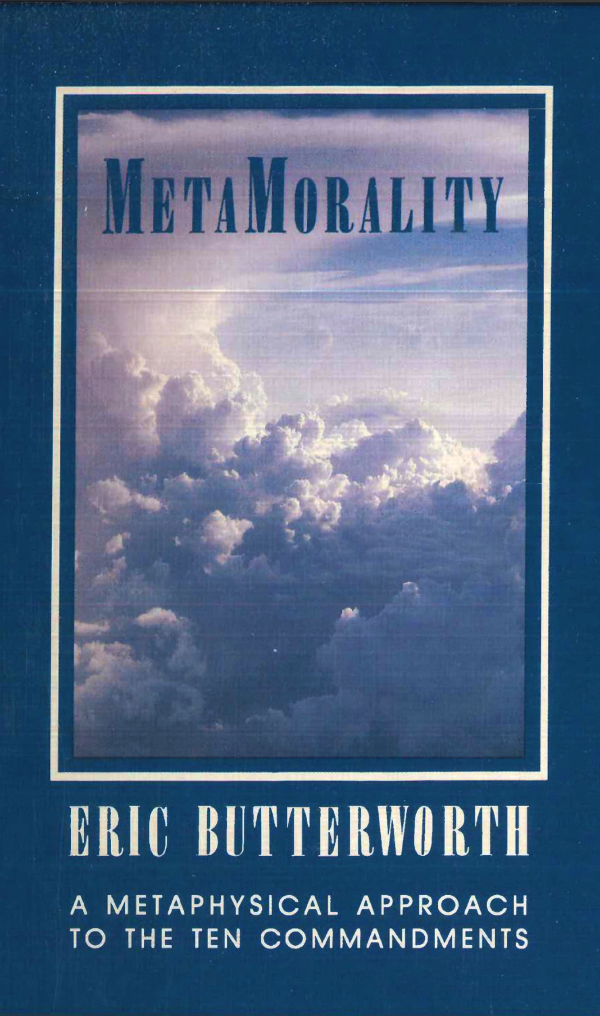
Eric Butterworth
Unity Books
Unity Village, MO 64065
Acknowledgment is made to Harcourt Brace Jovanovich, Inc., and to Faber and Faber Ltd., publishers of The Complete Poems and Plays of T. S. Eliot, for permission to reprint lines from The Cocktail Party by T. S. Eliot.
The Bible references, unless otherwise indicated, are from the Revised Standard Version, copyright 1946 (renewed 1973), 1952 and © 1971 by the Division of Christian Education of the National Council of the Churches of Christ in the U.S.A.
(This book was formerly published by Harper & Row, Publishers, Inc., under the title How to Break the Ten Commandments.)
To Olga, my beautiful helpmate for her loving support and indispensable collaboration of the Spirit
Contents
- Introduction
- The First Commandment
- The Second Commandment
- The Third Commandment
- The Fourth Commandment
- The Fifth Commandment
- The Sixth Commandment
- The Seventh Commandment
- The Eighth Commandment
- The Ninth Commandment
- The Tenth Commandment
© 1987, Unity Books
Reprinted with permission.
